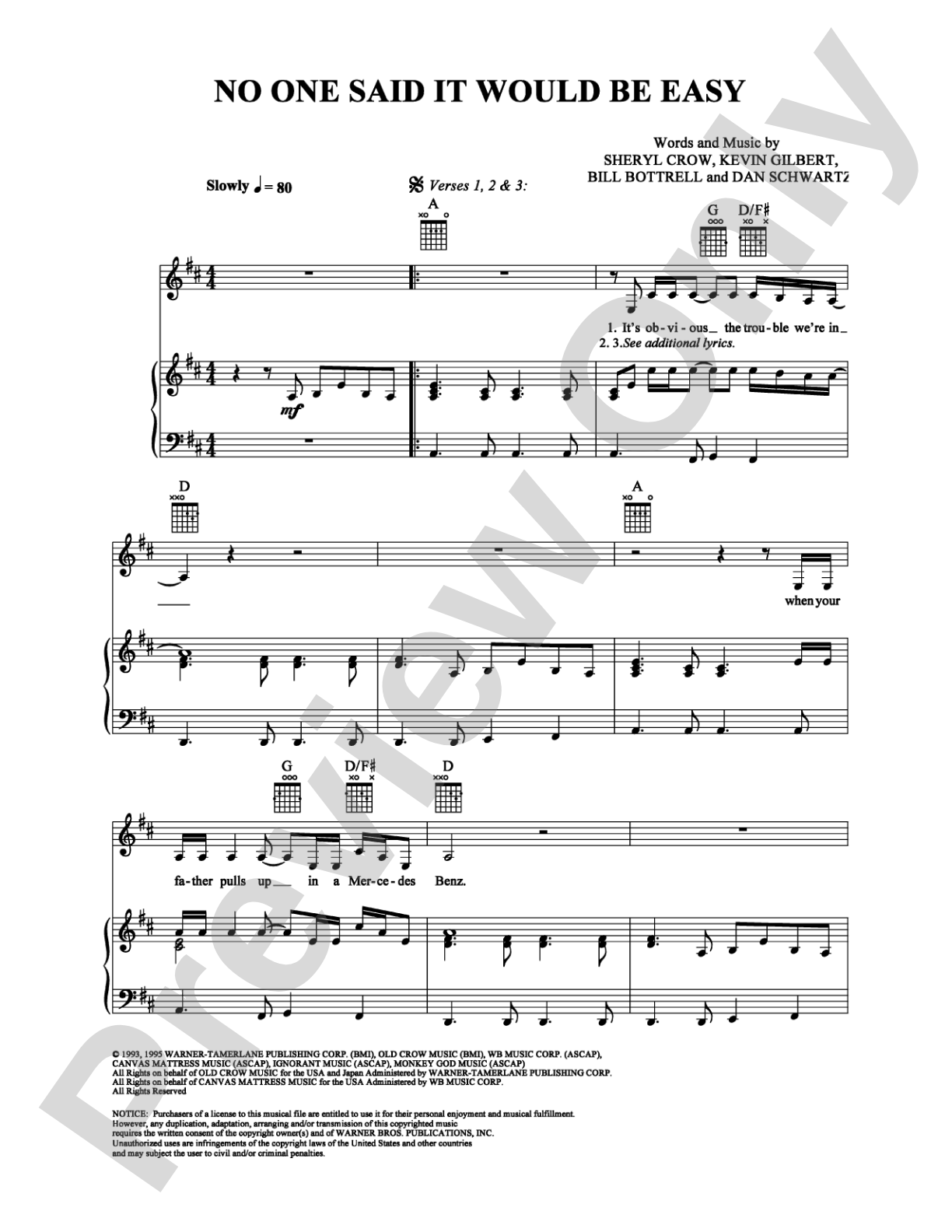
No One Said It Would Be Easy: Piano/Vocal/Chords Digital Sheet Music

No One Said It Would Be Easy: Piano/Vocal/Chords Digital Sheet Music

Sheryl Crow, Dan Schwartz, Bill Bottrell, Kevin Gilbert

Item: 00-PS-0005939

Digital Download
$3.99
Description

No One Said It Would Be Easy: Piano/Vocal/Chords Digital Sheet Music isn't in MakeMusic Cloud just yet...but it could be. Let us know you'd like to see it, and you'll help shape what comes next. In the meantime, start a free trial and dive into thousands of interactive titles your students can play along with today.

Sample Audio
No sample audio found.
Sample Video
Additional Details
SKU: 00-PS-0005939

More about this title

About the Artist: Sheryl Crow

Sheryl Crow emerged as one of the defining voices of 1990s rock and pop, known for her distinctive alto and her ability to craft deeply personal songs that resonate across genre lines. Her work spans country, rock, and pop sensibilities, and she has maintained a recording and touring career spanning three decades while also raising a family and advocating for music education in schools.

Why we love this

This song captures the emotional intelligence Crow brought to mainstream pop rock; it's the kind of tune that feels immediate when you hear it but reveals new depth with each rehearsal. The chord progression and melody sit naturally for most voices, and the lyrical honesty makes it compelling enough to hold an audience's attention without relying on production tricks.

What to expect

The song carries a bittersweet acceptance, acknowledging struggle without descending into self-pity. Its melody is conversational and warm, with harmonic movement that feels emotionally grounded rather than flashy.

Who it's for

Vocalists working in jazz, pop, or contemporary music settings who want to add a modern standard to their repertoire. Pianists accompanying singers will find the chord chart flexible enough for interpretation while the written voicings provide a solid foundation.

How to get the most out of it

  • Pay attention to the rhythmic phrasing in the vocal line; Crow's delivery often sits slightly behind or ahead of the beat in conversational passages, so use the chord chart as a harmonic anchor rather than a rigid rhythmic grid.
  • Balance the piano part so it supports rather than overwhelms the voice. The accompaniment should breathe with the vocal delivery, especially in verses where intimacy matters more than volume.
  • Explore dynamics across the song's arc. The journey from resignation to acceptance in the lyric deserves reflection in how soft or driven you allow each section to become.

How to use it

Program this alongside other contemporary acoustic-based songs in a solo recital, or use it as a bridge between classic pop standards and modern singer-songwriter material in a cabaret or variety concert. Its straightforward emotional content also makes it valuable for student recitals where the focus is on honest performance over technical fireworks.

Skills your students will build

  • Interpreting chord symbols and building flexible accompaniment voicings
  • Phrasing conversational melody against harmonic structure
  • Managing dynamics to support lyrical content rather than structural intensity
  • Accompanying singing with appropriate textural and dynamic sensitivity

You May Also Like