No One Is Alone - Part I Sheet Music Preview

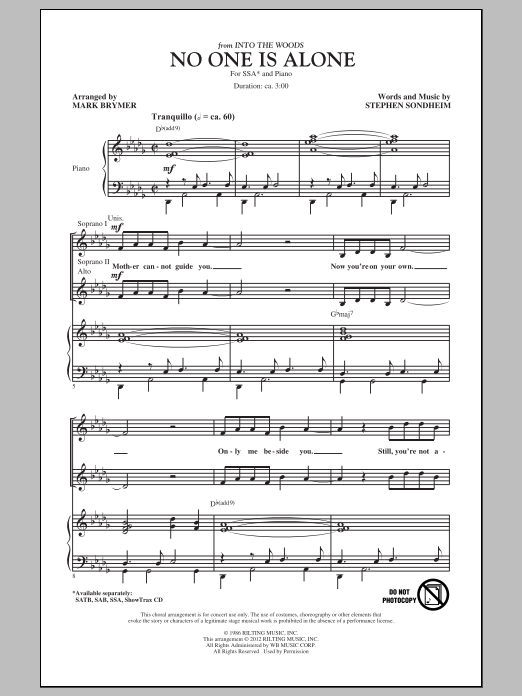
No One Is Alone - Part I: SSA Choral Octavo

By Stephen Sondheim / As performed by Into The Woods (Musical) / Arranged by Mark Brymer

Item: 35-DS00231867

Digital Download
$2.50
Description

No One Is Alone - Part I: SSA Choral Octavo isn't in MakeMusic Cloud just yet...but it could be. Let us know you'd like to see it, and you'll help shape what comes next. In the meantime, start a free trial and dive into thousands of interactive titles your students can play along with today.

Sample Audio
No sample audio found.
Sample Video
Additional Details
Publisher: Hal Leonard
Page Count: 10
SKU: 35-DS00231867

More about this title

About the Composer: Stephen Sondheim

Stephen Sondheim (1930–2021) fundamentally changed what music theater could express. His lyrics matched his melodies in sophistication, often abandoning rhyme schemes and conventional song structures to serve character and story. For music educators, Sondheim's catalog offers a masterclass in how melody, harmony, and language can work together to deepen emotional truth.

Why we love this

This arrangement captures one of Sondheim's most tender moments: a song about recognizing that no one journeys through darkness alone. The SSA voicing allows your singers to inhabit the warmth and vulnerability without getting tangled in complex divisi, making space for genuine storytelling. It's a piece that reminds audiences why Broadway matters.

What to expect

Intimate and reassuring, like someone reaching for your hand in the dark. The melody sits in a comfortable range for SSA voicing, allowing singers to focus on the tender narrative rather than fighting register shifts. This is a moment of grace in a darker story, and it feels like safety.

Who it's for

This works for treble choirs, show choirs mining Broadway repertoire beyond pop standards, and any program looking for a song that proves contemporary musical theater belongs in concert settings. It's accessible enough for intermediate ensembles but emotionally mature enough to satisfy serious singers.

How to get the most out of it

  • Treat the text with actor's precision. Each word lands differently depending on where the character is in their emotional journey, so mark your scores with character intentions alongside dynamic markings.
  • Balance the harmony so the top line sings through without strain. The arrangement likely supports Sondheim's original melody, but resist letting it dominate the other voices when the emotional weight shifts to interior harmonies.
  • Let rubato breathe. This song earns its quiet moments, and a conductor who rushes the pacing loses the chance for real connection with the audience.

How to use it

Pair it with other introspective moments from contemporary musicals, or use it as a closing piece that sends the audience home thinking about connection and community. It also works beautifully in a concert exploring Sondheim's gift for character songs, and it's short enough to anchor a spring concert without demanding extensive rehearsal time.

Skills your students will build

  • Singing legit theater style with proper vowel shaping and diction clarity
  • Phrase shaping in a song without traditional verse/chorus structure
  • Balancing four-part harmonic writing while maintaining lyrical storytelling
  • Sustaining emotional vulnerability through a full phrase without pushing tension into the voice
  • Interpreting Sondheim's sophisticated harmonic language and chromatic movement

You May Also Like