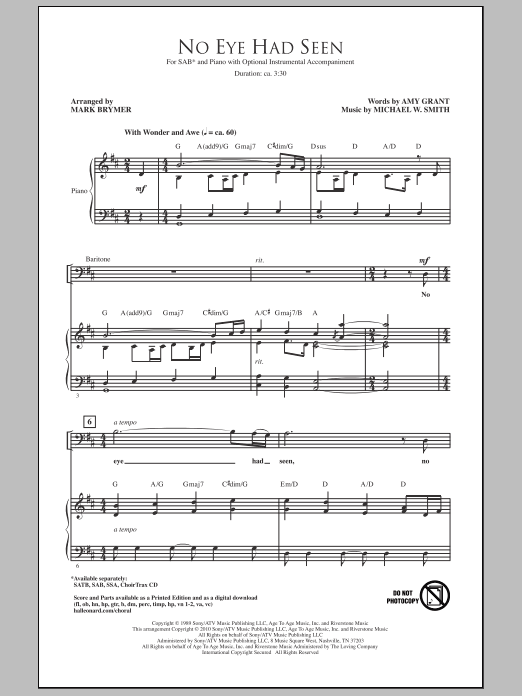
Amy Grant stands as a pioneering figure in contemporary Christian music, bringing artistic credibility and crossover appeal to a genre often dismissed by mainstream audiences. Her songwriting balances accessibility with genuine emotional depth, making her work particularly valuable for choirs seeking material that engages both performers and listeners across denominational lines.
Why we love this
Mark Brymer's arrangement captures the quiet reverence of Grant and Smith's composition while making it entirely accessible to developing choirs. The SAB voicing sits comfortably for mixed ensembles without sacrificing the song's contemplative power, and the eight-page format suggests enough musical substance to reward careful rehearsal without overwhelming singers tackling it for the first time.
What to expect
The piece unfolds with quiet wonder, its harmonies suggesting both mystery and assurance. Singers encounter a musical setting that honors the text's theological depth without demanding virtuosity, creating space for genuine expression rather than technical display.
Who it's for
Choirs preparing Christmas services or seasonal concerts will find this arrangement both singable and spiritually substantive. It works equally well for high school groups building their sacred repertoire and community choirs seeking meaningful contemporary texts.
How to get the most out of it
Emphasize the text's introspection by avoiding any rush through longer note values; let the harmonies breathe and settle.
Balance the three parts so the sopranos don't overshadow the alto and bass lines, which carry essential harmonic color.
Consider the acoustical space when choosing whether to use the recorded accompaniment; this piece often benefits from intimate sound rather than reinforced dynamics.
How to use it
Position this during the contemplative portion of a Christmas service or concert program, perhaps following a more energetic carol or as a bridge to instrumental music. Its moderate length makes it suitable for mid-program placement where it can reset the emotional tone without disrupting pacing.
Skills your students will build
Balancing three-part harmony while maintaining individual line integrity
Sustaining soft, supported tone quality through longer phrases
Interpreting sacred text with appropriate musical reverence
Coordinating SAB voicing to avoid overlap or covering of parts
You May Also Like
Scan to Complete Your Purchase
Use your phone's camera to scan the code below
You'll log in on your phone and the order will be added to your account