
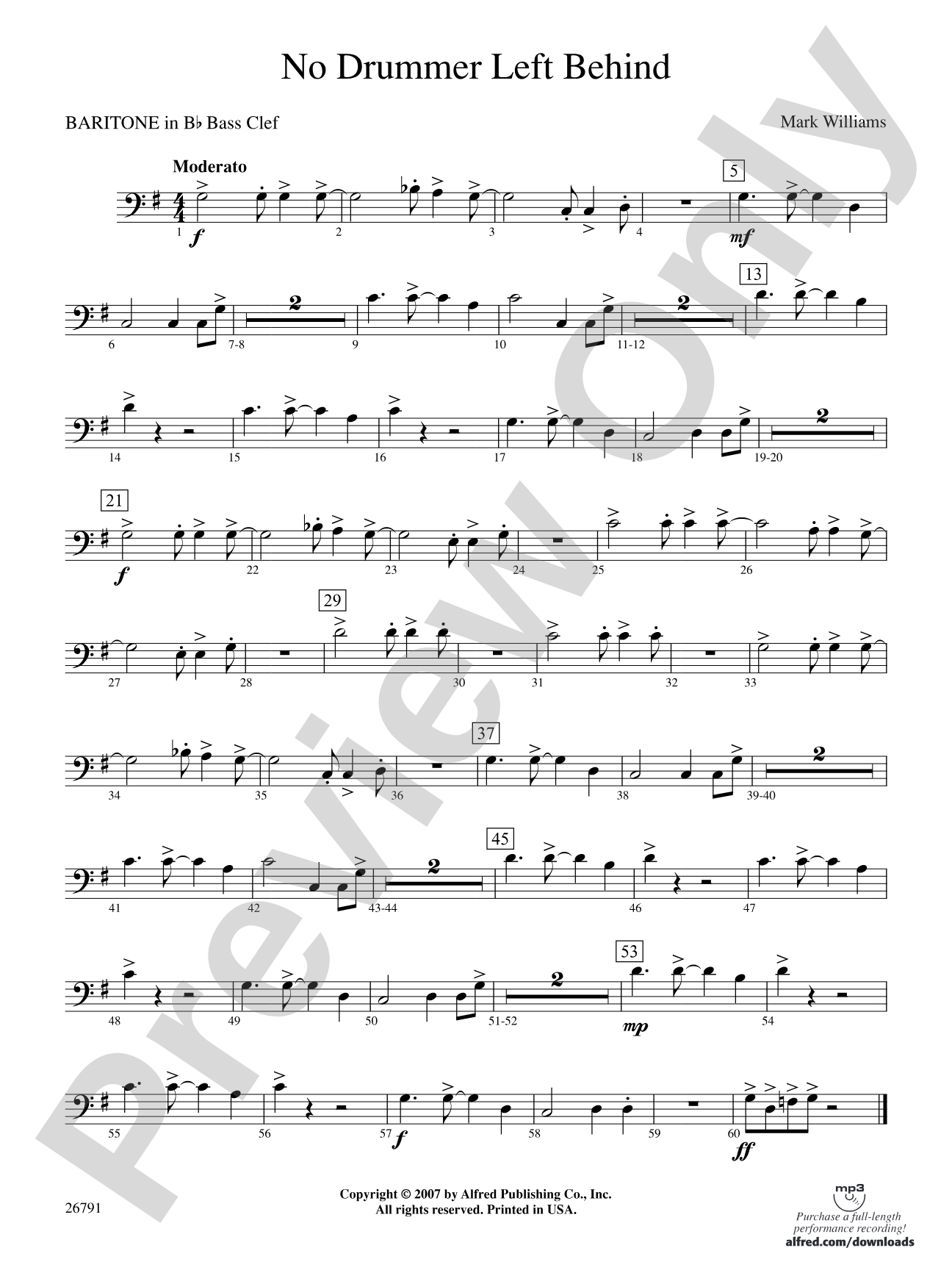

No Drummer Left Behind: (wp) B-flat Baritone B.C.
Percussion Section Feature
By Mark Williams
Grade: 1 (Very Easy)
Item: 00-PC-0001229_wpBBBC
$3.00
Pickup currently not available
Description
Your band will love this humorous rock piece that pays homage to the No Child Left Behind Act. Everybody gets involved as the individual drummers play solo flams, and the bass drum and cymbals get to solo as well. Your percussion section will rock out, and your audience will leave humming this catchy crowd pleaser.
Correlates with Accent on Achievement Book 1, page 32. This title is available in MakeMusic Cloud.


Correlates with Accent on Achievement Book 1, page 32. This title is available in MakeMusic Cloud.
Don't just read it, hear it, play along with it, and watch your students grow with it. In MakeMusic Cloud, No Drummer Left Behind: (wp) B-flat Baritone B.C. comes alive with professional accompaniment, adjustable tempo, and built-in practice tools that turn solo practice into real progress.
Open in the Player
Jump straight in and assign it today.
Start Your Free Trial
Open this title and explore the full library in minutes.
Sample Audio
1
Audio File
--:--
0:00
0:00
Sample Video
No sample videos found.
Additional Details
Series:
Accent on Achievement
Publisher:
Alfred Music
Page Count:
63
SKU:
00-PC-0001229_wpBBBC
More about this title
About the Composer: Mark Williams

Mark Williams built his reputation as one of the most prolific and respected composers for school bands. His catalog of over 200 works includes the co-authored Accent on Achievement Band Method, which has shaped elementary and middle school band programs across North America. Williams spent decades teaching music in Washington State with a particular focus on elementary band instruction, earning a Bachelor of Arts in Education and Master of Education from Eastern Washington University.
Beyond the classroom, Williams established himself as a clinician and guest conductor, traveling extensively throughout the United States, Canada, and Australia to work with school ensembles. He performed professionally on bassoon with the 560th Air Force Band and later served as Conductor and Artistic Director for the Spokane British Brass Band. His compositions earned recognition through the Western International Band Clinic's Gralia Competition and multiple ASCAP Special Awards, cementing his legacy as a composer who understood what young musicians needed to play and what audiences wanted to hear.
Why we love this
Williams has written a piece that understands exactly what makes a young band tick: give everyone a moment in the spotlight, keep the energy high, and deliver something the audience will actually remember. The humor lands without condescension, and the rock idiom gives your ensemble permission to play with attitude. This is the kind of novelty that strengthens your program because it builds confidence in players who get featured solos and reminds the whole band that making music together can be genuinely fun.
What to expect
A rock number with genuine wit, where the humor comes from the writing and the performers rather than from gimmickry. The piece swings with energy and attitude, and when each percussion section gets its moment, the band becomes the audience for a second. It's catchy in the best way: your listeners will go home humming it, and your players will want to perform it again.
Who it's for
This piece is built for Grade 1 bands that are ready to play together with some stylistic confidence and want a guaranteed audience engagement moment. It works especially well if your ensemble includes percussionists who've developed enough technique to handle flam work and solo responsibility, and woodwind/brass players who can commit to a rock feel without overthinking it.
How to get the most out of it
- Bring out the personality in each drummer's flam solo. These moments are comedy gold if players commit to their individual sound and timing rather than rushing to blend.
- Lock the bass drum and cymbal solo sections with your rhythm section early in rehearsal. The piece hinges on these percussionists understanding they're carrying the band, not just coloring the texture.
- Use the rock groove to anchor ensemble cohesion. This style rewards a steady, confident pulse from your brass and woodwinds, which gives the percussion solos room to breathe.
- Let the humor breathe. Resist over-rehearsing the funny parts; they work best when they feel spontaneous and lively rather than mechanical.
How to use it
Program this as a concert highlight or as part of a set that shows your band's range. It pairs well alongside more traditional Grade 1 repertoire because it demonstrates your ensemble's stylistic flexibility and gives the percussion section the recognition they rarely receive at the beginner level. Consider placing it mid-concert to shift energy and reset audience attention.
Skills your students will build
- Rock and popular music idiom recognition and performance style
- Percussion solo technique including flams and ensemble coordination
- Rhythmic confidence and pocket playing in a non-traditional meter feel
- Individual confidence and musicianship during featured sections
- Listening and responding to other sections in a humorous, character-driven arrangement