
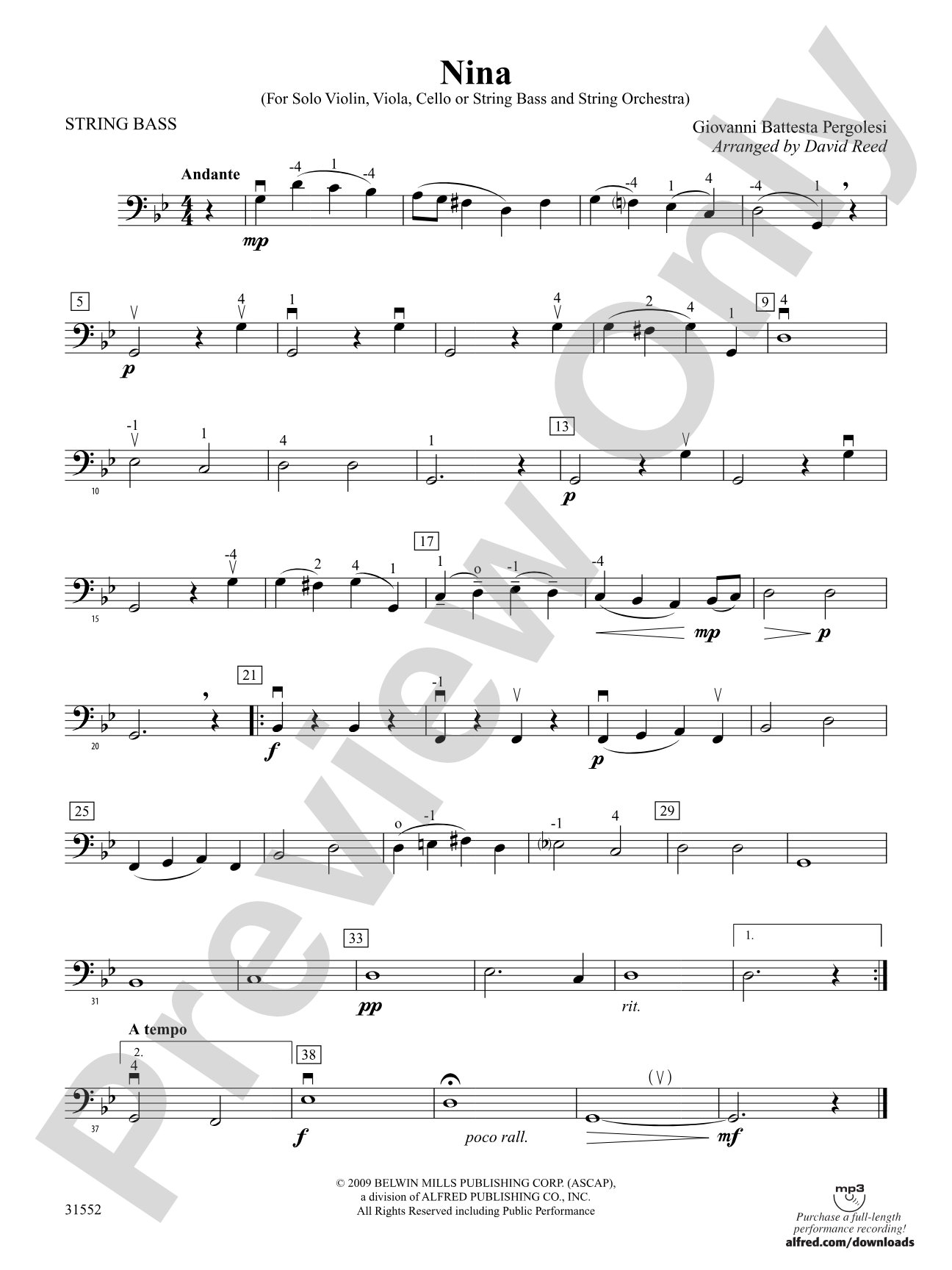

Nina: String Bass
For Solo Violin, Viola, Cello or String Bass and String Orchestra
By Giovanni Battista Pergolesi / arr. David Reed
Grade: 3.5
Item: 00-PC-0001736_SB
$5.99
Pickup currently not available
Description
A beautiful, melodic piece that is the perfect tune to showcase the player in your orchestra with that terrific tone! Arranged for violin, viola, cello or bass solo with string orchestra accompaniment, this would also make a good small ensemble piece, for festival/competition with one or several players to a part.


Don't just read it, hear it, play along with it, and watch your students grow with it. In MakeMusic Cloud, Nina: String Bass comes alive with professional accompaniment, adjustable tempo, and built-in practice tools that turn solo practice into real progress.
Open in the Player
Jump straight in and assign it today.
Start Your Free Trial
Open this title and explore the full library in minutes.
Sample Audio
1
Audio File
--:--
0:00
0:00
Sample Video
No sample videos found.
Additional Details
Series:
Belwin Concert String Orchestra
Publisher:
Alfred Music
Page Count:
70
SKU:
00-PC-0001736_SB
More about this title
About the Composer: Giovanni Battista Pergolesi
Giovanni Battista Pergolesi (1710-1736) was an Italian composer whose short life produced an outsized impact on European music. Working primarily in Naples, he excelled at both opera and sacred music, developing a gift for memorable melody and emotional directness that influenced composers across the continent. His style bridged the ornate Baroque and the emerging galant aesthetic, making his work accessible to modern ensembles while retaining authentic period character.
Pergolesi's most famous work, the Stabat Mater, secured his legacy, but his instrumental pieces reveal equal craftsmanship. Nina, often performed as a gentle vocal interlude or instrumental showpiece, demonstrates why his melodies remain so teachable and moving. He died at 26, yet his music has endured as core repertoire in music education for three centuries.
Why we love this
David Reed's arrangement captures the lilting elegance of Pergolesi's original while giving your orchestra a real musical responsibility. Rather than treating the soloist as the only voice that matters, the string accompaniment breathes alongside the featured player, creating genuine chamber music where every section listens and responds. This balance makes it rewarding for conductors who want the whole ensemble invested in the performance.
What to expect
Nina carries the warmth of a Baroque serenade translated for modern string voices. Graceful and unhurried, it settles into the ear like a remembered melody, offering both soloist and orchestra a chance to play with genuine lyricism rather than technical display. There's elegance in the restraint here, a quality that feels both timeless and intimate.
Who it's for
This work suits orchestras with a soloist worth featuring: a violinist with genuine expressive depth, a violist seeking repertoire that showcases tone quality, or any string player whose musicianship justifies a spotlight. It works equally well as a festival or competition entry for small ensembles, where one to several players per part maintain intimacy while engaging the full orchestra.
How to get the most out of it
- Shape the solo line with legato phrasing that reflects the original vocal origins of the piece; Baroque melody benefits from singing through entire phrases rather than punctuating at bar lines.
- Balance the accompaniment so it supports without overwhelming the soloist. The string parts should provide harmonic warmth, not compete for attention.
- Maintain steady pulse and clear articulation in the accompanying parts to anchor the soloist's rubato. Accompaniment players lock in so the soloist breathes freely.
- Experiment with dynamic shaping around the climax of the solo line. A gentle swell into the highest point, followed by understated resolution, honors both Baroque proportion and lyrical expression.
How to use it
Program this as a showcase moment in a concert built around Baroque and Classical string repertoire, where it can sit naturally alongside works by Vivaldi or Boccherini. It also serves well as an opener or closer that leaves audiences with a memorable, accessible melody. For festival play, the piece's clarity and moderate difficulty make it an intelligent choice for demonstrating ensemble musicianship without straining your level.
Skills your students will build
- Playing legato phrasing across longer melodic lines
- Balancing solo prominence with ensemble support in accompaniment texture
- Understanding Baroque phrase structure and harmonic movement
- Responding to and supporting a featured soloist's interpretive choices
- Managing rubato and flexibility within a steady harmonic foundation