
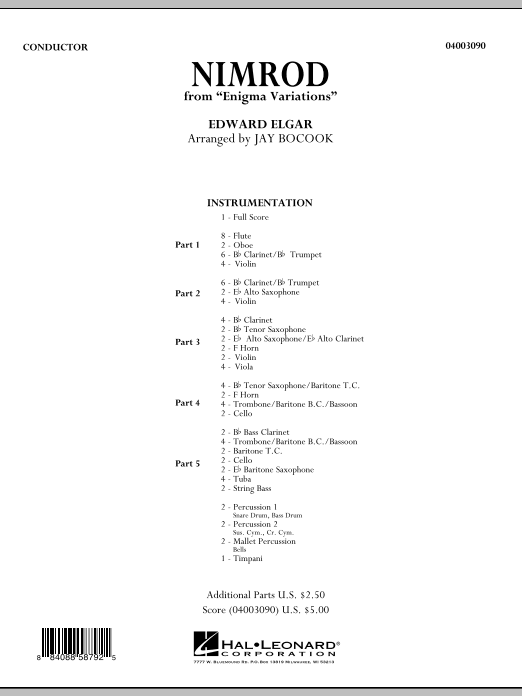

Nimrod (from Enigma Variations): Flex Ensemble Conductor Score & Parts
By Edward Elgar / Arranged by Jay Bocook
Grade: 2-3
Item: 35-PK00187361
$60.00
Pickup currently not available
Buy Extra Parts (Digital PDF Download)
Parts Added to Cart!
Description
This "adagio" movement from the "Enigma Variations" provides an excellent opportunity for developing bands to work on tone, blend, intonation, and dynamics. Jay Bocook's arrangement is designed for smaller bands and features flexible scoring options to fit most any ensemble. Dur: 2:15


Nimrod (from Enigma Variations): Flex Ensemble Conductor Score & Parts isn't in MakeMusic Cloud just yet...but it could be. Let us know you'd like to see it, and you'll help shape what comes next. In the meantime, start a free trial and dive into thousands of interactive titles your students can play along with today.
Request This Title
Tell us you want it.
Start Your Free Trial
Explore everything that's ready to play right now.
Sample Audio
No sample audio found.
Sample Video
No sample videos found.
Additional Details
Publisher:
Hal Leonard
SKU:
35-PK00187361
More about this title
About the Composer: Edward Elgar
Edward Elgar stands as one of England's most significant composers, bridging the Romantic era and the modern age through works that combined deeply personal expression with orchestral mastery. His "Enigma Variations" remains his most celebrated composition, a set of 14 interconnected movements each depicting a friend or colleague, and "Nimrod" has become iconic as a touchstone for musicians seeking to explore noble, sustained melody and emotional depth.
Why we love this
Bocook's arrangement transforms this orchestral masterpiece into something entirely teachable for developing ensembles without sacrificing Elgar's fundamental gift for songful writing. The flexible scoring means you're not stuck; you work with what you have while maintaining the piece's emotional core. Directors consistently report that even younger players rise to meet this music's demands for control and sensitivity.
What to expect
Nimrod unfolds like a quiet conversation between old friends, dignified without being severe. There's a stillness here; the music breathes in long phrases and asks players to listen to one another rather than push. The arrangement preserves Elgar's hallmark warmth, creating a space where young musicians can discover the difference between playing notes and making music.
Who it's for
Developing bands at grades 2 to 3 who are ready to tackle sustained, lyrical repertoire with real emotional weight. This works equally well for mixed ensembles, wind ensemble configurations, or full band setups, thanks to its flexible instrumentation. If your students have solid fundamentals and you want to teach them what it means to "sing" on their instruments, this is the piece.
How to get the most out of it
- Shape the melody with the full arc of the phrase rather than breath-by-breath changes in dynamics; this creates the breadth Elgar intended even in a shorter arrangement.
- Balance inner voices carefully once they enter; they support rather than compete with the primary line, and clarity here prevents the texture from becoming murky.
- Establish a reference for intonation early in rehearsal by listening to the top notes in unison, then build downward through the harmony.
- Take time in the final phrase to let the ritardando and dynamic drop feel earned, not rushed; the ending should feel like a gentle close rather than a sudden stop.
How to use it
This pairs beautifully in a concert as a moment of repose between more energetic works; it also stands alone as a poignant opener or closer. Consider programming it alongside contemporary pieces to show students that great melody and careful orchestration transcend era. Many directors use it as a concert piece for mid-year performances when students have built enough technical foundation to handle the intonation and blend demands.
Skills your students will build
- Sustained tone production across the full range of the instrument
- Blend and balance within four-part harmony
- Dynamic control (particularly soft playing with clarity)
- Intonation adjustment in vertical harmony
- Phrase shaping and long-line phrasing
- Listening and responding to colleagues' tone colors