
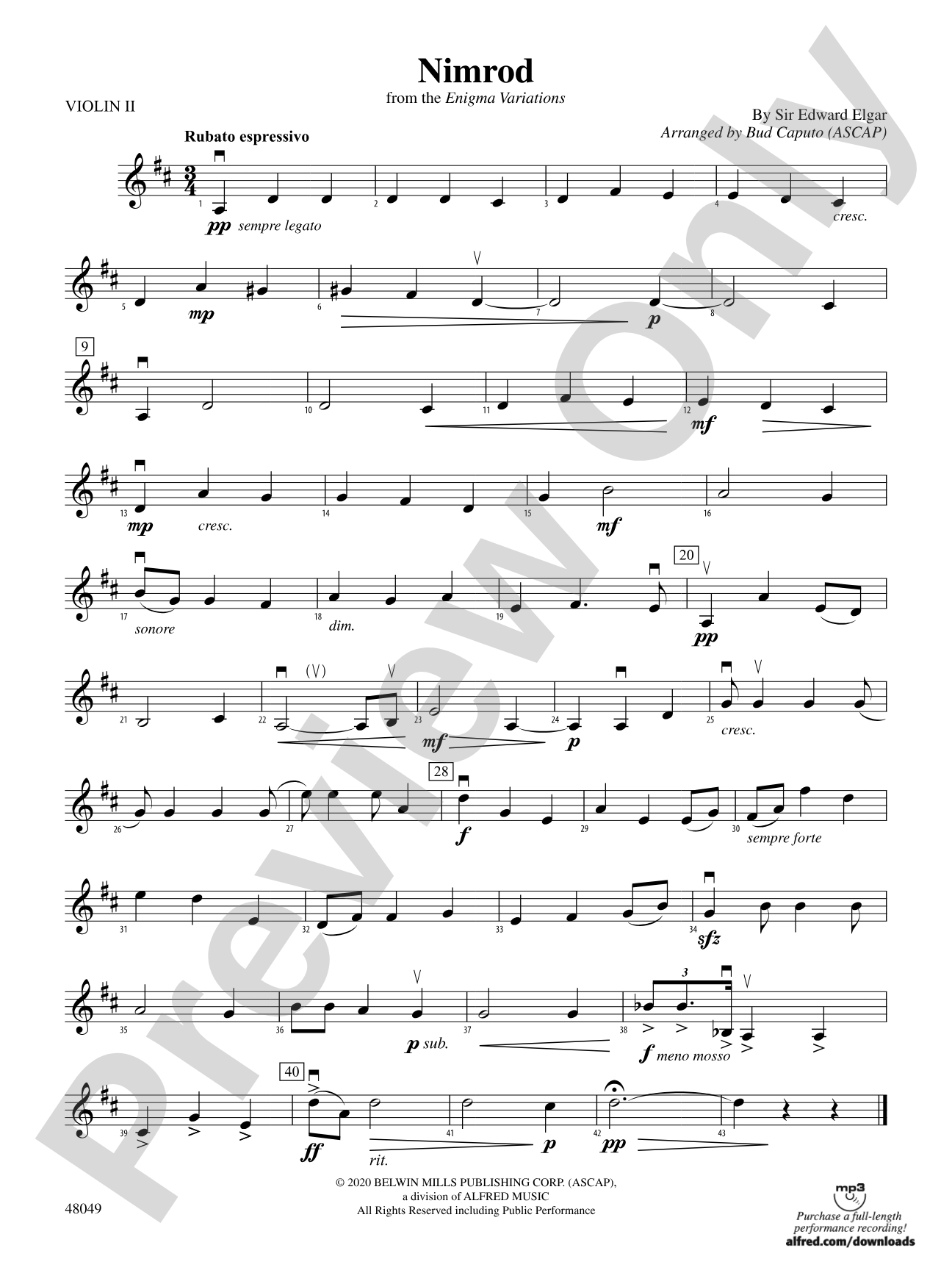

Nimrod: 2nd Violin
From the Enigma Variations
By Sir Edward Elgar / arr. Bud Caputo
Grade: 3
Item: 00-PC-0018449_VN2
$5.99
Pickup currently not available
Description
A wonderful string arrangement by Bud Caputo of the beloved work, Nimrod is the ninth variation from Elgar's Enigma Variations. This setting is perfect for contest! (3:25) This title is available in MakeMusic Cloud.


Don't just read it, hear it, play along with it, and watch your students grow with it. In MakeMusic Cloud, Nimrod: 2nd Violin comes alive with professional accompaniment, adjustable tempo, and built-in practice tools that turn solo practice into real progress.
Open in the Player
Jump straight in and assign it today.
Start Your Free Trial
Open this title and explore the full library in minutes.
Sample Audio
1
Audio File
--:--
0:00
0:00
Sample Video
Additional Details
Series:
Belwin Concert String Orchestra
Publisher:
Alfred Music
Page Count:
62
SKU:
00-PC-0018449_VN2
More about this title
About the Composer: Sir Elgar
Edward Elgar (1857-1934) was an English composer whose works became cornerstones of the British musical repertoire. Though largely self-taught, he developed a mastery of orchestration and an instinct for memorable melody that made him one of the most performed composers in schools and concert halls worldwide. His Enigma Variations remain his most celebrated orchestral work, a set of fourteen variations each dedicated to a friend or family member, with the original theme itself presented as a musical enigma.
Elgar's influence on music education is substantial and enduring. His pieces appear regularly in school concerts and competitions because they offer genuine artistic substance at accessible levels. Teachers value his work for its emotional clarity, its strong harmonic foundation, and the way it opens students' ears to late Romantic orchestration without overwhelming them technically.
Why we love this
Bud Caputo's string arrangement preserves everything that makes Nimrod unforgettable: the soaring violin melody, the warm harmonic progression, and that moment of profound stillness that sits at the heart of Elgar's original. At Grade 3, it remains accessible enough for solid high school orchestras while never sacrificing the piece's dignity or emotional weight. Directors consistently program it because it delivers the impact of a genuine masterwork without the complexity of the full orchestral score.
What to expect
Nimrod unfolds with quiet nobility and deep sincerity. The opening violin melody seems to emerge from silence, supported by warm, full harmonies that give the piece its characteristic sense of grandeur. There is no flash or urgency here, only the kind of emotional authenticity that makes audiences listen intently and players feel the significance of what they are performing together.
Who it's for
High school string orchestras and advanced middle school programs looking for a masterwork arrangement that builds confidence and musicianship without requiring advanced techniques. Conductors seeking a piece that programs well in both concert and festival contexts will find this an excellent choice for developing ensembles.
How to get the most out of it
- Shape the main melody across the longer phrases rather than breaking it into small gestures; let the violin line breathe as a single arch from beginning to end.
- Balance the harmony voices carefully so that inner parts support the melody without obscuring it; the cello and viola lines carry important harmonic information that frames the sopranos.
- Establish a warm, unhurried tempo that allows listeners to feel the emotional weight of the harmony; rushing undermines the contemplative character of the piece.
- Use the recorded accompaniment in MakeMusic Cloud to establish ensemble cohesion during sectional rehearsals and to help less experienced players hear how their parts fit into the whole.
How to use it
Program this as a centerpiece of a spring concert, where its contemplative quality provides necessary contrast to lighter or more energetic works. It also stands alone effectively in festival settings, where its three-minute-twenty-five-second duration and Grade 3 difficulty make it an ideal selection for competitions focused on musicianship and ensemble balance.
Skills your students will build
- Sustaining long melodic lines with consistent tone and vibrato
- Balancing harmonic voices to support rather than compete with the primary melody
- Playing with rubato and subtle tempo flexibility within a structured phrase
- Building dynamic control across extended passages
- Reading and executing a published arrangement of a major orchestral work