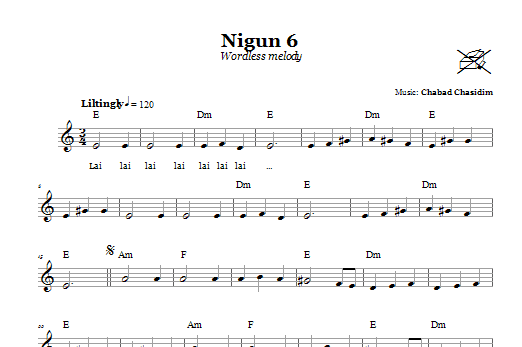
Nigun 6 (Wordless Melody) Sheet Music Preview

Nigun 6 (Wordless Melody): Lead Sheet / Fake Book

As performed by Chabad Chasidim

Item: 35-DS00090926

Digital Download
$3.99
Description

Nigun 6 (Wordless Melody): Lead Sheet / Fake Book isn't in MakeMusic Cloud just yet...but it could be. Let us know you'd like to see it, and you'll help shape what comes next. In the meantime, start a free trial and dive into thousands of interactive titles your students can play along with today.

Sample Audio
No sample audio found.
Sample Video
Additional Details
Publisher: Hal Leonard
Page Count: 1
SKU: 35-DS00090926

More about this title

About the Artist: Chabad Chasidim

Chabad Chasidim refers to the musical traditions of the Chabad Lubavitch movement, a major branch of Hasidic Judaism. Their music emerged from Eastern European Jewish communities and became central to Chabad spiritual practice, spreading globally through the 20th century as the movement expanded.

Niggunim (wordless melodies) are foundational to Chabad worship and teaching. These melismatic, often hypnotic melodies serve as vehicles for contemplation and collective spiritual experience. They require no text, allowing the music itself to carry meaning and emotion across language and cultural barriers.

Why we love this

A genuine one-page entry point into Hasidic musical expression. Wordless melodies strip away textual complexity and invite musicians to listen to pure line and phrasing, making this accessible for keyboard players and singers seeking spiritual repertoire that doesn't require specialized liturgical knowledge.

What to expect

Introspective and unhurried. The wordless melody invites the listener inward, creating space for personal reflection while maintaining a coherent musical journey. There is both simplicity and depth here, qualities that make niggunim memorable and emotionally resonant across repeated hearings.

Who it's for

Pianists and singers exploring world music traditions, liturgical musicians building Shabbat or holiday programming, and ensemble directors seeking authentic Jewish spiritual music that bridges vocal and keyboard performance. Works equally well for soloists and small groups.

How to get the most out of it

  • Shape the melody as a long, connected breath. Even though it's wordless, imagine each phrase resolving toward a point of rest rather than treating it as a series of separate moments.
  • Let silence speak. Niggunim often benefit from generous space around and within phrases; resist the urge to fill every gap with sound.
  • Explore the meditative quality by experimenting with tempo flexibility. A steady pulse grounds the piece, but subtle rubato in key moments can deepen the contemplative character.

How to use it

Feature this during a concert segment exploring prayer and spirituality across traditions, or pair it with other meditative pieces for a recital intermission. It works particularly well in interfaith contexts where the absence of text makes the music universally accessible. Consider it for religious school music classes introducing students to Jewish musical heritage.

Skills your students will build

  • Phrasing and breath management in wordless melody
  • Meditative listening and performance presence
  • Cultural awareness of Hasidic musical practice
  • Keyboard voicing and sustain pedal control to support vocal or ensemble melody

You May Also Like