
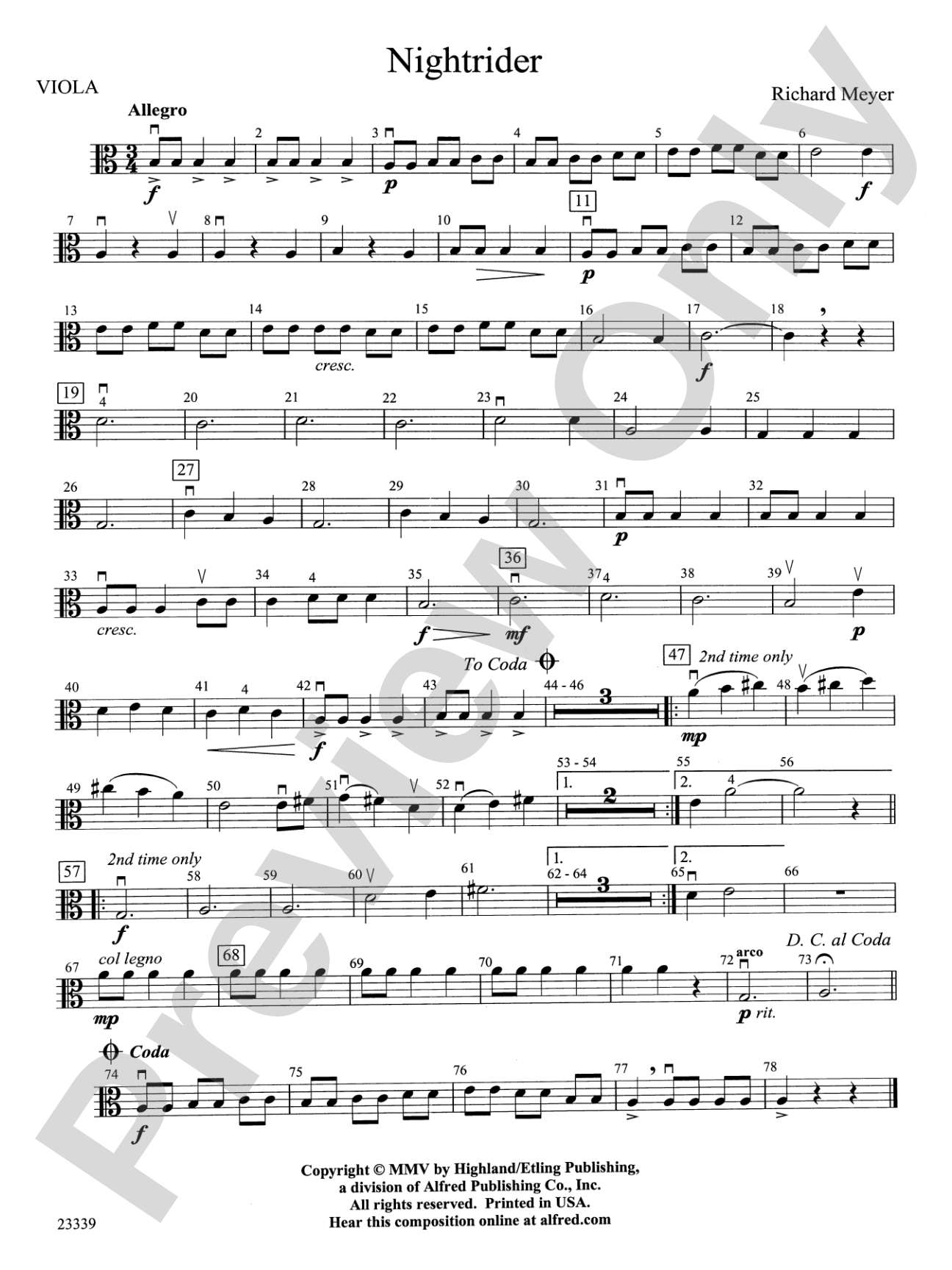

Nightrider: Viola
By Richard Meyer
Grade: 1
Item: 00-PC-0000685_VA1
$5.99
Pickup currently not available
Description
Written in a minor mode, this thrilling piece is reminiscent of Schumann's character pieces for young musicians and has been composed to reinforce F and C naturals and give young orchestras more experience in 3/4 meter. The bulk of the piece is in A minor, contrasted by a brief section in parallel major, accompanied by a simple col legno bowing. Students will love the mysterious tonality and driving rhythms. Highly entertaining and educational at the same time! This title is available in MakeMusic Cloud.


Don't just read it, hear it, play along with it, and watch your students grow with it. In MakeMusic Cloud, Nightrider: Viola comes alive with professional accompaniment, adjustable tempo, and built-in practice tools that turn solo practice into real progress.
Open in the Player
Jump straight in and assign it today.
Start Your Free Trial
Open this title and explore the full library in minutes.
Sample Audio
1
Audio File
--:--
0:00
0:00
Sample Video
No sample videos found.
Additional Details
Series:
Highland/Etling String Explorer
Publisher:
Alfred Music
Page Count:
72
SKU:
00-PC-0000685_VA1
More about this title
About the Composer: Richard Meyer

Richard Meyer spent 35 years teaching strings in public schools, with 22 of those years directing orchestras at Oak Avenue Intermediate School in Temple City, California. During his tenure, he expanded that program from 29 students to 200 and oversaw the city's elementary string curriculum. He led the Pasadena Youth Symphony Orchestra for 16 years, taking ensembles on international tours to Vienna, Australia, and Canada.
Meyer has established himself as a prolific composer with over 190 published works and arrangements to his name. He served 16 years as string editor for Alfred Publishing Company and co-authored the String Explorer Series and Sight-read It for Strings. His innovative "Giving Bach" program, launched in 2009, uses interactive concerts to bring music to special needs and underserved students throughout Southern California. He has been a featured clinician at the A.S.T.A. National Conference, the Texas Orchestra Directors' Association Conference, and string workshops at Ohio State University.
Why we love this
Meyer writes with real understanding of what young orchestras can accomplish musically without overwhelming them technically. The piece captures genuine dramatic energy through driving rhythms and mysterious tonality, proving that Grade 1 music doesn't require simplification in character or engagement. Directors will appreciate how the col legno section and major key contrast provide teachable moments while keeping the focus on the visceral thrill of the piece itself.
What to expect
Tense and theatrical, with an almost noir-like atmosphere that unfolds in A minor. The piece builds momentum through driving rhythms and sparse textures, then opens briefly into parallel major before returning to the original tension, creating a satisfying arc of mystery and release.
Who it's for
Young string orchestras ready for their first taste of character pieces with real dramatic stakes. The Grade 1 level keeps technical demands minimal while the mysterious A minor tonality and rhythmic energy appeal to musicians who want substance, not just simple melodies.
How to get the most out of it
- Shape the driving rhythms with clear articulation in the lower strings; avoid letting the pulse flatten, especially during the A minor sections.
- Introduce the col legno bowing slowly in rehearsal, perhaps isolating it from the full texture first so students understand the technique before adding it to the ensemble sound.
- Balance the parallel major section so it reads as a genuine tonal shift rather than a dramatic key change; this contrast is what creates the mystery Meyer intended.
- Use the brief major section to highlight musicality and tone quality, pulling back the intensity slightly before the return to A minor brings the drama back.
How to use it
Program this as a concert opener or closer to anchor a young orchestra concert with dramatic confidence. The competition-ready label suggests contest appeal, but the strong musical character makes it equally effective as a centerpiece in a school concert showcasing what beginning orchestras can achieve.
Skills your students will build
- Sustaining A minor tonality and recognizing parallel major relationships
- Reading and maintaining 3/4 meter with precision
- Managing driving rhythmic passages without rushing
- Executing col legno bowing technique with control
- Balancing ensemble sound across contrasting textural sections