
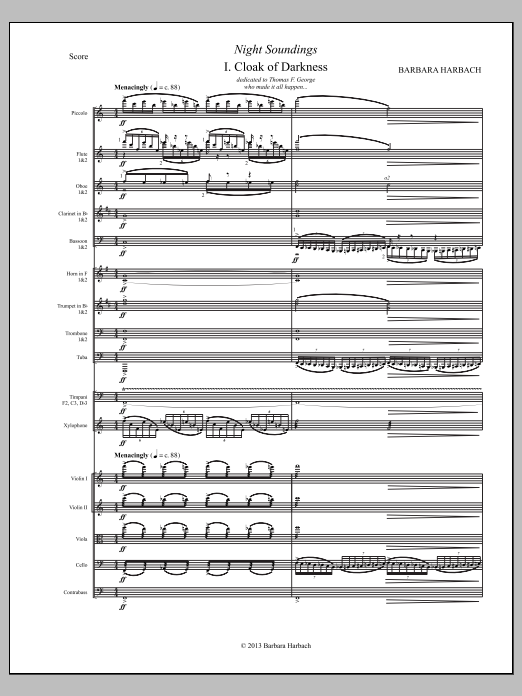

Night Soundings for Orchestra: Full Orchestra Conductor Score & Parts
Arranged by Barbara Harbach
Item: 35-PK00291421
$22.85
Pickup currently not available
Buy Extra Parts (Digital PDF Download)
Parts Added to Cart!
Description
Cloak of Darkness is the hour of the wolf, between night and light, just before the dawn awakens. Chromatic whirlwinds of sound, evocative melodies emerge until the brass end the nightmare with a brief phrase of Dies Irae, our Day of Wrath. Notturno opens with luminous and eerie night sounds, twitters and chirps from the dark of night portrayed by the woodwinds over open fifths in the strings. Wisps of sounds and melodies portray the dry whisper of leaves, the rustle of night creatures, and the heaviness of a hot, languid night. Midnight Tango - At this midnight hour, two lovers slowly approach, drawn to music that only they can hear - the midnight tango. As the music sinuously builds in volume and energy, more instruments embrace the themes, enticing the lovers to dance in close embrace before driving to the ecstatic, frenetic ending Duration: 16:00


Discover MakeMusic Cloud: thousands of interactive titles your students can play along with today.
Sample Audio
No sample audio found.
Sample Video
No sample videos found.
Additional Details
Publisher:
Hal Leonard
SKU:
35-PK00291421
More about this title
About the Arranger: Barbara Harbach
Barbara Harbach has built a reputation for orchestral writing that balances accessibility with genuine artistic substance. Her compositions often explore atmospheric textures and vivid storytelling, engaging both players and audiences through imaginative orchestration and memorable melodic writing.
Why we love this
Harbach's suite offers three distinct musical narratives that work as a complete arc or can stand independently, giving you flexibility in programming. The orchestration is sophisticated without being unwieldy, with each movement presenting clear pedagogical and dramatic purpose that keeps student musicians engaged throughout.
What to expect
The journey unfolds from unsettling darkness into shimmering nocturnal mystery before arriving at the sensual, driving energy of a midnight romance. Harbach's orchestration paints with color and atmosphere, creating cinematic moments that linger in the listener's ear long after the final ecstatic outburst.
Who it's for
This suite works for advanced high school or collegiate orchestras comfortable with contemporary harmonic language and theatrical interpretation. The 16-minute duration and three-movement structure make it an ideal centerpiece for concert programming, offering substantial artistic content without excessive technical demands on individual players.
How to get the most out of it
- Shape the chromatic clusters in Cloak of Darkness with precision; they should feel intentional and unsettling rather than chaotic. Have your woodwinds and strings practice these passages separately to lock the gesture before combining.
- Bring out the woodwind soloists in Notturno's opening measures. Those bird calls and rustling sounds are the movement's narrative foundation, so individual voices matter even within dense texture.
- Control the dynamic arc in Midnight Tango carefully during the build into the ecstatic ending. The crescendo works only if you establish clear dynamic layers early so there's genuine room to grow toward the frenetic conclusion.
How to use it
Consider opening a concert with this complete suite to establish an imaginative, slightly unconventional tone for the evening. It pairs effectively with more traditional orchestral repertoire, or you might program it alongside other contemporary works that explore orchestral color and storytelling.
Skills your students will build
- Executing rapid figuration and chromatic passage work
- Shaping atmospheric textures through dynamic control and balance
- Sustaining ensemble cohesion across complex harmonic movement
- Interpreting theatrical and programmatic content through orchestral color
- Managing sectional independence within densely layered arrangements