
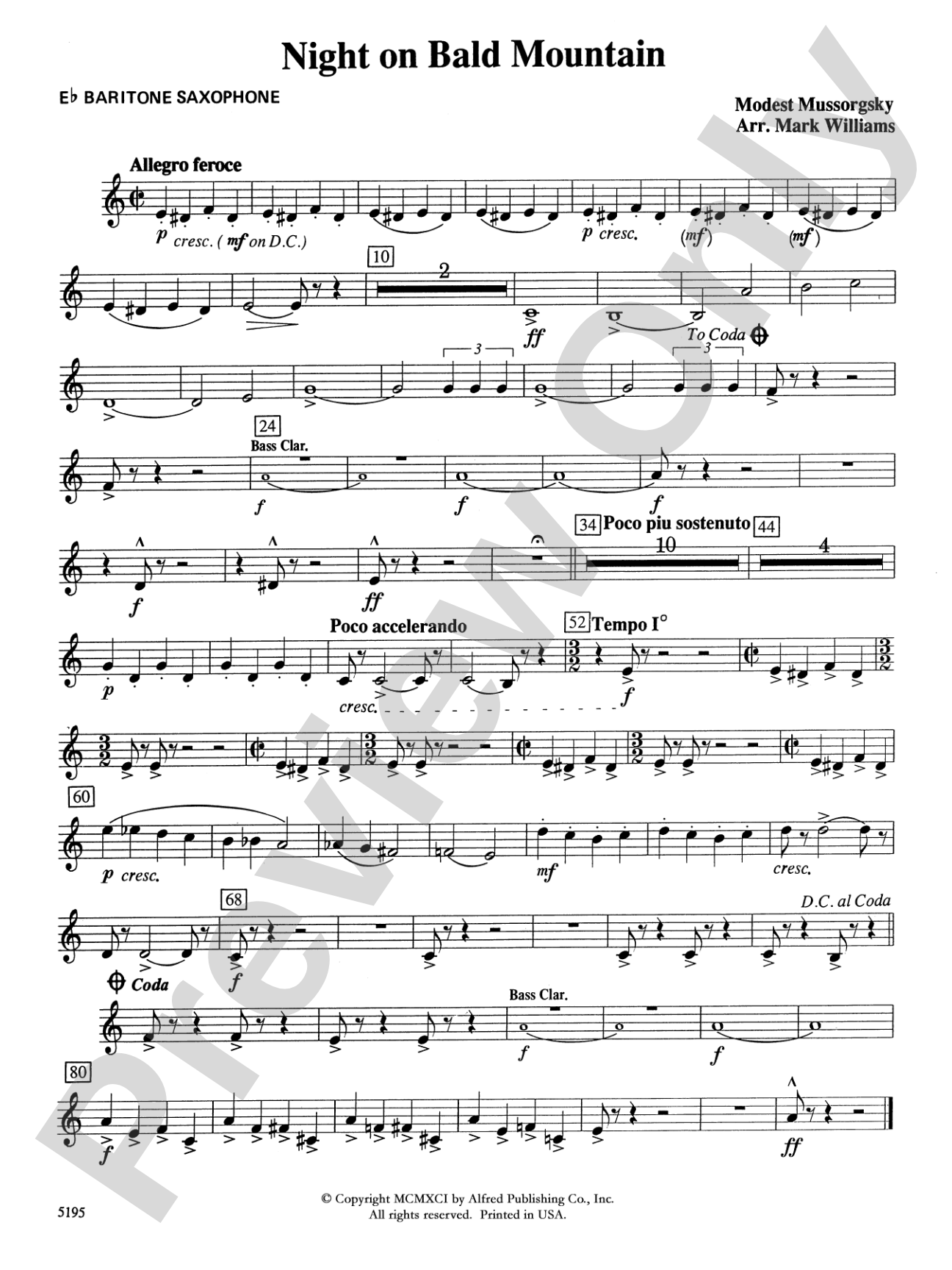

Night on Bald Mountain: E-flat Baritone Saxophone
By Modest Mussorgsky / arr. Mark Williams
Grade: 3 (Medium)
Item: 00-PC-0001887_BTX
$3.00
Pickup currently not available
Description
This concert band adaptation of Mussorgsky's spectacular orchestral work will make a thrilling addition to any concert performance. It depicts a witches' Sabbath, and was used to great effect in the Walt Disney animated film 'Fantasia.' Trills, staccato phrases, time signature changes and wide variances in dynamics all add to its effectiveness. A striking transcription. (Grade 3)


Don't just read it, hear it, play along with it, and watch your students grow with it. In MakeMusic Cloud, Night on Bald Mountain: E-flat Baritone Saxophone comes alive with professional accompaniment, adjustable tempo, and built-in practice tools that turn solo practice into real progress.
Open in the Player
Jump straight in and assign it today.
Start Your Free Trial
Open this title and explore the full library in minutes.
Sample Audio
1
Audio File
--:--
0:00
0:00
Sample Video
Additional Details
Series:
Growing Band Series
Publisher:
Alfred Music
Page Count:
132
SKU:
00-PC-0001887_BTX
More about this title
About the Composer: Modest Mussorgsky
Modest Mussorgsky (1839-1881) was a Russian composer who fundamentally reshaped how music could depict narrative and character without relying on traditional harmonic structures. Working largely outside the conservatory establishment, he composed operas, piano works, and orchestral pieces that captured Russian folk traditions and vivid storytelling through innovative orchestration and harmonic language. His willingness to break compositional rules made him a revolutionary figure in 19th-century music.
Night on Bald Mountain stands as one of his most recognizable works, originally conceived as an interlude for an unfinished opera before becoming the independent orchestral showpiece heard today. The piece gained widespread fame through its inclusion in Walt Disney's Fantasia, introducing millions to Mussorgsky's unapologetic approach to musical drama. For conductors and students, his work demonstrates how clarity of musical intent and memorable melodic content matter far more than adherence to academic convention.
Why we love this
Mark Williams's transcription captures the raw dramatic power of Mussorgsky's original while remaining thoroughly idiomatically written for concert band. The Grade 3 scoring distributes the witches' Sabbath chaos across the full ensemble without requiring virtuosic technical facility, making this an exceptionally musical choice for bands ready to tackle Romantic-era orchestral color on a manageable timeline. Audiences respond to this piece instantly—its theatrical energy and Fantasia connection mean students perform for a crowd already invested in the result.
What to expect
A whirling descent into musical chaos: dissonant harmonies, rapid staccato figures, and wild dynamic shifts paint a scene of supernatural mischief and dark celebration. The piece crackles with nervous energy and manic momentum, building from eerie suggestion to full pandemonium before collapsing back into shadow. Students feel the theatrical urgency coursing through every measure.
Who it's for
Concert bands at the Grade 3 level seeking a showstopper that combines orchestral sophistication with reasonable technical demands across all sections. This works equally well for festival competition, Halloween-themed concerts, or general repertoire programming when a band wants to prove their musicality without stretching into Grade 4 virtuosity.
How to get the most out of it
- Shape the dynamic swells carefully through the rapid staccato passages; each accent should feel like part of a larger swell rather than isolated. This prevents the texture from becoming merely busy.
- Lock the woodwind trills to a steady pulse early in rehearsal. The optionality of some trilled notes means sections need absolute clarity on which players execute them and where.
- Balance the high woodwind lines against the lower brass foundation during the fast sections. The melody sits high, but the harmonic weight must remain grounded.
- Treat the time signature changes (whether present in this arrangement) as natural phrase punctuation, not disruptions. Conductor clarity and steady beats will eliminate student hesitation.
How to use it
Program this as a concert finale to leverage its thrilling dramatic arc and audience recognition. It pairs effectively before an intermission or as the closing number on a fall or Halloween concert, where its visual energy translates even to listeners unfamiliar with classical music. The 132-page full score ensures a substantial, polished performance that justifies its programming weight.
Skills your students will build
- Executing rapid staccato articulation with rhythmic precision
- Reading and responding to frequent dynamic changes and extreme dynamic range
- Coordinating ensemble balance when melody and harmony span wide registral distances
- Interpreting time signature changes (if present in this arrangement) as musical events rather than technical obstacles
- Sustaining musical momentum through non-traditional harmonic progressions