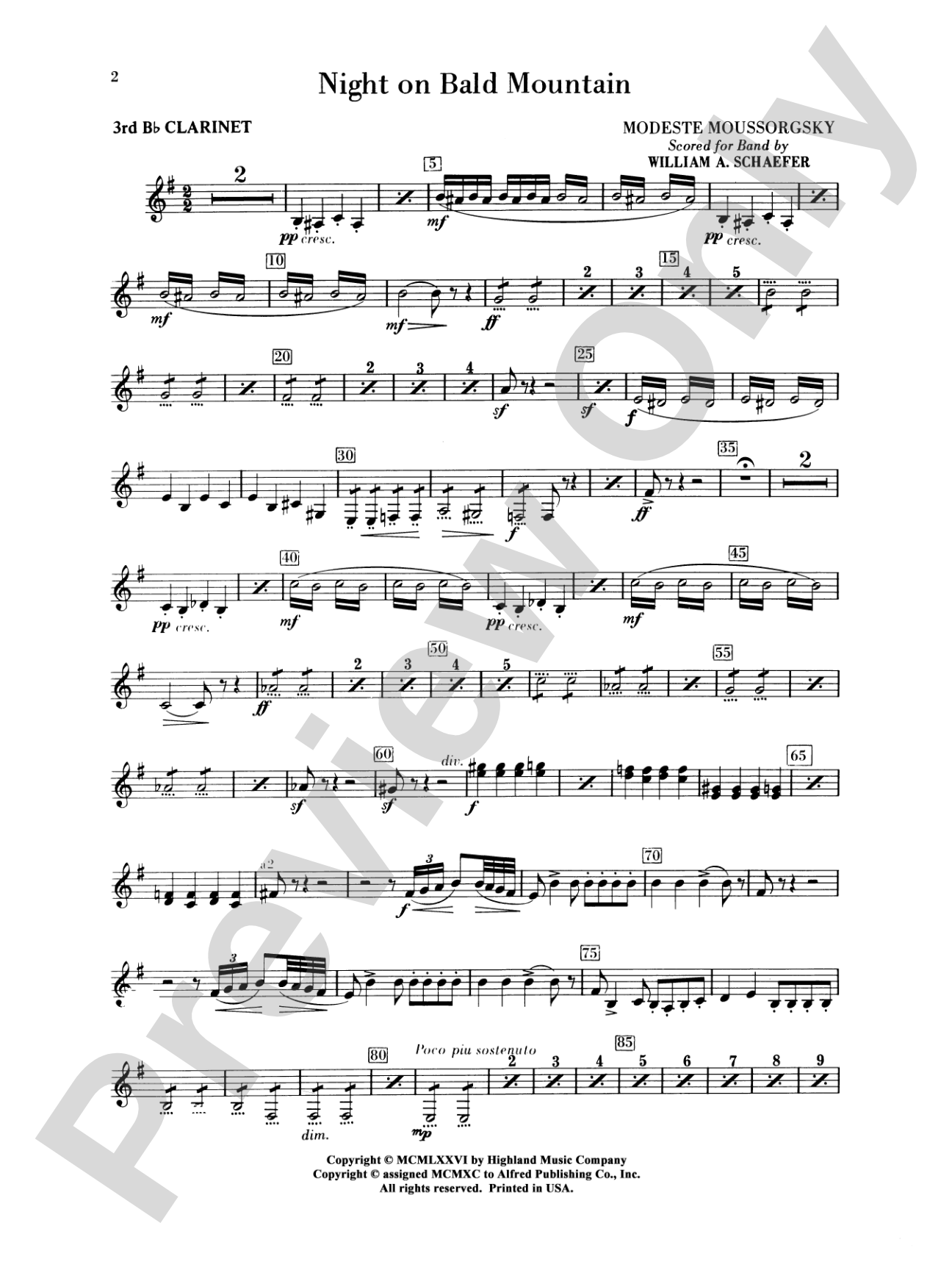
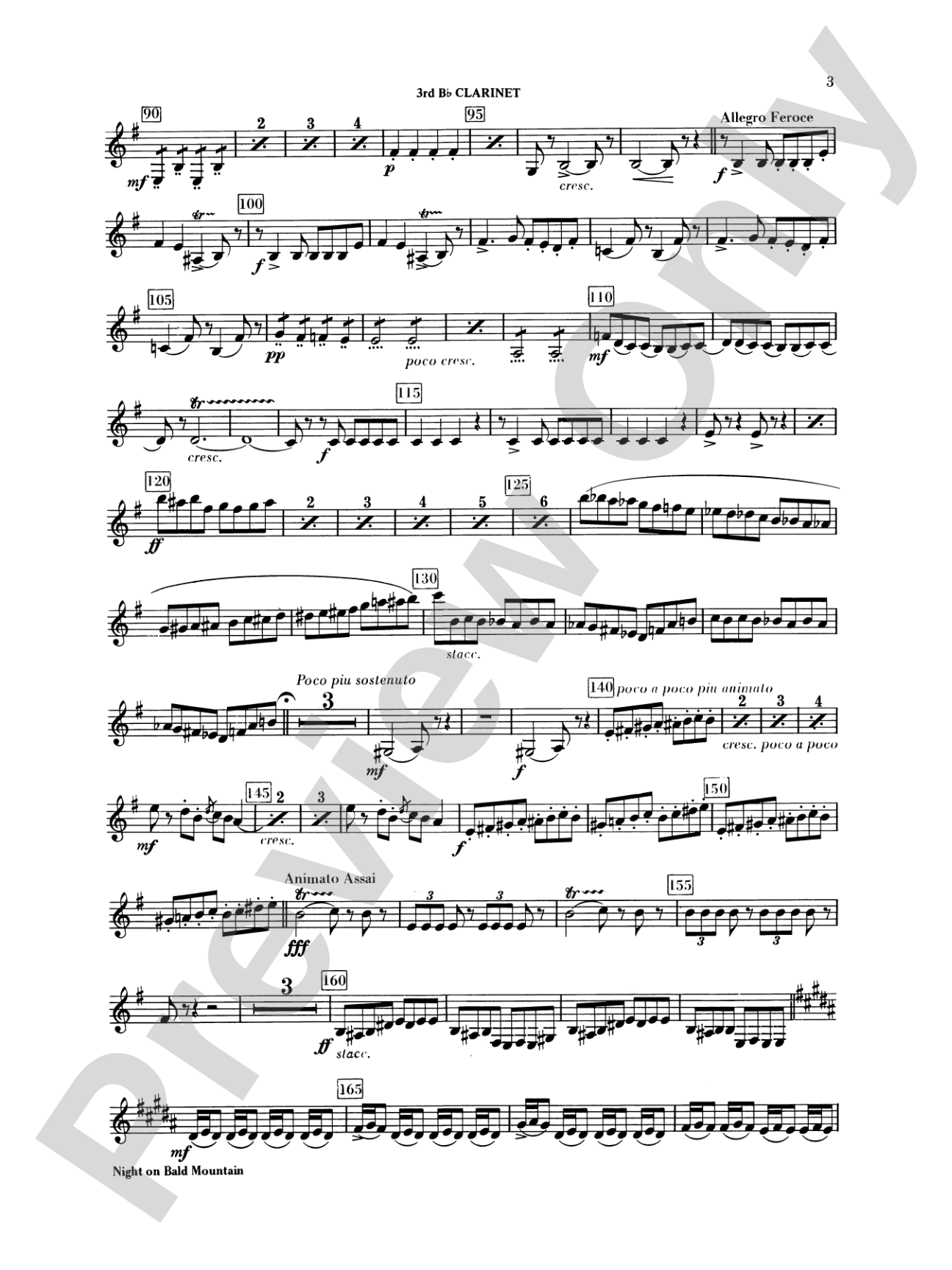
Night on Bald Mountain: 3rd B-flat Clarinet
By Modest Mussorgsky / arr. William Schaefer
Grade: 4 (Medium Difficult)
Item: 00-PC-0000032_C3
Pickup currently not available
Description
Night on Bald Mountain: 3rd B-flat Clarinet isn't in MakeMusic Cloud just yet...but it could be. Let us know you'd like to see it, and you'll help shape what comes next. In the meantime, start a free trial and dive into thousands of interactive titles your students can play along with today.
Tell us you want it.
Explore everything that's ready to play right now.
Sample Audio
Sample Video
Additional Details
More about this title
About the Composer: Modest Mussorgsky
Modest Mussorgsky (1839-1881) was a Russian composer who rejected formal training in favor of self-directed study, yet produced some of the most imaginative and structurally bold works of the Romantic era. His music captures Russian folk traditions and historical narratives with vivid orchestration and harmonic innovation that influenced generations of composers. Night on Bald Mountain exemplifies his gift for instrumental storytelling and his fearless approach to program music.
Mussorgsky's career was marked by struggle and personal hardship, yet his compositional voice remained distinctive and uncompromising. He valued authenticity and emotional truth over technical convention, making his works enduringly powerful vehicles for student musicians learning to balance technical demands with interpretive conviction.
Why we love this
This Schaefer arrangement captures the orchestral ambition of the original while remaining teachable for Grade 4 bands. The dynamic range, rhythmic variety, and narrative arc make it a showstopper that rewards student investment without requiring virtuosic soloists. Most importantly, it performs spectacularly on a standard concert program and never fails to engage an audience.
What to expect
Mussorgsky's witches' sabbath unfolds as musical chaos and spectral energy. The piece crackles with unexpected harmonic turns, jagged rhythmic figures, and sudden shifts in color and intensity that keep performers and listeners alike on edge. It builds from eerie whispers to a triumphant, slightly sinister climax.
Who it's for
This arrangement serves concert bands at the intermediate to early advanced level seeking a dramatic showpiece that also functions as solid pedagogical material. Directors will appreciate its accessibility relative to the original orchestral score, while students gain experience with a genuine masterwork.
How to get the most out of it
- Shape the opening tremolo and staccato figures with clear articulation and light tonguing to establish the witches' sabbath atmosphere before the main melodic material enters.
- Balance the brass section carefully during the fortissimo passages to prevent the melody from being buried; the texture should sound menacing, not muddled.
- Prepare students for the time signature changes and dynamic shifts by isolating these transitions in sectional rehearsal so they feel intentional rather than jarring.
- Use the wide dynamic range as a teaching opportunity for ensemble control; practice moving from triple piano to fortissimo with precision and uniformity.
How to use it
Program this as a fall or Halloween concert feature, or place it as a high-impact finale that leaves the audience talking. Its cultural currency through Fantasia makes it accessible to general audiences while maintaining artistic substance, making it ideal for school concerts or community programs where you want to bridge popular recognition with serious musicianship.
Skills your students will build
- Playing across wide dynamic ranges (ppp to fff) with control and precision
- Executing trills and rapid articulation cleanly and consistently
- Reading and performing time signature changes (managing metric shifts without losing pulse)
- Balancing ensemble blend in thick, sustained harmonic textures
- Responding to rapid and unexpected changes in tempo and character