Night On Bald Mountain Sheet Music Preview

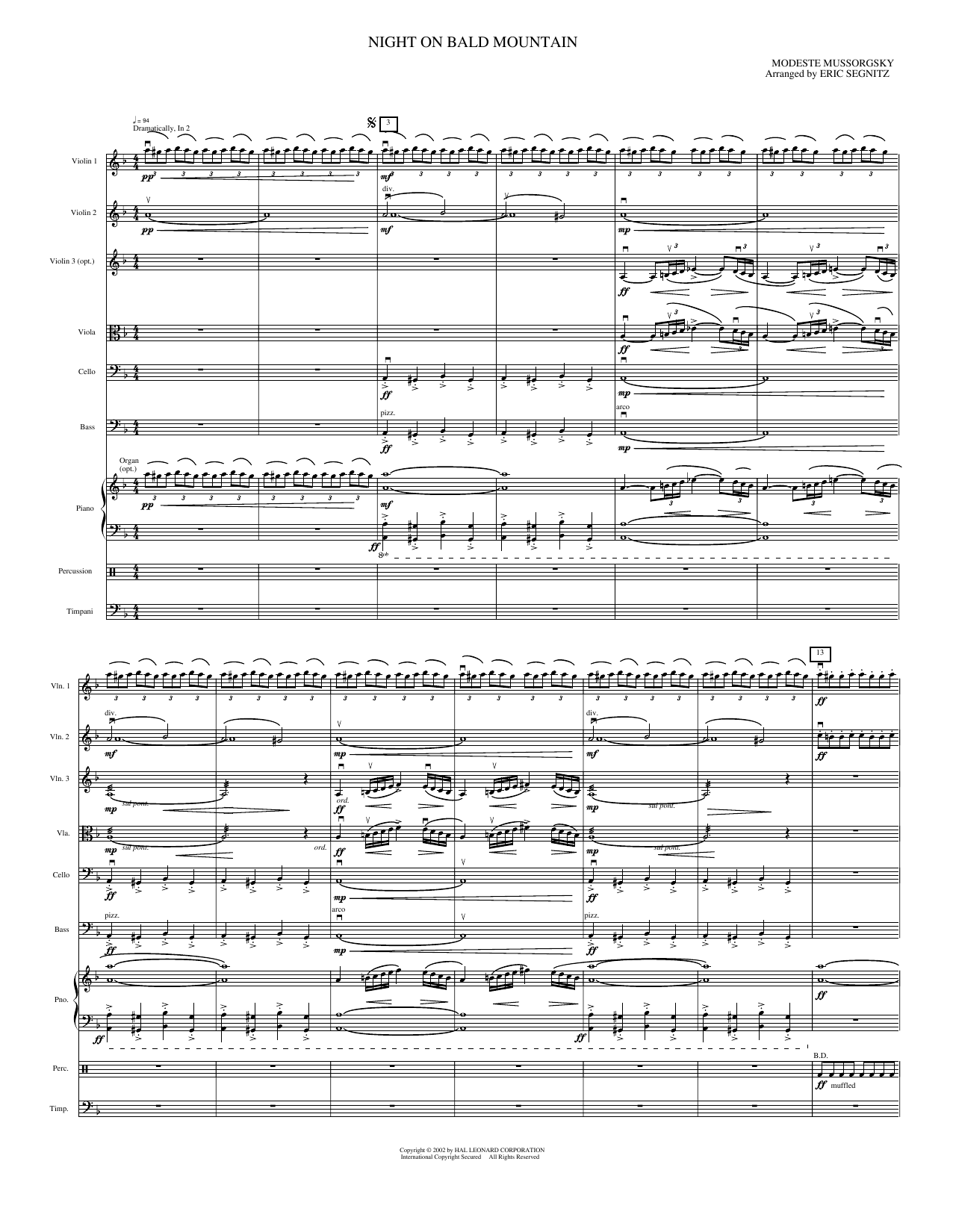
Night On Bald Mountain: String Orchestra Conductor Score & Parts

By Modest Mussorgsky / Arranged by Eric Segnitz

Grade: 3-4

Item: 35-PK00426662

Digital Download
$40.00

Buy Extra Parts (Digital PDF Download)

Product Price Quantity
Night On Bald Mountain - Full Score $40.00

Parts Added to Cart!

Description
Night on Bald Mountain

Night On Bald Mountain: String Orchestra Conductor Score & Parts isn't in MakeMusic Cloud just yet...but it could be. Let us know you'd like to see it, and you'll help shape what comes next. In the meantime, start a free trial and dive into thousands of interactive titles your students can play along with today.

Sample Audio
No sample audio found.
Sample Video
Additional Details
Publisher: Hal Leonard
SKU: 35-PK00426662

More about this title

About the Composer: Modest Mussorgsky

Modest Mussorgsky (1839–1881) was a Russian composer who rejected formal conservatory training in favor of self-directed study and radical musical innovation. He composed for voice, piano, and orchestra with an unapologetic focus on Russian national identity, folk melody, and harmonic freedom that challenged the conventions of his era.

Night on Bald Mountain stands as one of his most performed orchestral works, originally conceived for a ballet and later expanded into the symphonic poem that programs worldwide recognize today. His willingness to prioritize dramatic storytelling and orchestral color over academic correctness made him a model for generations of composers who valued artistic vision above musical "rules."

Why we love this

This arrangement captures the theatrical electricity of the original without requiring a full orchestra. The writing sits perfectly for string players at the intermediate level, balancing technical demands with immediate musical gratification. Your ensemble will experience what makes this work endure: relentless rhythmic drive, vivid harmonic color, and the kind of narrative arc that keeps an audience locked in from first note to last.

What to expect

Restless and menacing from the opening note, the piece builds an atmosphere of supernatural gathering. Jagged rhythms, tremolo strings, and sudden harmonic shifts create visceral unease. The climax erupts into pure kinetic energy, a whirlwind of sound that feels both wild and precisely controlled.

Who it's for

Intermediate string orchestras ready to tackle serious symphonic repertoire and directors seeking a showstopper that demonstrates how arrangement can preserve a masterwork's essence. This works equally well for ensembles with 15 players or 40, scaling seamlessly without compromising musical integrity.

How to get the most out of it

  • Establish the opening tremolo as an unsettling foundation rather than just texture. Have players shape the dynamic swell gradually so the chaos feels earned rather than sudden.
  • Mark the principal melodic lines clearly in parts so section leaders know exactly when they carry the story forward. Without clear ownership, the piece fragments into competing rhythmic gestures.
  • Experiment with the tempo in spots where the music roils most intensely. A slight acceleration through climactic passages creates momentum without losing control; pull back deliberately as the satanic celebration peaks.
  • Pay attention to bow direction changes in the rapid passagework. Consistency in the section transforms what could sound ragged into a unified sonic force.

How to use it

Consider this as a closing piece for a concert exploring Russian nationalism or symphonic storytelling alongside Borodin or Rimsky-Korsakov. It also serves as an effective opener if you want to grab immediate attention and establish that your program will venture into dramatic, ambitious territory.

Skills your students will build

  • Sustaining tremolo texture with dynamic control and rhythmic precision
  • Balancing individual melodic responsibility against ensemble cohesion in densely orchestrated passages
  • Executing rapid scalar and arpeggio figures cleanly across string sections
  • Responding to frequent dynamic and tempo shifts without losing musical direction
  • Interpreting rubato and expressive phrasing within a strongly rhythmic framework

You May Also Like