Night Moves Sheet Music Preview

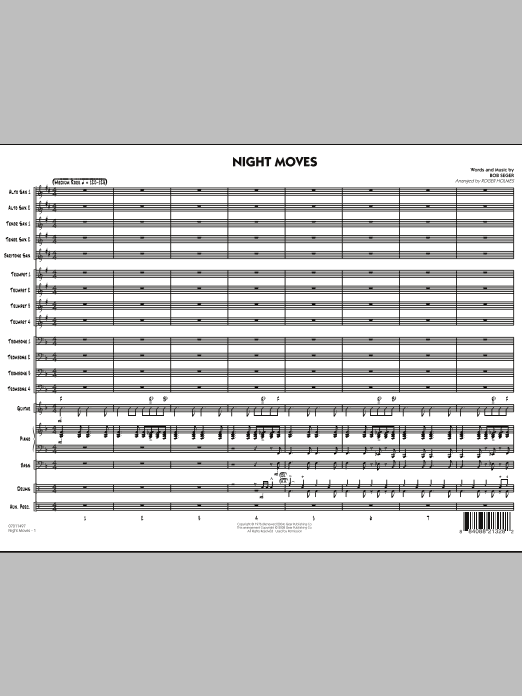
Night Moves: Jazz Ensemble Conductor Score & Parts

By Bob Seger / Arranged by Roger Holmes

Grade: 3

Item: 35-PK00118620

Digital Download
$45.00

One moment…

Description
This 1977 hit by Bob Seger features a distinctive rock style from the heartland with a medium tempo pulse and strong melodies. Here's a powerful chart that will sound great even with younger players.

Night Moves: Jazz Ensemble Conductor Score & Parts isn't in MakeMusic Cloud just yet...but it could be. Let us know you'd like to see it, and you'll help shape what comes next. In the meantime, start a free trial and dive into thousands of interactive titles your students can play along with today.

Sample Audio
No sample audio found.
Sample Video
Additional Details
Publisher: Hal Leonard
SKU: 35-PK00118620

More about this title

About the Composer: Bob Seger

Bob Seger emerged from Detroit's working-class rock scene in the 1960s, becoming one of America's most enduring songwriters through his ability to capture authentic heartland narratives set to memorable melodies and driving rhythms. His 1976 album "Night Moves" marked a commercial breakthrough, establishing him as a master of accessible rock that connected with mainstream audiences without sacrificing musical substance or integrity.

Why we love this

Roger Holmes has crafted an arrangement that preserves the song's infectious groove and sing-along melody while making it genuinely playable for Grade 3 ensembles. The writing sits comfortably across the ensemble without requiring virtuosity, yet the chart captures that signature Seger swagger that students recognize and respond to immediately.

What to expect

Honest and grounded, with a steady heartbeat that propels the melody forward. There's a Midwestern directness to the harmonic movement and orchestration, delivering the kind of satisfying rock groove that sounds good in a gym or auditorium without pretense or overcomplexity.

Who it's for

This arrangement suits ensembles eager to program recognizable material that excites students without overwhelming them technically. It works equally well for directors seeking a confidence-builder for younger or less experienced players, or for groups wanting a fun, musically solid selection that balances their season.

How to get the most out of it

  • Nail the rhythmic pocket from the first rehearsal. The medium tempo might feel slower than students expect for rock material, so lock in the steady quarter-note pulse and let the syncopation sit on top of it rather than rushing.
  • Balance the melodic line with textural support from the rhythm section. The hook needs clarity, but the arrangement works best when reeds and brass blend into a cohesive foundation rather than competing for attention.
  • Shape phrases with natural breath points instead of playing straight through. Even in a rock context, phrasing between melodic statements prevents fatigue and gives the tune room to breathe.
  • Use the recorded accompaniment to establish the groove during sectionals, then gradually build independence as ensemble confidence grows.

How to use it

Pair this with other rock standards to build a contemporary segment of your spring or fall concert. It works particularly well as a bridge between classical repertoire and more adventurous jazz or pop arrangements, signaling to audiences that your ensemble embraces musical breadth. Consider programming it after an uptempo chart to let the medium tempo serve as a moment of melodic focus before closing out a set.

Skills your students will build

  • Steady rhythmic grooving at medium tempo without accelerating
  • Balancing melody with accompaniment texture
  • Rock and pop phrasing conventions
  • Section independence from recorded rhythm tracks
  • Dynamics and articulation within a rock idiom

You May Also Like