
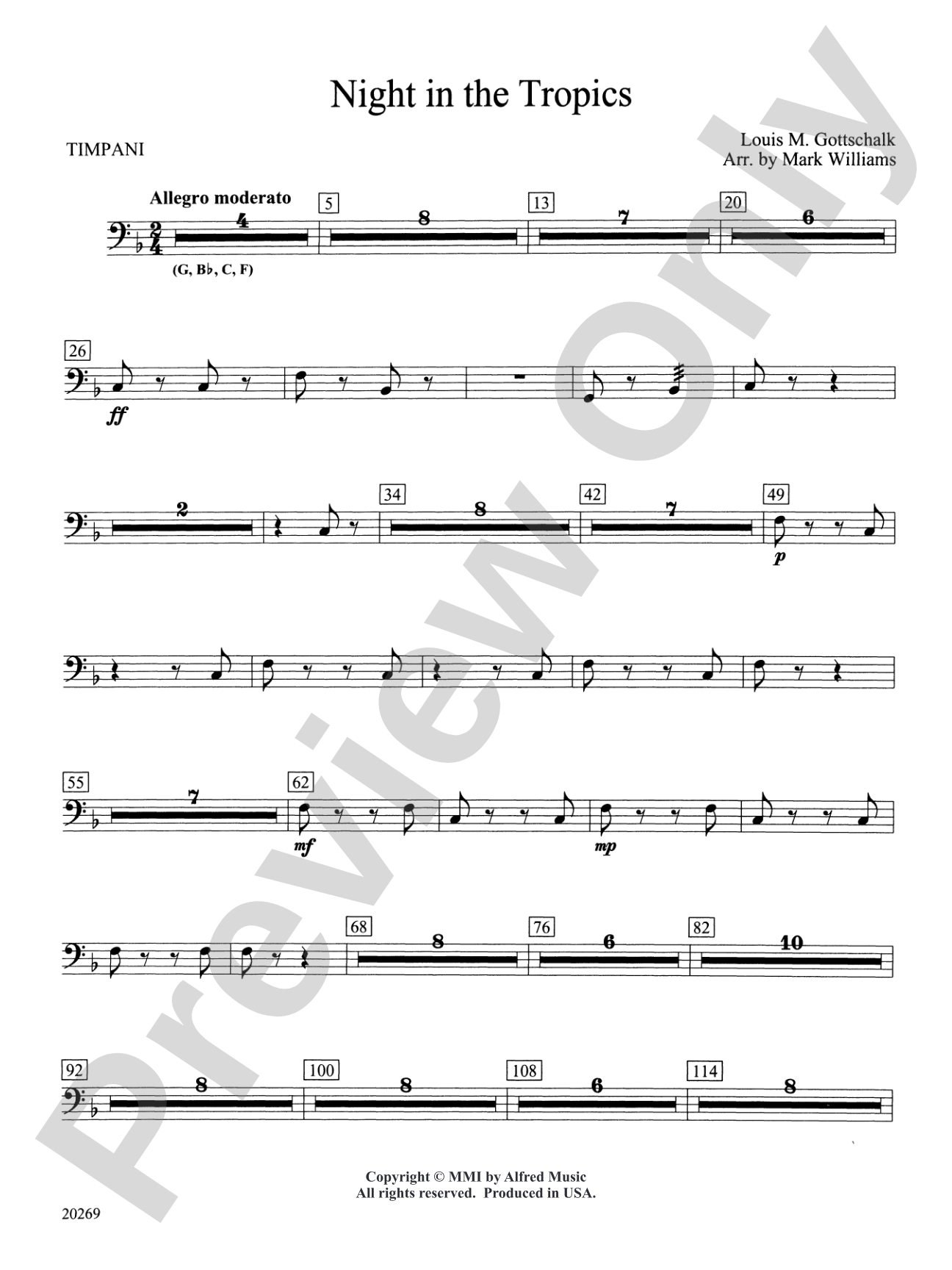

Night in the Tropics: Timpani
By Louis Moreau Gottschalk / arr. Mark Williams
Grade: 4 (Medium Difficult)
Item: 00-PC-0017563_TMP
$3.00
Pickup currently not available
Description
Grab your suitcase and get ready to spend a Night in the Tropics! Composed in Guadeloupe in 1859, it was written to be performed by combined symphony orchestra and large band, with improvisational parts for many local percussionists. This arrangement of the second movement is based on original manuscripts found in the New York Public Library. Great fun!


Don't just read it, hear it, play along with it, and watch your students grow with it. In MakeMusic Cloud, Night in the Tropics: Timpani comes alive with professional accompaniment, adjustable tempo, and built-in practice tools that turn solo practice into real progress.
Open in the Player
Jump straight in and assign it today.
Start Your Free Trial
Open this title and explore the full library in minutes.
Sample Audio
1
Audio File
--:--
0:00
0:00
Sample Video
No sample videos found.
Additional Details
Series:
Alfred Concert Band
Publisher:
Alfred Music
Page Count:
296
SKU:
00-PC-0017563_TMP
More about this title
About the Composer: Louis Moreau Gottschalk
Louis Moreau Gottschalk (1829–1869) was an American pianist and composer who bridged European Romanticism and Caribbean music traditions. Born in New Orleans, he spent much of his career in Europe and the Caribbean, absorbing local musical idioms and weaving them into concert works that anticipated later American compositional voices. His fusion of classical form with folk melody and rhythm made him a vital figure in 19th-century music on both sides of the Atlantic.
Gottschalk's output ranged from virtuosic piano pieces to orchestral works, many incorporating creole, Cuban, and Brazilian elements. Night in the Tropics reflects his deep engagement with Caribbean culture during his time in Guadeloupe and stands as one of his most ambitious orchestral scores. For band directors, his work offers rare access to an American master whose language is both sophisticated and immediately engaging.
Why we love this
Mark Williams's arrangement captures the sensory richness of Gottschalk's tropical soundscape while keeping the band writing idiomatically rewarding at Grade 4. The second movement's looser form and improvisational character give your section leaders space to breathe without sacrificing ensemble control. Programming this signals to your audience that concert band repertoire extends far beyond marches and show tunes.
What to expect
Lush and languid, with rhythmic vitality underneath. You're transported to a warm evening where classical form loosens into dance-like urgency, where the familiar European language of the Romantic era collides with Caribbean colors and percussion textures that feel alive and unpredictable.
Who it's for
Band directors seeking repertoire that challenges intermediate ensembles while delivering concert-hall impact. This works equally well for directors who want to deepen students' knowledge of American musical history or simply need a piece that sounds more sophisticated than its Grade 4 difficulty level suggests.
How to get the most out of it
- Balance the exotic percussion parts carefully; they should color the texture rather than dominate it. Assign experienced players to triangle, woodblock, and cowbell so the rhythmic layering stays clear.
- Shape phrase contours generously through the wind sections. Gottschalk's melodies benefit from vocal phrasing that lets longer lines breathe across multiple measures.
- The improvisational elements work best when the band understands the harmonic center. Run sectional rehearsals that establish the tonal anchor before adding the decorative percussion and rhythmic figures.
- Use the full 296 pages of material as a teaching opportunity. Review the original Gottschalk score alongside the arrangement to show students how a composer's intentions can transfer across ensemble types.
How to use it
Position this as a centerpiece in a concert exploring American Romanticism or music of the Americas. It pairs beautifully with later works by Copland or Gershwin and works equally well as a spring festival selection where its celebratory, warm character will resonate with audiences.
Skills your students will build
- Balancing ensemble texture with prominent percussion and solo lines
- Playing with longer, shapeful phrases in the Romantic style
- Reading and executing syncopated rhythmic figures across sections
- Listening to harmonic motion and maintaining tonal center in less structured forms
- Responding to conductor direction in passages with flexible, improvisational character