
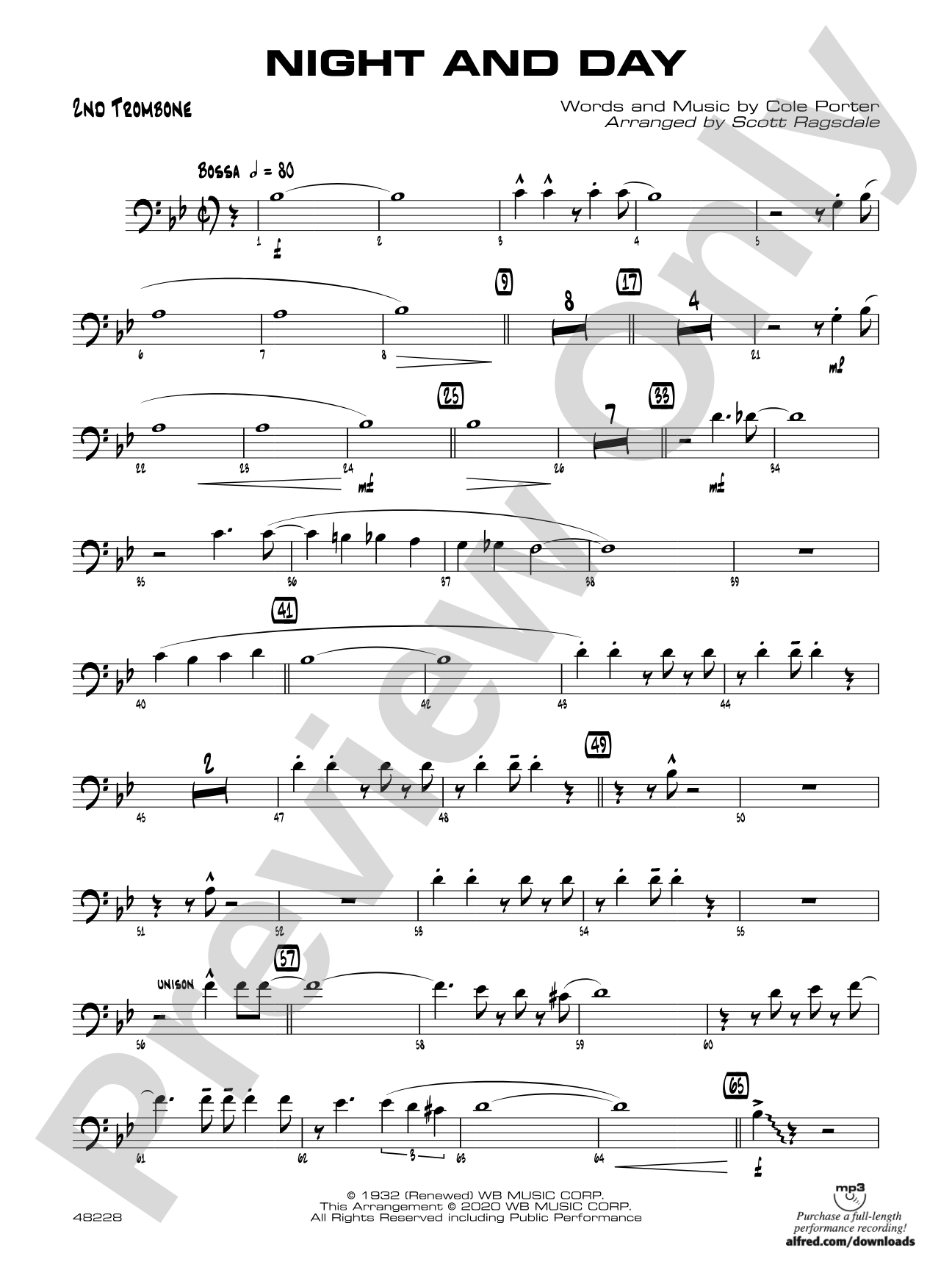

Night and Day: 2nd Trombone
Words and music by Cole Porter / arr. Scott Ragsdale
Grade: 3 (Medium)
Item: 00-PC-0018598_TN2
$5.99
Pickup currently not available
Description
Night and Day arranged by Scott Ragsdale is a great Cole Porter standard for your vocalist with a bossa groove around 160 BPM. Lead trumpet range is to a written A above the staff with a written-out tenor sax solo and optional C, B-flat, E-flat, and trombone solo lead parts for flexibility. Vocal range is from low F below middle C to B third line treble clef. Excellent chart! (3:15)


Don't just read it, hear it, play along with it, and watch your students grow with it. In MakeMusic Cloud, Night and Day: 2nd Trombone comes alive with professional accompaniment, adjustable tempo, and built-in practice tools that turn solo practice into real progress.
Open in the Player
Jump straight in and assign it today.
Start Your Free Trial
Open this title and explore the full library in minutes.
Sample Audio
1
Audio File
--:--
0:00
0:00
Sample Video
Additional Details
Series:
Jazz Vocal Series
Publisher:
Alfred Music
Page Count:
90
SKU:
00-PC-0018598_TN2
More about this title
About the Composer: Cole Porter
Cole Porter (1891-1964) was an American composer and lyricist who defined the golden age of musical theater through sophisticated harmonies, witty lyrics, and enduring melodies. His songs became standards of the Great American Songbook, performed across jazz, pop, and classical contexts. Porter's influence on jazz repertoire is profound; his chord progressions and melodic sophistication challenge musicians while remaining deeply rewarding to perform.
Porter composed for Broadway musicals, Hollywood films, and concert settings with equal facility. His work appears regularly in jazz ensemble curricula because his songs reward both technical precision and interpretive expression. Generations of jazz vocalists and ensembles have built their sound through his catalog.
Why we love this
Ragsdale's bossa groove arrangement preserves the sophistication of Porter's harmonic language while creating forward momentum that engages both your ensemble and audience. The flexibility to feature trumpet, tenor sax, or trombone soloists means you can rotate leading voices across the ensemble season, and the carefully considered vocal range sits comfortably for most singers without requiring extremes.
What to expect
Warm and urbane, with the unhurried sophistication of late-night conversation. The bossa groove gives the tune forward motion without urgency, allowing Porter's lyrical sophistication to emerge naturally over a gently swaying accompaniment.
Who it's for
This arrangement serves jazz ensembles with strong vocalists and solid rhythm sections who want to program sophisticated standards that challenge both soloist and ensemble. Directors seeking Grade 3 material that sounds more advanced than its difficulty level will find the harmonic writing and ensemble interaction particularly valuable.
How to get the most out of it
- Balance the written-out tenor sax solo against the ensemble backdrop by letting it breathe in the middle register; avoid pushing it into competition with the trumpet section during the head.
- Anchor the bossa groove through the kick drum and bass line, working those parts to lock before the vocalist enters so the foundation feels inevitable rather than tentative.
- Shape the vocalist's phrasing around the lyrical content rather than metrically; Porter's lyrics invite conversational delivery, and the best performances lean into that storytelling quality even within a strict tempo.
- Rehearse the optional solo lead parts (trumpet, sax, trombone, C melody) separately so whichever soloists you choose feel ownership of their material and can voice their solos distinctly.
How to use it
This works beautifully as a second-set opener on a jazz concert where you want to establish elegant musicianship and feature your vocalist without stretching into the most demanding repertoire. It also programs well alongside other Porter standards or as a bridge piece between higher-energy swing tunes and slower ballads.
Skills your students will build
- Reading and interpreting written-out jazz solos while maintaining ensemble cohesion
- Balancing swing eighth-note articulation within a bossa nova rhythmic framework
- Accompanying a lead vocalist with attention to phrasing, space, and dynamic support
- Understanding harmonic substitution and reharmonization in a working jazz arrangement
- Communicating ensemble changes when rotating optional solo leads across different instruments