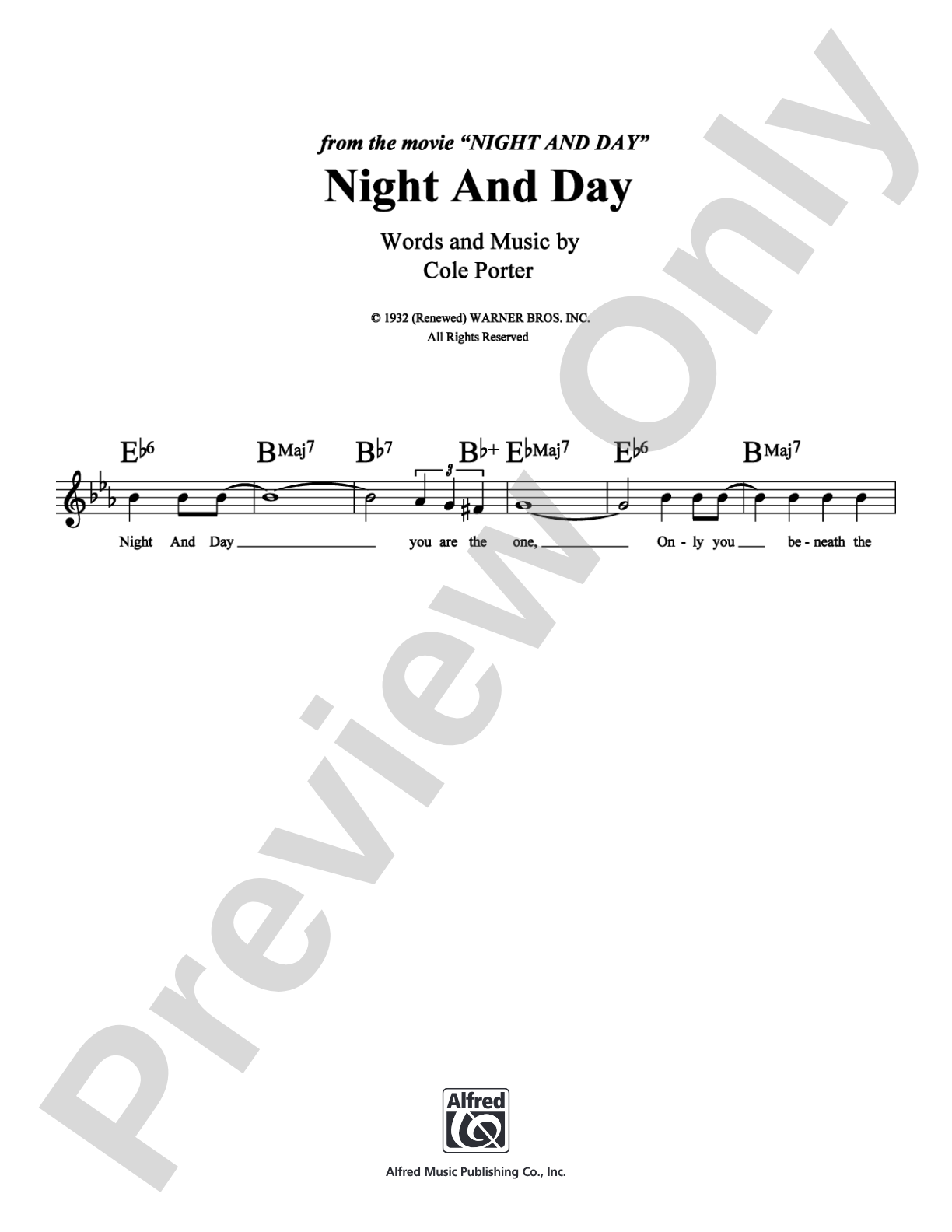
Night and Day: Lead Sheet Digital Sheet Music

Night and Day: Lead Sheet Digital Sheet Music

Cole Porter, Frank Sinatra, Fred Astaire

Item: 00-PS-0008437

Digital Download
$1.99
Description

Night and Day: Lead Sheet Digital Sheet Music isn't in MakeMusic Cloud just yet...but it could be. Let us know you'd like to see it, and you'll help shape what comes next. In the meantime, start a free trial and dive into thousands of interactive titles your students can play along with today.

Sample Audio
No sample audio found.
Sample Video
Additional Details
SKU: 00-PS-0008437

More about this title

About the Artist: Frank Sinatra

Frank Sinatra (1915-1998) shaped American popular song through his interpretive gifts and technical mastery of phrasing. His approach to the Great American Songbook set the standard for jazz vocalists and influenced generations of singers across genres. For educators, Sinatra's recordings remain essential listening for understanding how a vocalist can reshape a melody through breath control, rhythmic flexibility, and emotional authenticity.

As both a performer and interpreter, Sinatra demonstrated that lead sheets are blueprints for personal expression rather than rigid instructions. His versions of standards like "Night and Day" show how a skilled musician can honor a song's architecture while making it entirely their own, a principle that serves music students across levels.

Why we love this

"Night and Day" is a masterclass in sophisticated melody and Cole Porter's harmonic language, and this lead sheet gives students direct access to the song's essential structure. Singers and musicians studying American songbook repertoire need to understand the backbone of these standards, and a clean lead sheet strips away arrangement choices to focus on what makes the song work harmonically and melodically.

What to expect

The song moves between reflective longing and restless energy, matching the lyrical conceit of day and night as opposing states of mind. Porter's sophisticated harmony creates moments of harmonic surprise and chromaticism that keep the melody from settling into predictability. There's an inherent elegance in the melodic line, yet the chord progression gives players and singers plenty of room to interpret.

Who it's for

This lead sheet serves vocalists, pianists, and jazz musicians who need a clean, readable version of the melody and chord changes. High school and college musicians studying American song standards, jazz repertoire, or popular music will find it essential for understanding the song's harmonic foundation. Music educators can use it as a reference tool when teaching students about jazz harmony and melodic construction.

How to get the most out of it

  • Study the original recordings by Sinatra and Fred Astaire to hear how different artists shape the phrasing and navigate the syncopation; your interpretation should start with listening, not assuming.
  • Pay attention to the chromatic movement in the harmony, particularly how Porter uses it to build tension and release across sections; let those harmonic moves inform your tempo and dynamic choices.
  • The "night and day" motif returns throughout; track how you'll vary your approach each time it appears rather than treating each occurrence identically.
  • Consider how the lyric rhythm interacts with the melodic line; lead sheets don't always capture the subtlety of text-setting, so sing through with the words to find natural phrasing points.

How to use it

Use this as a study score alongside recordings when teaching jazz standards or twentieth-century American song repertoire. It works well as a lead for a jazz combo, small ensemble, or vocalist-pianist pairing in a cabaret-style program. Assign it to advanced students exploring the Great American Songbook as a way to develop harmonic awareness and improvisational thinking.

Skills your students will build

  • Reading lead sheet notation with chord symbols
  • Understanding diatonic and chromatic harmony in American popular song
  • Phrasing and interpretation choices based on harmonic movement
  • Connecting melody to underlying chord changes
  • Recognizing and performing syncopated rhythmic figures

You May Also Like