
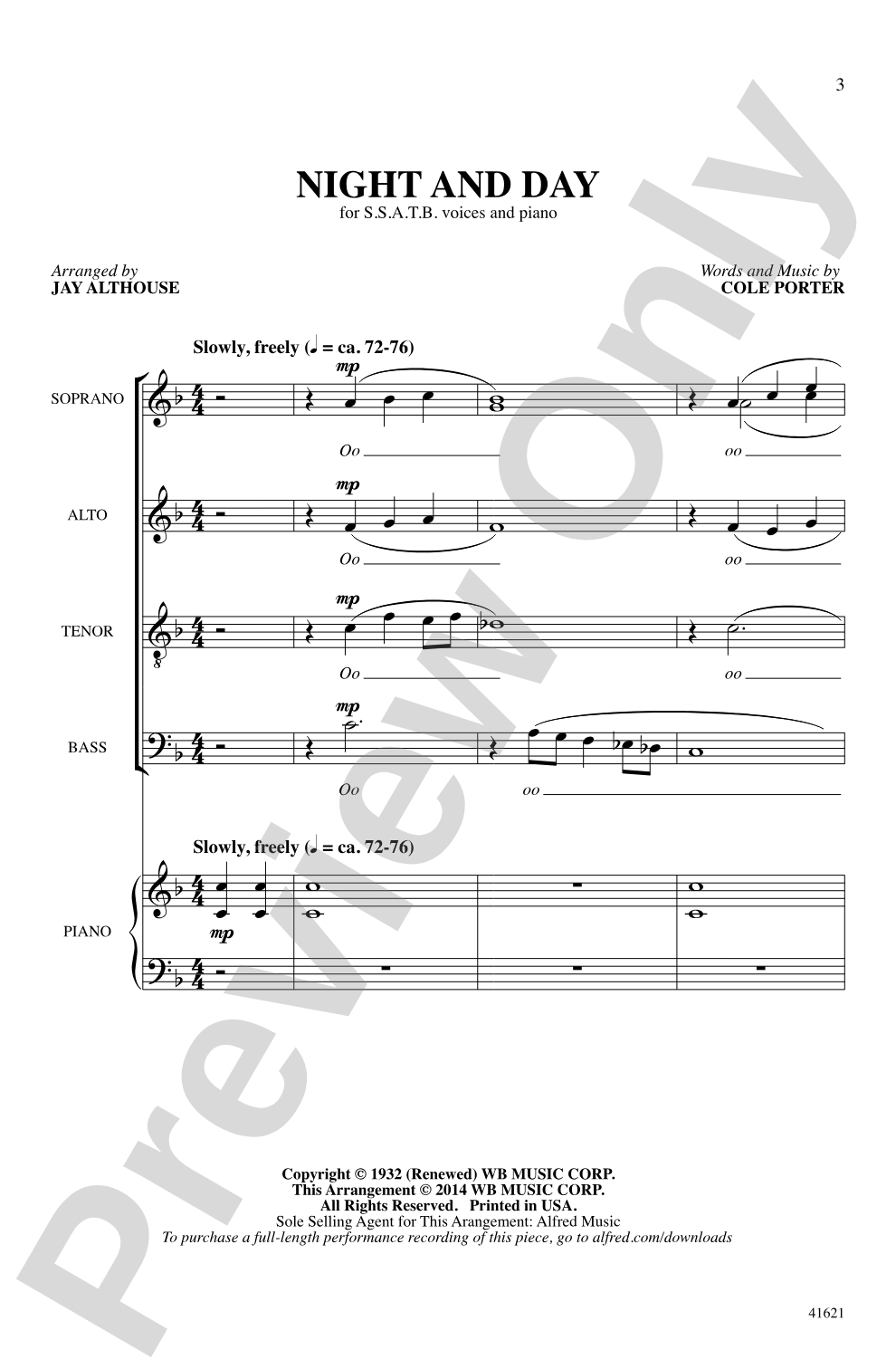

Night and Day: SSATB Choral Octavo
Words and music by Cole Porter / arr. Jay Althouse
Item: 00-PO-0001928
$2.10
Minimum order quantity: 20 copies
One moment…
Related Items
Night and Day: SSATB Choral Octavo |
$2.10
|
View |
Description
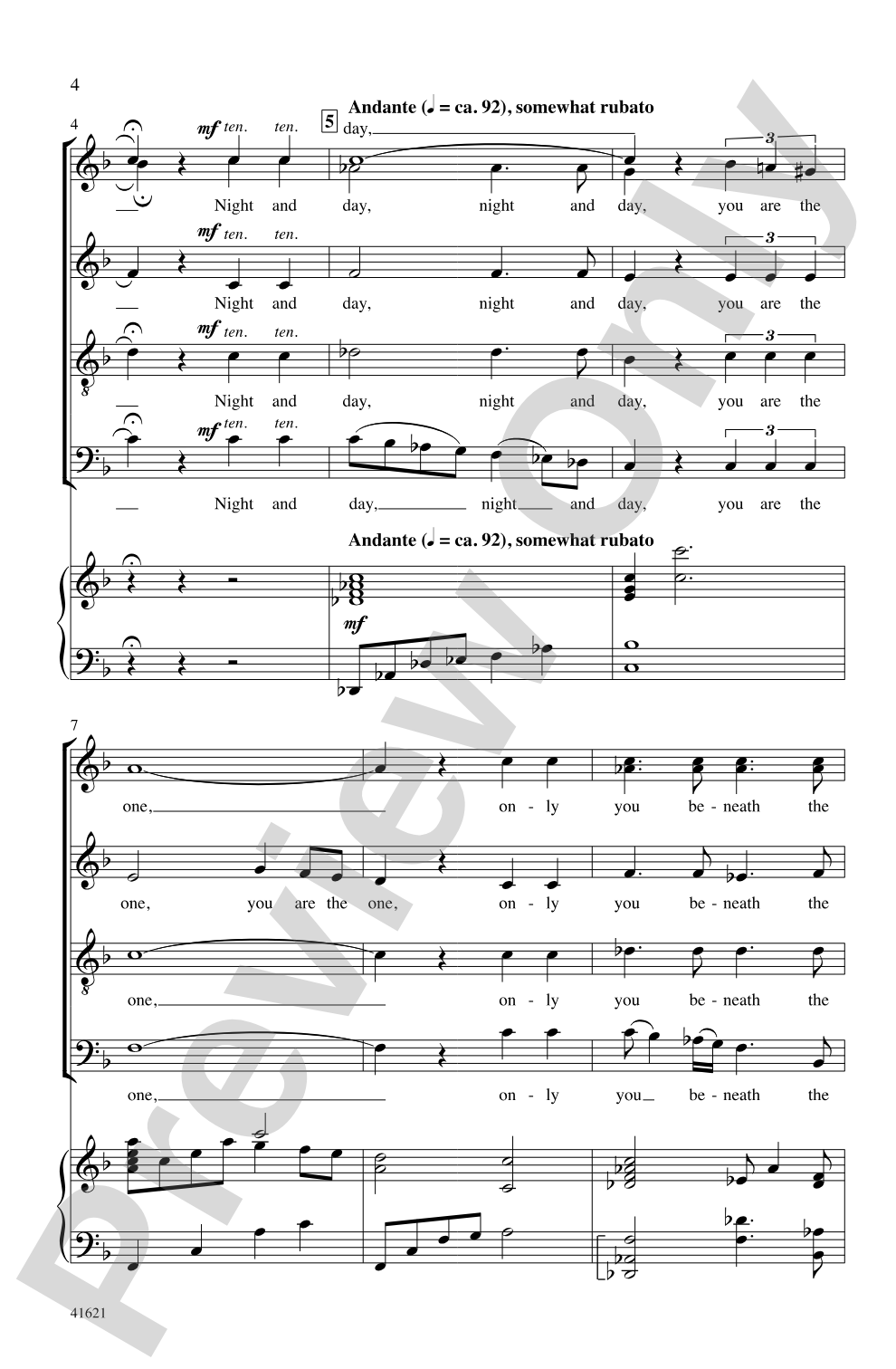
Hailed by many as Porter's greatest contribution to the Great American Songbook, "Night and Day" uses a harmonic structure that broke all the rules found in other popular songs from the 1930s. Your accompanist will really shine on this one!


Night and Day: SSATB Choral Octavo isn't in MakeMusic Cloud just yet...but it could be. Let us know you'd like to see it, and you'll help shape what comes next. In the meantime, start a free trial and dive into thousands of interactive titles your students can play along with today.
Request This Title
Tell us you want it.
Start Your Free Trial
Explore everything that's ready to play right now.
Sample Audio
1
Audio File
--:--
0:00
0:00
Sample Video
No sample videos found.
Additional Details
Series:
Alfred Pop Choral Series
Publisher:
Alfred Music
Page Count:
12
SKU:
00-PO-0001928
More about this title
About the Composer: Cole Porter
Cole Porter (1891-1964) was an American composer and lyricist who shaped popular music across five decades. Born to wealth in Indiana, he studied music formally and traveled extensively, drawing inspiration from jazz, Latin rhythms, and European classical traditions. His sophisticated harmonies, witty lyrics, and melodic gifts made him one of the most performed songwriters of the twentieth century, with hits spanning Broadway, film, and the concert hall.
Porter's influence on music education extends far beyond his own era. His harmonic innovations—particularly his use of chromatic voice leading and unexpected chord progressions—challenged songwriting conventions and continue to teach musicians about harmonic possibility. Teachers and students return to his work repeatedly because it rewards close listening and deepens understanding of how melody, harmony, and lyrical meaning intertwine.
Why we love this
Jay Althouse's arrangement of this Porter classic respects the harmonic sophistication that made the original revolutionary while making it genuinely singable for SATB ensembles. The piano accompaniment carries enough personality to anchor the singers without overwhelming them, letting both the singers and accompanist contribute meaningfully to the performance. This is the kind of standard that sounds effortless when it's done well and reveals how much craft lies beneath that impression.
What to expect
The song unfolds like a conversation with someone you can't stop thinking about. Harmonically restless and chromatically rich, it never settles where you expect it to, which mirrors the emotional state of someone caught between day and night, presence and absence, certainty and doubt. The melody moves with conversational ease while the harmony beneath it creates a gentle sense of unease—beautiful and melancholic.
Who it's for
This arrangement serves mixed choirs with solid upper-voice readers and some harmonic maturity. High school choirs with two to three years of ensemble experience, college and community choirs, and adult singers looking for substantial popular standards will all find rewarding material here.
How to get the most out of it
- Balance the harmonic density in the inner voices so the soprano melody emerges clearly; many singers instinctively sing too loudly on their parts, which muddies the chromatic voice leading.
- Work the piano part separately with your accompanist before full rehearsal; the harmonies shift frequently and the accompanist needs confidence before the ensemble joins.
- Shape the phrases by breath and text meaning rather than by resting on harmonic strong beats; Porter's irregular phrasing is part of what makes the song distinctive.
- Maintain a warm, conversational tone throughout; this is a song of intimate reflection, not a showstopper delivered at full volume.
How to use it
This belongs in a concert program where you want to shift mood into something more introspective and harmonically sophisticated. It pairs well after a more energetic opening work and can anchor a set of American standards or twentieth-century popular music. It also works beautifully as a finale to a concert built around Porter or the Great American Songbook.
Skills your students will build
- Reading chromatic voice leading and unusual harmonic progressions
- Balancing mixed-voice harmony with clear melodic projection
- Interpreting rhythm and phrasing in popular song contexts
- Collaborating with an accompanist on harmonically complex material