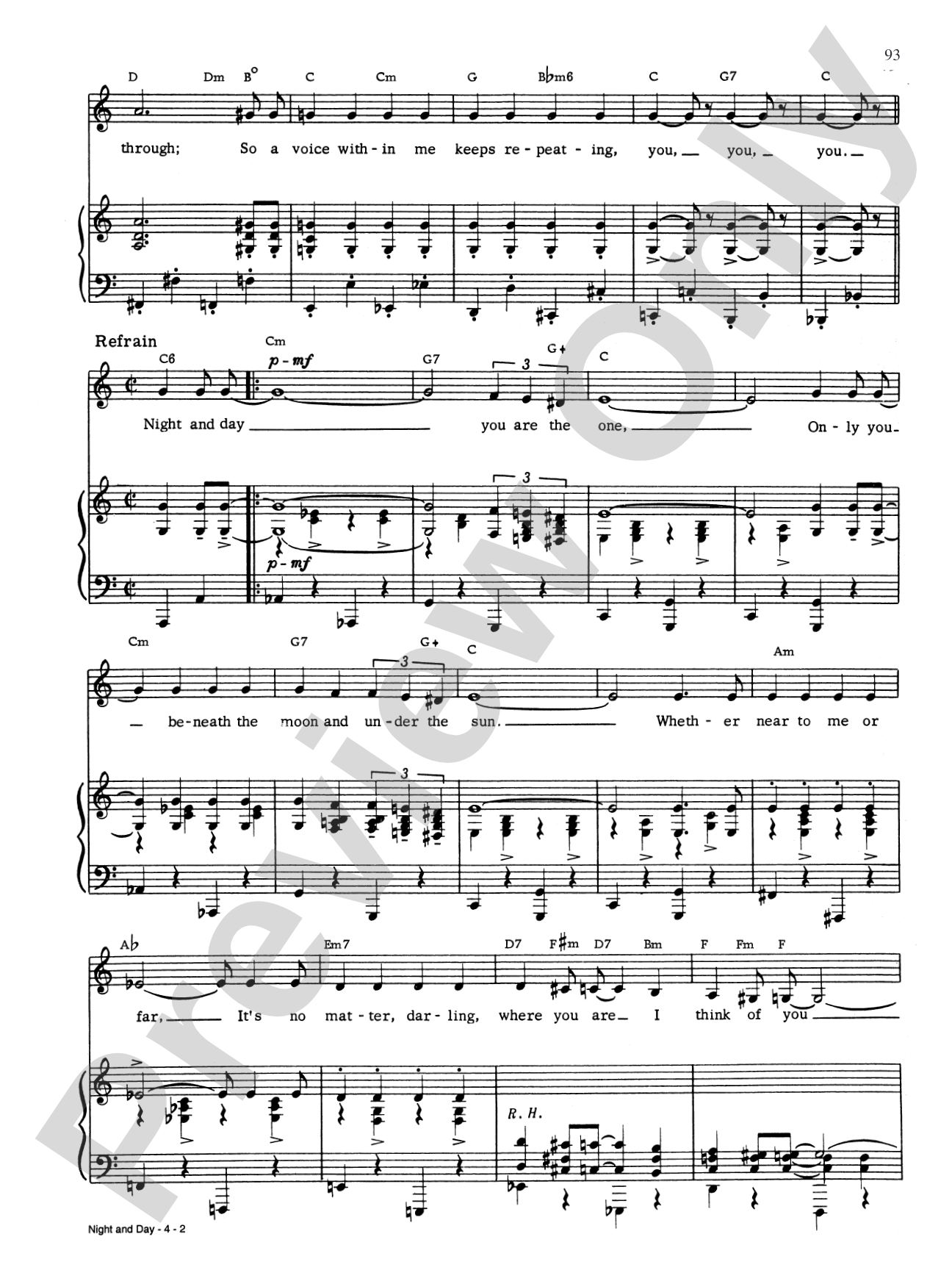
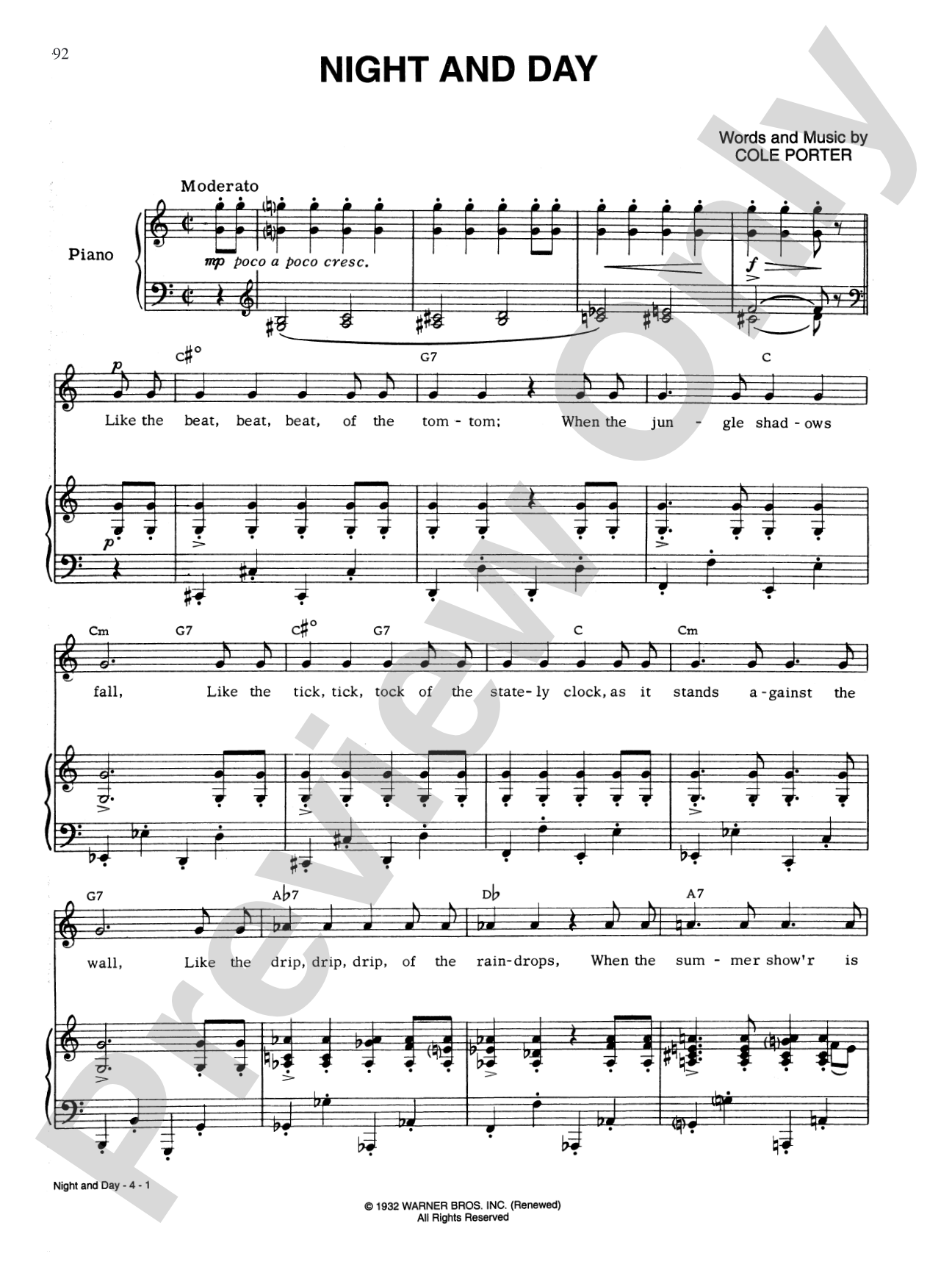
Night and Day Sheet Music Preview

Night and Day: Piano/Vocal/Chords

By Cole Porter

Item: 00-PIP-000087

Digital Download
$3.99

One moment…

Description

Night and Day: Piano/Vocal/Chords isn't in MakeMusic Cloud just yet...but it could be. Let us know you'd like to see it, and you'll help shape what comes next. In the meantime, start a free trial and dive into thousands of interactive titles your students can play along with today.

Sample Audio
No sample audio found.
Sample Video
Additional Details
Publisher: Alfred Music
Page Count: 6
SKU: 00-PIP-000087

More about this title

About the Composer: Cole Porter

Cole Porter (1891-1964) was an American composer and lyricist who defined the golden age of musical theater and the American songbook. His sophisticated harmonies, witty lyrics, and knack for memorable melodies made him one of the most performed composers in popular music. Porter's songs have become standards in jazz, cabaret, and vocal repertoires worldwide, studied by musicians seeking to understand how melody, harmony, and language intersect.

Porter's influence on music education extends beyond performance. His songs teach voice students about phrasing over complex chord changes, his keyboard writing shows pianists how to accompany singers with both support and elegance, and his compositional techniques reveal principles of craft that apply across genres. Many of his pieces remain central to jazz pedagogy and vocal training.

Why we love this

Night and Day is one of Porter's most recognizable standards, and this piano/vocal/chords edition gives singers and accompanists a clear, accessible format for learning it. The chord symbols make it invaluable for jazz students and those exploring comping and reharmonization, while the full vocal line with piano part ensures singers can work independently or with an accompanist. It's a song that teaches as much as it delights.

What to expect

Night and Day unfolds with romantic yearning and sophistication. The opening establishes an introspective, almost obsessive quality that Porter sustains through shifting harmonies and a melody that hovers between angular and lyrical. There's an elegance to the piece that asks both vocalist and accompanist to bring maturity and intention to every phrase.

Who it's for

This edition serves vocalists preparing standards for recital, jazz students learning to navigate sophisticated chord changes, and pianists accompanying singers at any skill level. It works equally well for singers studying jazz interpretation, music theater students building a core repertoire, or anyone exploring American songbook classics.

How to get the most out of it

  • Study the chord progression before focusing on the melody. The harmonic movement in this standard is intricate; understanding it first will clarify phrasing and interpretation.
  • Approach the vocal line with speech-like flexibility. Porter's lyrics drive the melody, so let the natural rhythm and meaning of the words shape your phrasing rather than forcing strict meter.
  • Balance accompaniment texture. As the pianist, support the singer's line without drowning it; the right hand often doubles or outlines the melody, while the left hand anchors harmonic movement.
  • Experiment with tempo and rubato within the ballad framework. This standard rewards interpretation; small adjustments in tempo can deepen emotional impact without losing structural coherence.

How to use it

Program this as a solo feature in a vocal recital, jazz combo performance, or cabaret-style concert. It pairs naturally with other Porter standards or works beautifully as a bridge between classical art song and jazz vocal repertoire. Many studios use it as a benchmark piece for intermediate-to-advanced voice students.

Skills your students will build

  • Navigating chromatic and diatonic harmonic movement over an extended form
  • Coordinating vocal phrasing with piano accompaniment patterns
  • Reading chord symbols and understanding harmonic function
  • Balancing lyrical expression with rhythmic precision in a ballad tempo
  • Interpreting and executing interpretive flexibility within a standard form

You May Also Like