
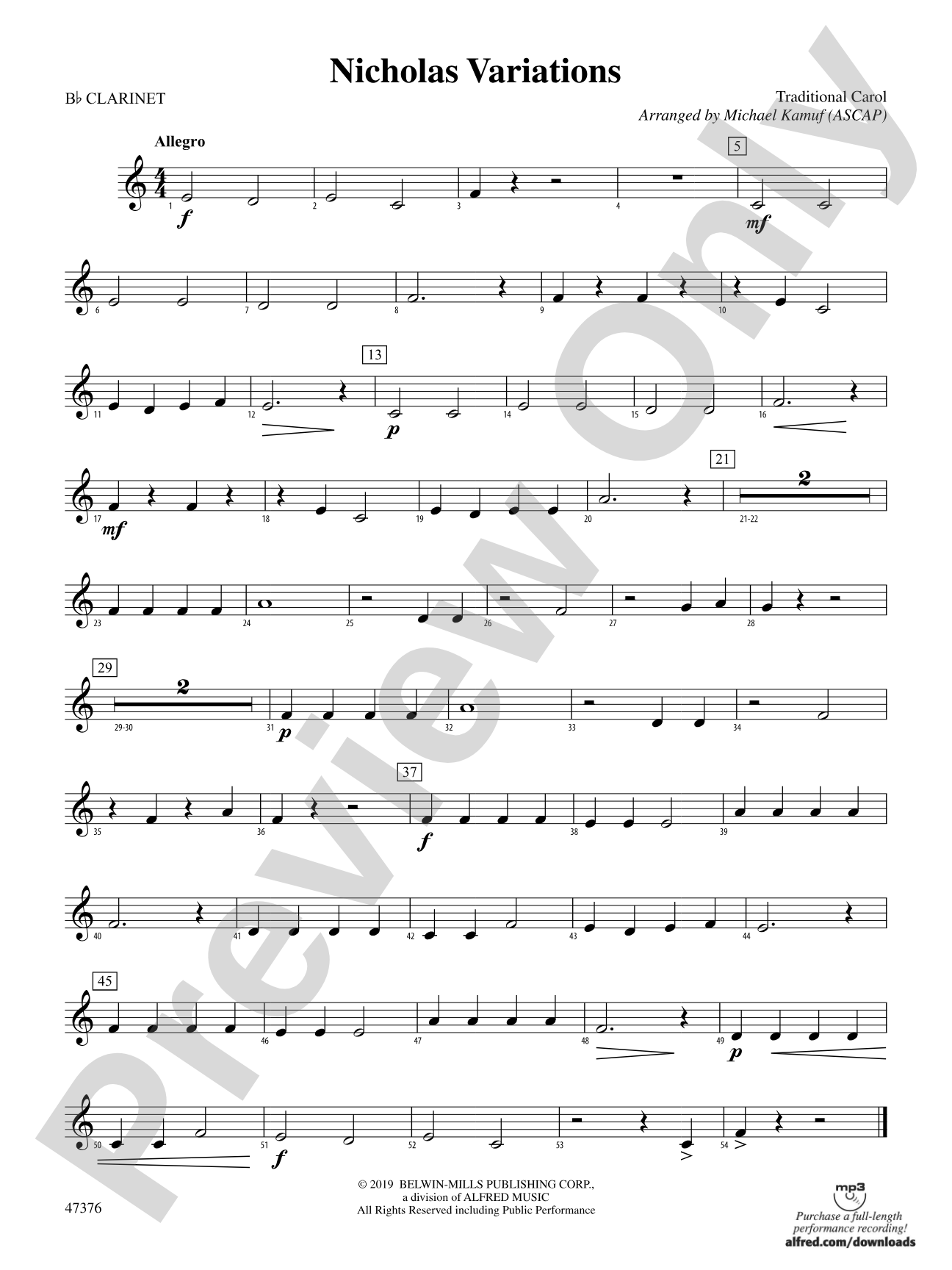

Nicholas Variations: 1st B-flat Clarinet
Traditional Carol / arr. Michael Kamuf
Grade: 0.5 (Very Easy)
Item: 00-PC-0017910_C1
$3.00
Pickup currently not available
Description
Complete your first holiday concert with an energetic setting of "Jolly Old Saint Nicholas" in three brief variations that use only six notes and no key signature! All instruments get an opportunity to play melodic material, and this piece is a great vehicle to introduce both crescendo and decrescendo. (1:45)


Don't just read it, hear it, play along with it, and watch your students grow with it. In MakeMusic Cloud, Nicholas Variations: 1st B-flat Clarinet comes alive with professional accompaniment, adjustable tempo, and built-in practice tools that turn solo practice into real progress.
Open in the Player
Jump straight in and assign it today.
Start Your Free Trial
Open this title and explore the full library in minutes.
Sample Audio
1
Audio File
--:--
0:00
0:00
Sample Video
Additional Details
Series:
Belwin Very Beginning Band
Publisher:
Alfred Music
Page Count:
134
SKU:
00-PC-0017910_C1
More about this title
About the Arranger: Michael Kamuf

Michael Kamuf studied jazz performance and music education at Youngstown State University's Dana School of Music, then earned a master's degree in instrumental conducting from George Mason University. His compositions and arrangements have been performed by prestigious ensembles including the Woody Herman and Glenn Miller Orchestras, the USAF Airmen of Note, and the US Navy Commodores, as well as by notable soloists such as James Moody, Eddie Daniels, and Sean Jones.
Kamuf spent three decades teaching instrumental music in Montgomery County Public Schools in Maryland, serving for twenty-seven years as Director of Bands and Orchestras and Music Department Chairperson at John T. Baker Middle School. Under his leadership, the school's ensembles earned consistent festival recognition and commissioned works for young concert bands. He is an exclusive writer for Belwin Division of Alfred Music and has over 100 publications in print across jazz, orchestra, and concert band catalogs. Currently, he leads the Mike Kamuf Little Big Band, a jazz octet based in the Baltimore and Washington, DC region.
Why we love this
This arrangement strips away the technical barriers that often derail beginning bands from playing a recognizable melody together. The six-note limitation and absence of key signature make this immediately accessible, yet Kamuf's three-variation structure keeps the energy moving and gives every section a moment in the spotlight. It's the rare holiday piece that teaches genuine conducting concepts (crescendo and decrescendo) while sounding finished and confident.
What to expect
Jolly and bright, with a holiday spirit that never feels forced. The three variations build a gentle sense of triumph, moving from a gentle statement of the melody to a full-voiced celebration that feels earned rather than obvious.
Who it's for
Beginning concert band directors staging their first winter concert. This works for groups at the very start of the school year when students are still learning to produce a unified sound and read basic notation. It's especially valuable for mixed-ability sections where some players are still building confidence.
How to get the most out of it
- Work the crescendos and decrescendos as intentional musical gestures, not as dynamic accidents. Have students watch the conductor and shape their dynamic changes together as an ensemble.
- Balance the variations so each one feels distinct. Variation 1 might be lighter and more tentative; Variation 2 can bloom with fuller instrumentation; Variation 3 builds to the celebratory finish.
- Keep the tempo steady across all three variations. The 1:45 duration depends on consistent pulse, which also helps younger players lock in rhythmically.
How to use it
Place this early in your concert when attention spans are fresh and the audience is ready to hear developing musicians play something familiar. It pairs well as a prelude to a longer, more ambitious holiday work later in the program, or stands alone as the opening number that sets a warm, accessible tone for the concert.
Skills your students will build
- Reading music without a key signature
- Performing crescendo and decrescendo as deliberate musical choices
- Sustaining a steady pulse through rhythmic repetition
- Listening to ensemble balance when multiple sections carry the melody
- Following conductor cues for dynamic changes