
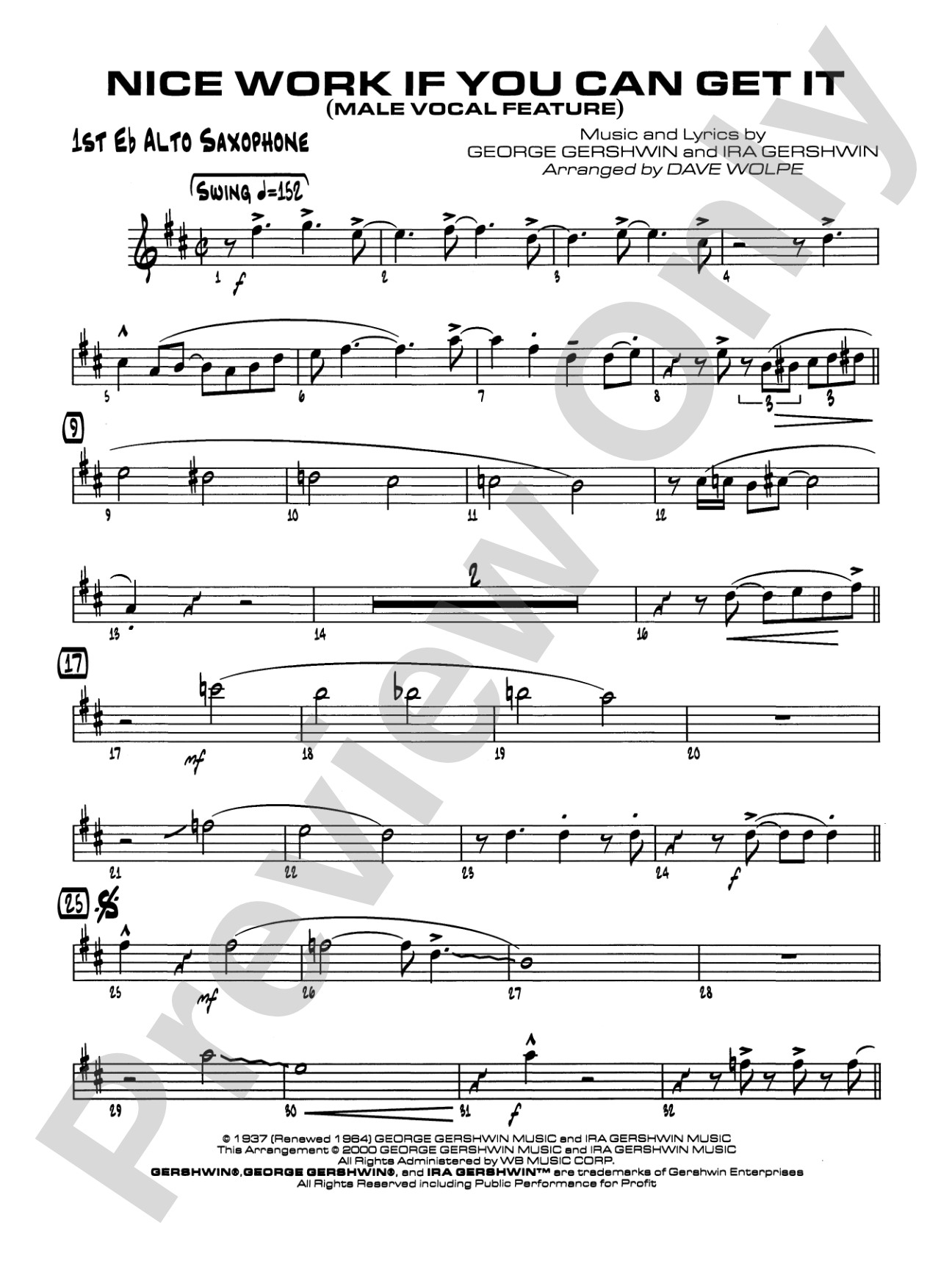

Nice Work If You Can Get It: E-flat Alto Saxophone
Vocal Feature
By George Gershwin / arr. Dave Wolpe
Grade: 3 (Medium)
Item: 00-PC-0014740_AX1
$3.00
Pickup currently not available
Description
A great combination of Gershwin and Wolpe! This vocal solo with big band chart is written in two different keys for your flexibility---it works for your female or male vocalist. A great Gershwin song with wonderful lyrics, this chart has reversible parts---just flip the page for female or male vocal key. Scored with easy vocal ranges, tasty backgrounds, a tenor sax solo and a swinging ensemble, it's the perfect chart for any concert or dance. (Male vocal in F, female vocal in C)


Don't just read it, hear it, play along with it, and watch your students grow with it. In MakeMusic Cloud, Nice Work If You Can Get It: E-flat Alto Saxophone comes alive with professional accompaniment, adjustable tempo, and built-in practice tools that turn solo practice into real progress.
Open in the Player
Jump straight in and assign it today.
Start Your Free Trial
Open this title and explore the full library in minutes.
Sample Audio
1
Audio File
--:--
0:00
0:00
Sample Video
No sample videos found.
Additional Details
Series:
Jazz Vocal Series
Publisher:
Alfred Music
Page Count:
80
SKU:
00-PC-0014740_AX1
More about this title
About the Composer: George Gershwin
George Gershwin (1898-1937) bridged classical and popular music in ways that transformed American concert music. His ability to write memorable melodies with sophisticated harmonic language made him one of the most performed composers in the world, and his influence on jazz-inflected classical writing remains unmatched nearly a century later.
Gershwin's Broadway songs are part of the standard repertoire precisely because they work at multiple levels. Whether heard as pure melody, as harmonic study, or as vehicles for improvisation and arrangement, they reveal new dimensions with each encounter. For music educators, his music offers students access to a composer whose work demonstrates that popular and concert traditions can coexist with integrity.
Why we love this
Dave Wolpe's arrangement treats the melody with genuine respect while building an arrangement that swings naturally and gives every section something musical to do. The reversible vocal parts eliminate the need for two separate charts, making this practical for programs where casting happens late or where you want to showcase both a male and female vocalist across a season.
What to expect
Gershwin's "Nice Work If You Can Get It" sits in that sweet spot between Broadway sophistication and genuine swing. This arrangement captures the optimistic wit of the song while letting the ensemble breathe around the vocal line, creating an energetic but never frantic energy that feels like a classic jazz club moment.
Who it's for
This arrangement works for jazz ensembles with a strong vocalist and competent rhythm section. Whether you're programming a concert, a swing dance, or a show that needs a Gershwin standard, this chart accommodates both higher and lower voices without transposition.
How to get the most out of it
- Balance the vocal line clearly over the ensemble backgrounds, particularly in the verse where the harmonic movement supports but shouldn't overshadow the lyrical content.
- Lock the tenor sax solo with the rhythm section by having your drummer sit in rehearsals and work that section until the phrasing feels integrated rather than spotlit.
- Shape the dynamics across the full form so that the ensemble builds gradually toward the final statement rather than playing at a consistent level throughout.
- Encourage your vocalist to articulate the lyrics conversationally, letting the Gershwin melody serve the words rather than treating the tune as a vehicle for display.
How to use it
Program this as a concert centerpiece or as a bridge between a more serious set and a finale that brings the audience into the room. It also serves beautifully in a show context where you need a solo vocalist featured with full band support, or in a jazz festival where a strong melodic statement with ensemble color makes an impression.
Skills your students will build
- Balancing vocal melody against jazz ensemble accompaniment
- Reading and executing swing rhythms and articulation
- Following a conductor's interpretation of tempo and dynamics across a longer form
- Understanding how ensemble backgrounds support rather than compete with a featured soloist
- Adapting to transposition (reading the same chart in two different keys)