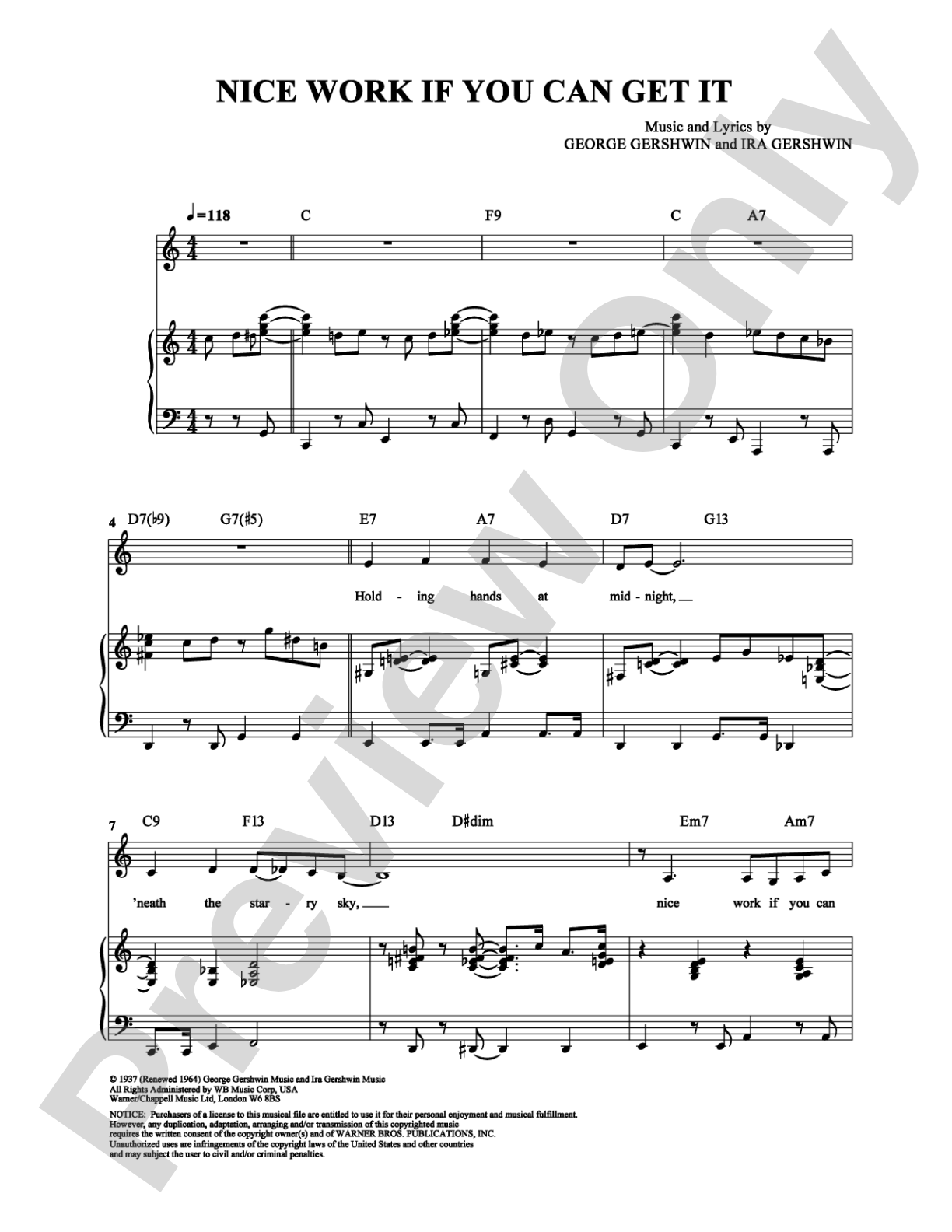
Nice Work If You Can Get It: Piano/Vocal/Chords Digital Sheet Music

Nice Work If You Can Get It: Piano/Vocal/Chords Digital Sheet Music

George Gershwin, Ira Gershwin, Ella Fitzgerald

Item: 00-PS-0004569

Digital Download
$3.99
Description

Nice Work If You Can Get It: Piano/Vocal/Chords Digital Sheet Music isn't in MakeMusic Cloud just yet...but it could be. Let us know you'd like to see it, and you'll help shape what comes next. In the meantime, start a free trial and dive into thousands of interactive titles your students can play along with today.

Sample Audio
No sample audio found.
Sample Video
Additional Details
SKU: 00-PS-0004569

More about this title

About the Artist: Ella Fitzgerald

Ella Fitzgerald (1917-1996) was one of the most influential jazz vocalists in American music history, known for her impeccable intonation, rhythmic precision, and ability to interpret the Great American Songbook with both technical mastery and emotional depth. Her influence on jazz singing and standard interpretation remains central to vocal pedagogy today, making her recordings essential listening for students studying phrasing, swing, and the art of accompanying a vocalist.

Why we love this

Fitzgerald's definitive recording of this Gershwin standard offers pianists and vocalists a masterclass in how to handle a sophisticated melody with natural swing and conversational phrasing. The chord changes are accessible yet musically rich, making it ideal for intermediate pianists learning to comp jazz changes while supporting a vocalist.

What to expect

Breezy and sophisticated, with a touch of romantic optimism. The melody floats naturally over warm, bluesy harmonies, and the whole piece swings with the ease of someone who knows exactly what they're doing—no strain, just musical confidence and charm.

Who it's for

Vocalists and pianists working at the intermediate to advanced level who are building their jazz standards repertoire and want to learn from one of the definitive interpretations of this repertoire. This is also valuable for piano students studying jazz voicing and comp technique in a real musical context.

How to get the most out of it

  • Anchor the groove with the walking bass line in your left hand, keeping it conversational rather than metronomic; let the vocal melody breathe above a relaxed harmonic foundation.
  • Listen closely to Fitzgerald's phrasing on recordings to understand where she sits slightly behind the beat and where she pulls ahead; this rubato is essential to the style.
  • Voice your chord extensions (ninths, thirteenths) smoothly to capture the sophistication of the Gershwin harmonies without cluttering the accompaniment.
  • Balance your comping texture between sparse moments (letting the vocalist shine) and fuller harmonic support on instrumental passages or when the melody needs grounding.

How to use it

This works beautifully in a jazz recital, American Songbook concert, or as a sophisticated encore piece. It pairs well with other Gershwin standards or other vocalists' interpretations of standards in a comparative listening program.

Skills your students will build

  • Jazz chord voicing and extensions (ninths, thirteenths)
  • Comping technique that supports rather than competes with the vocal line
  • Phrasing and rubato in swing style
  • Chord chart reading and interpretation
  • Collaboration skills between vocalist and accompanist

You May Also Like