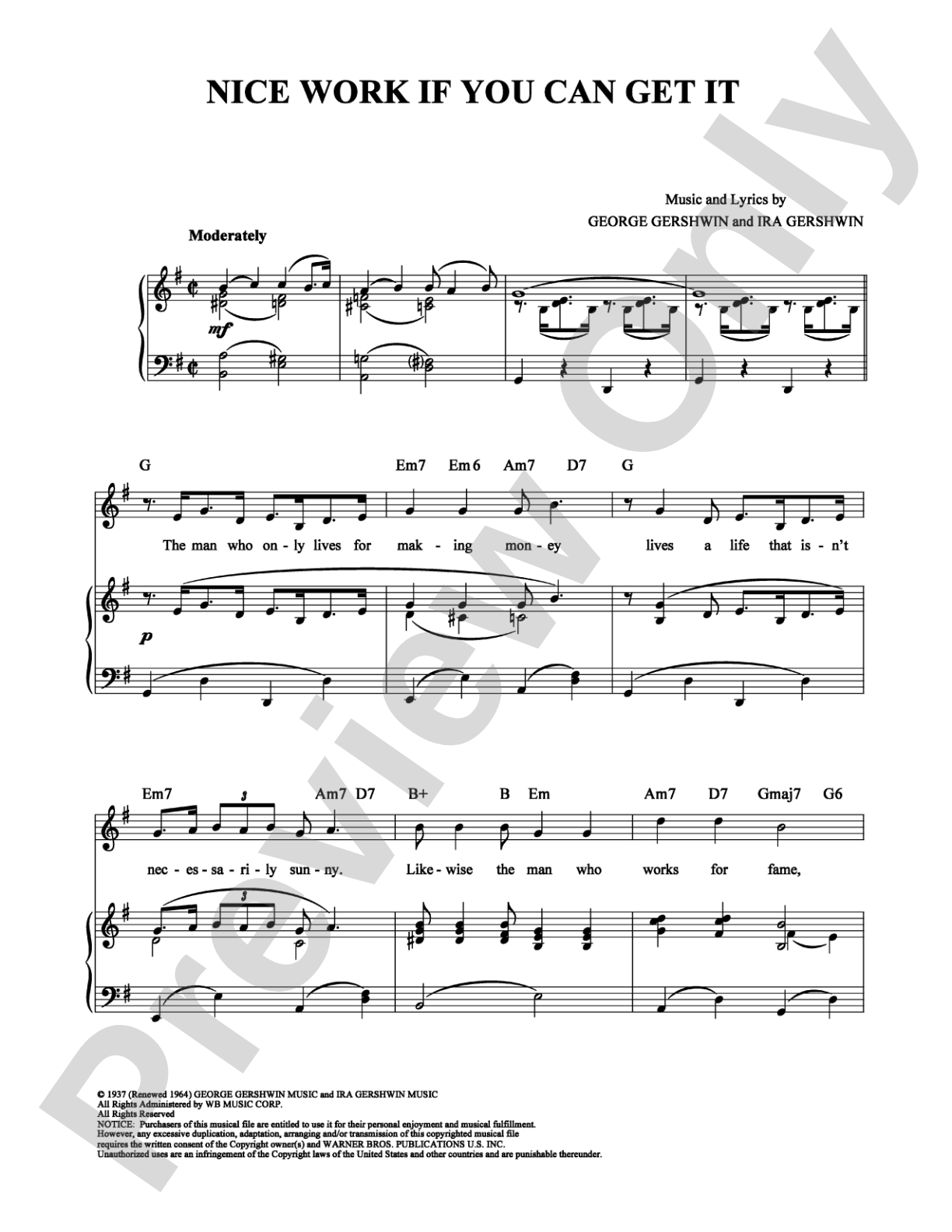
Nice Work If You Can Get It: Piano/Vocal/Chords Digital Sheet Music

Nice Work If You Can Get It: Piano/Vocal/Chords Digital Sheet Music

George Gershwin, Fred Astaire, The Andrews Sisters

Item: 00-PS-0001156

Digital Download
$3.99
Description

Nice Work If You Can Get It: Piano/Vocal/Chords Digital Sheet Music isn't in MakeMusic Cloud just yet...but it could be. Let us know you'd like to see it, and you'll help shape what comes next. In the meantime, start a free trial and dive into thousands of interactive titles your students can play along with today.

Sample Audio
No sample audio found.
Sample Video
Additional Details
SKU: 00-PS-0001156

More about this title

About the Artist: Fred Astaire

Fred Astaire (1899-1987) was an American dancer, singer, and actor whose influence on popular music and performance extended far beyond the stage and screen. His recordings with various ensembles, including the Andrews Sisters, shaped the sound of American popular music in the 1930s and 1940s. Astaire's approach to interpreting song emphasized clarity, rhythm, and emotional directness, qualities that made his vocal recordings enduring models for singers learning the American songbook.

Why we love this

This is a tune that works equally well in a jazz-inflected arrangement or stripped down to its harmonic essentials, making it a genuine teaching resource rather than a novelty. The melody sits naturally for voices across a range of part types, and the chord progression gives students real material to work with when exploring jazz harmony and comping patterns. Vocalists benefit from text that's conversational and rhythmically flexible, while pianists get a piece that rewards attention to voicing and rhythmic independence between hands.

What to expect

Sophisticated without pretension. The lyric's witty observation about life and success sits on top of a jazz-influenced melody that feels both chatty and composed. There's a lightness to it, an ease that comes from genuinely good songwriting rather than novelty or sentiment.

Who it's for

This sheet music serves singers learning the American popular songbook and pianists who want to accompany vocalists in standards. It's equally useful for students exploring jazz harmony or building arrangements, since the chord structure is clear and the melody is simple enough to modify without losing its character.

How to get the most out of it

  • Listen closely to how the original recording handles the swing feel and syncopation, then decide whether your interpretation leans into that groove or takes a different approach. Either way, consistency matters more than strict adherence to the recording.
  • Pay attention to the lyrical phrasing over the bar lines. Words like "nice work" and "if you can get it" ask for specific rhythmic placement that affects how the melody lands against the harmony.
  • In the piano part, resist the urge to fill every space. The song's charm comes partly from what's left unsaid between vocal phrases.
  • Experiment with the chord voicings to match your arrangement style. Block voicings feel one way; spread voicings feel another. Choose based on the mood you want.

How to use it

Feature this in a cabaret or jazz-focused recital, or pair it with other songs from the Great American Songbook as part of a vocal recital set. It also works in an ensemble arrangement context, where students can study how the Andrews Sisters handled vocal harmony over swing-inflected chords. For music theory classes, the chord progression is strong enough to support analysis and reharmonization exercises.

Skills your students will build

  • Interpreting syncopation and swing rhythms in a vocal melody
  • Reading and voicing jazz chords on piano
  • Balancing melody phrasing with harmonic rhythm
  • Analyzing and applying the structure of a 32-bar popular song
  • Comping techniques that support rather than compete with the vocalist

You May Also Like