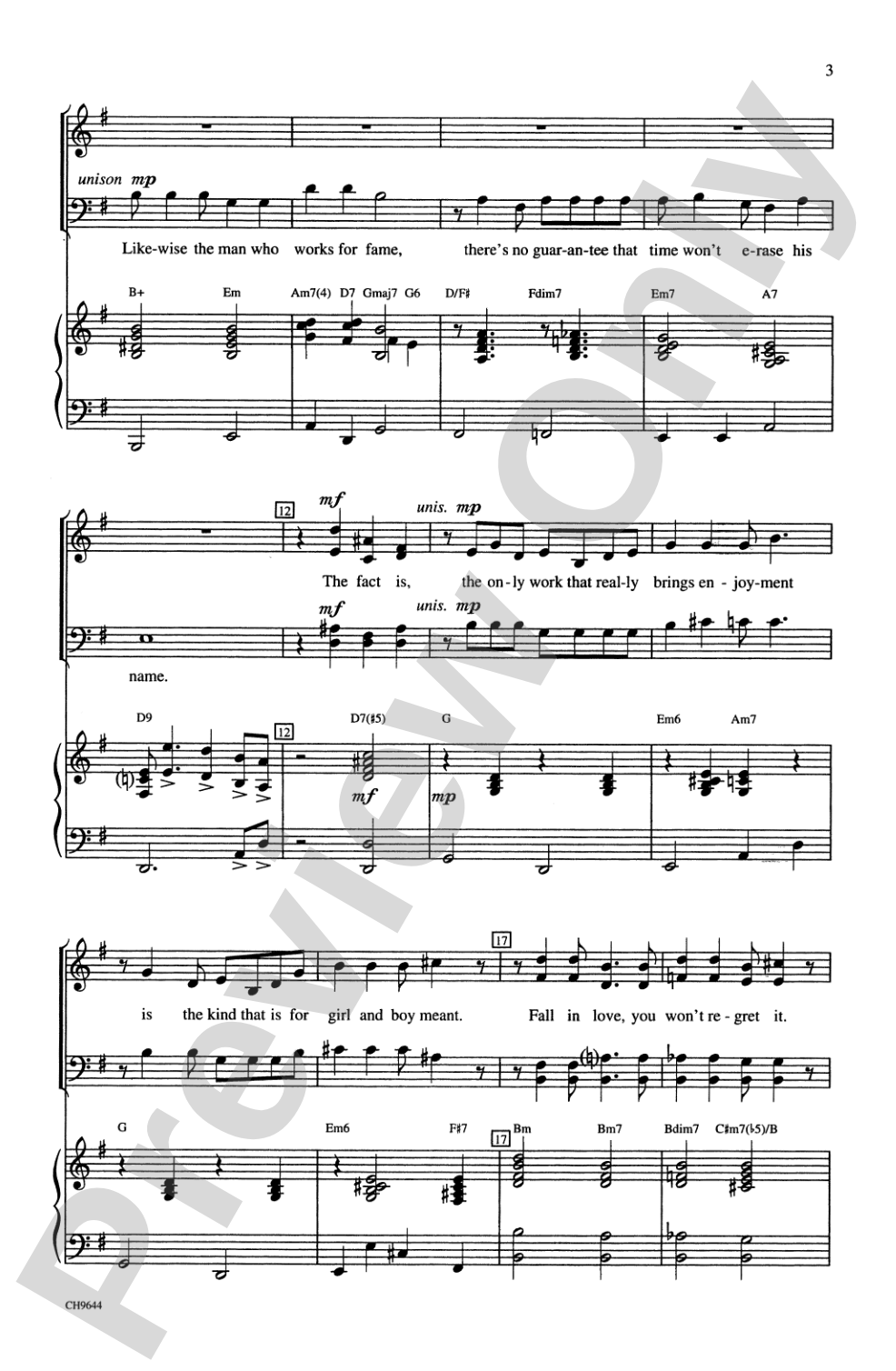
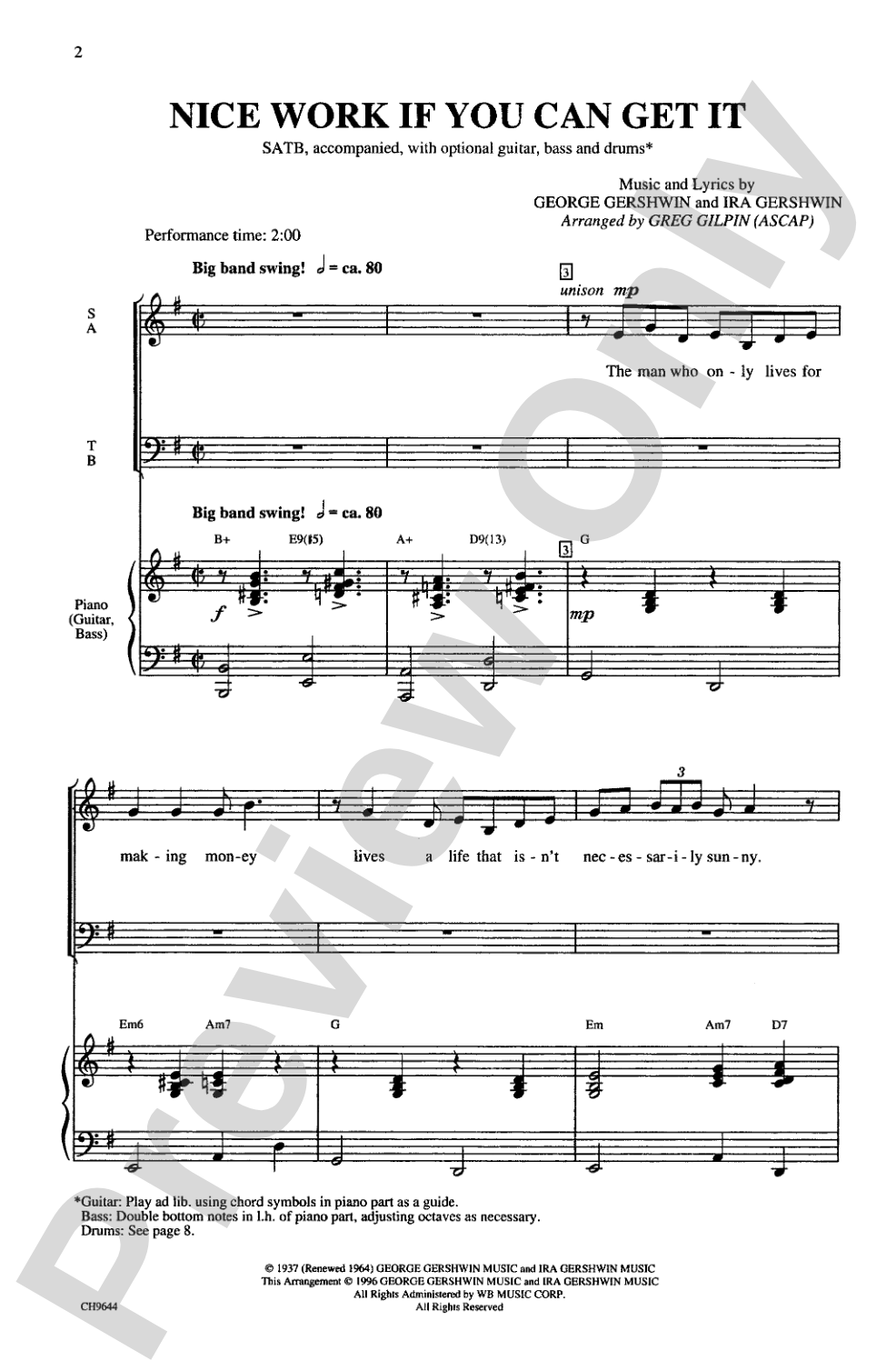
Nice Work If You Can Get It Sheet Music Preview

Nice Work If You Can Get It: SATB Choral Octavo

By George Gershwin and Ira Gershwin / arr. Greg Gilpin

Level: Moderate

Item: 00-PO-0004708

Digital Download
$2.25

Minimum order quantity: 20 copies

One moment…

Description
The George Gershwin and Ira Gershwin song that appears in the Broadway show Crazy for You was also featured in My One And Only. Now it's a part of our Great Songwriters Series. This work is a super addition to any concert, or you can add some choreography and use it as a showy feature number!

Nice Work If You Can Get It: SATB Choral Octavo isn't in MakeMusic Cloud just yet...but it could be. Let us know you'd like to see it, and you'll help shape what comes next. In the meantime, start a free trial and dive into thousands of interactive titles your students can play along with today.

Sample Audio
No sample audio found.
Sample Video
Additional Details
Series: Alfred Archive Edition: Alfred Pop Choral Series
Publisher: Alfred Music
Page Count: 8
SKU: 00-PO-0004708

More about this title

About the Composer: George Gershwin

George Gershwin (1898–1937) bridged classical and popular music in ways that few composers have managed. His gift for melody and harmonic sophistication made him a defining voice of the American songbook, and his work with lyricist Ira Gershwin produced some of the most durable standards in theater and concert music.

For music educators, Gershwin's catalog offers accessible entry points into 20th-century composition. His melodies sit naturally in the voice, his harmonies reward close listening, and his rhythmic language feels contemporary even now. Teaching his work means teaching American musical identity.

Why we love this

Greg Gilpin's arrangement captures the breezy optimism of Gershwin's tune while giving each voice part genuine interest. The moderate difficulty level makes it realistic for most high school choirs, and the built-in choreography potential means you can program this as either a concert number or a full-stage feature without extra work. It's the kind of piece that energizes both singers and audiences.

What to expect

Bright, witty, and just a touch sophisticated. There's a lightness to the piece that comes from Gershwin's gift for melody, but the harmonies underneath have real depth. When sung well, it should feel like a conversation among friends who know how to have fun without being loud about it.

Who it's for

High school choirs at the intermediate to confident level will find this arrangement sits right in their wheelhouse. The SATB voicing is standard, the ranges are sensible, and the harmonic language is sophisticated enough to teach voice independence without overwhelming the singers. Directors programming a spring concert, musical theater showcase, or assessment festival will find this a reliable crowd-pleaser that also has substance.

How to get the most out of it

  • Establish a relaxed, conversational tone from the opening phrase. This song lives in understatement, so resist the urge to oversing or over-articulate.
  • Balance the inner voices carefully during the harmony passages. The melody will take care of itself if sopranos and altos lock in their support beneath it.
  • If you stage movement or choreography, rehearse the singing and staging separately at first, then layer them together only once the choir is secure with the music. Divided attention early will cloud both.
  • Use the recorded accompaniment to establish the exact swing feel and tempo. Gershwin's rhythms are deceptively tricky, and the recording anchors the ensemble's confidence.

How to use it

Program this alongside other American songbook standards from the early 20th century to build a mini-concert arc through Gershwin, Rodgers and Hart, or Cole Porter. It pairs well with both comedic numbers and more balladic pieces because it occupies the middle ground. For a musical theater showcase or pops concert, it's a natural centerpiece; for a formal spring concert, it works as a relaxed palate-cleanser between heavier choral works.

Skills your students will build

  • Swing rhythm and syncopation in an SATB context
  • Voice independence in four-part harmony with stepwise inner voice movement
  • Coordinate ensemble singing with choreography or staged movement
  • Interpretation of jazz-influenced harmonic language typical of American popular song

You May Also Like