
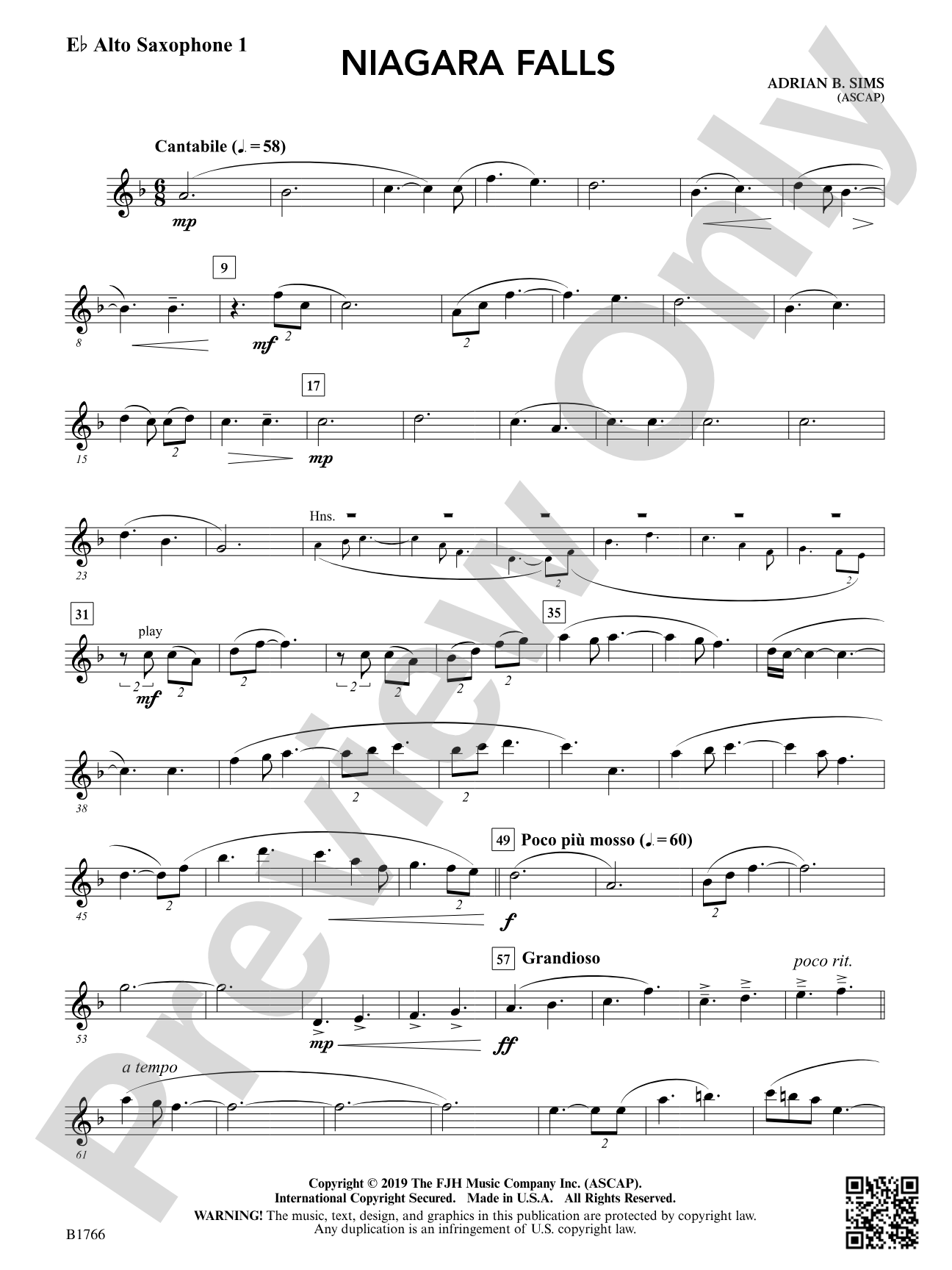

Niagara Falls: E-flat Alto Saxophone 1
By Adrian B Sims
Grade: 3.5
Item: 98-PC-DB1766_AX1
$7.00
Pickup currently not available
Description
With flowing melodic lines and rich harmonic textures throughout, this work depicts a beautiful journey down the Niagara River. As the river gains strength, the music gradually builds in intensity until it gives way to the awe-inspiring view of Niagara Falls. Exceptional writing by a young composer, and a great way to expose your students to music by one of their peers.


Niagara Falls: E-flat Alto Saxophone 1 isn't in MakeMusic Cloud just yet...but it could be. Let us know you'd like to see it, and you'll help shape what comes next. In the meantime, start a free trial and dive into thousands of interactive titles your students can play along with today.
Request This Title
Tell us you want it.
Start Your Free Trial
Explore everything that's ready to play right now.
Sample Audio
1
Audio File
--:--
0:00
0:00
Sample Video
Additional Details
Series:
FJH Concert Band
Publisher:
The FJH Music Company, Inc.
SKU:
98-PC-DB1766_AX1
More about this title
About the Composer: Adrian B Sims
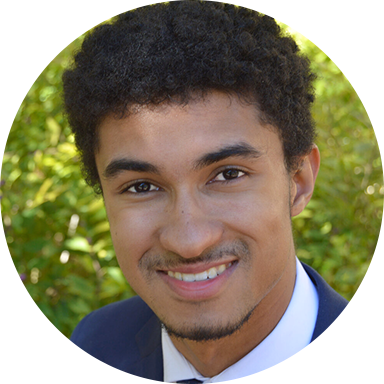
Adrian B Sims (b. 2000) grew up in Seattle before his family relocated to Maryland, where he completed his secondary education at Catonsville High School in 2018. A composer, conductor, educator, and trombonist, Sims has already secured performances at The Midwest Band and Orchestra Clinic and earned recognition on the Bandworld Top 100 List. He has won multiple composition competitions, including the Maryland Music Educators Association Young Composers Project and the Make Music Young Composers Contest, and has conducted his own works in performances across Maryland schools.
As a performer, Sims has participated in pit orchestras, symphony orchestras, jazz ensembles, and concert bands at the highest levels. During his high school years, he earned multiple selections to the Maryland All-State Band and performed alongside the Baltimore Symphony Orchestra. He currently studies at the University of Maryland, where he performs in the top ensembles on trombone and pursues a dual degree in Music Education and Composition under the mentorship of Dr. Robert Gibson and world-renowned composer Brian Balmages. He studies trombone with Matthew Guilford, solo bass trombonist with the National Symphony Orchestra.
Why we love this
Sims writes with a compositional maturity that belies his age, crafting a narrative arc that feels genuinely earned rather than merely descriptive. The programmatic journey from river to falls unfolds through sophisticated harmonic choices and orchestration that rewards careful listening, making this an ideal piece for helping your students understand how structure and instrumentation can serve storytelling in band music. Programming work by young composers validates your students' own creative ambitions while maintaining artistic integrity.
What to expect
The opening unfolds with gentle, flowing lines that evoke the quiet beginning of the river. As harmonic textures deepen and the arrangement gains layering, energy builds with increasing urgency, mirroring the river's accelerating power. The final section captures the majestic, almost overwhelming presence of the falls themselves, creating a moment of genuine awe.
Who it's for
Concert bands working at the Grade 3.5 level who want repertoire that combines strong compositional technique with accessible performance demands. This piece serves directors seeking to expose students to contemporary voices in band music and to demonstrate that compelling programmatic writing exists at mid-level difficulty.
How to get the most out of it
- Shape the opening melody with patient phrasing; the flowing character depends on legato lines that breathe naturally rather than rush forward.
- Balance the gradual dynamic build carefully across all sections so the crescendo feels inevitable rather than sudden, allowing the final climax to land with genuine impact.
- Use the harmonic depth to your advantage during rehearsals by isolating sections and identifying where inner voices support or color the primary melodic line.
- Let the programmatic journey guide your interpretation; understand where the river transitions from gentle flow to turbulent power so your conducting gestures convey that energy shift to the ensemble.
How to use it
This pairs well with other programmatic concert band works on a concert exploring nature or landscape themes. Its Grade 3.5 difficulty makes it accessible enough for mid-year programming while sophisticated enough to anchor a concert alongside more substantial works. Consider pairing it with works by other young composers to create a meaningful context for celebrating emerging voices in band composition.
Skills your students will build
- Sustaining musical narrative across longer formal structures
- Balancing individual voice integrity within full ensemble textures
- Executing controlled dynamic growth over gradual increases in intensity
- Recognizing compositional devices that support programmatic storytelling
- Responding to conductor gesture that conveys character and emotional arc