
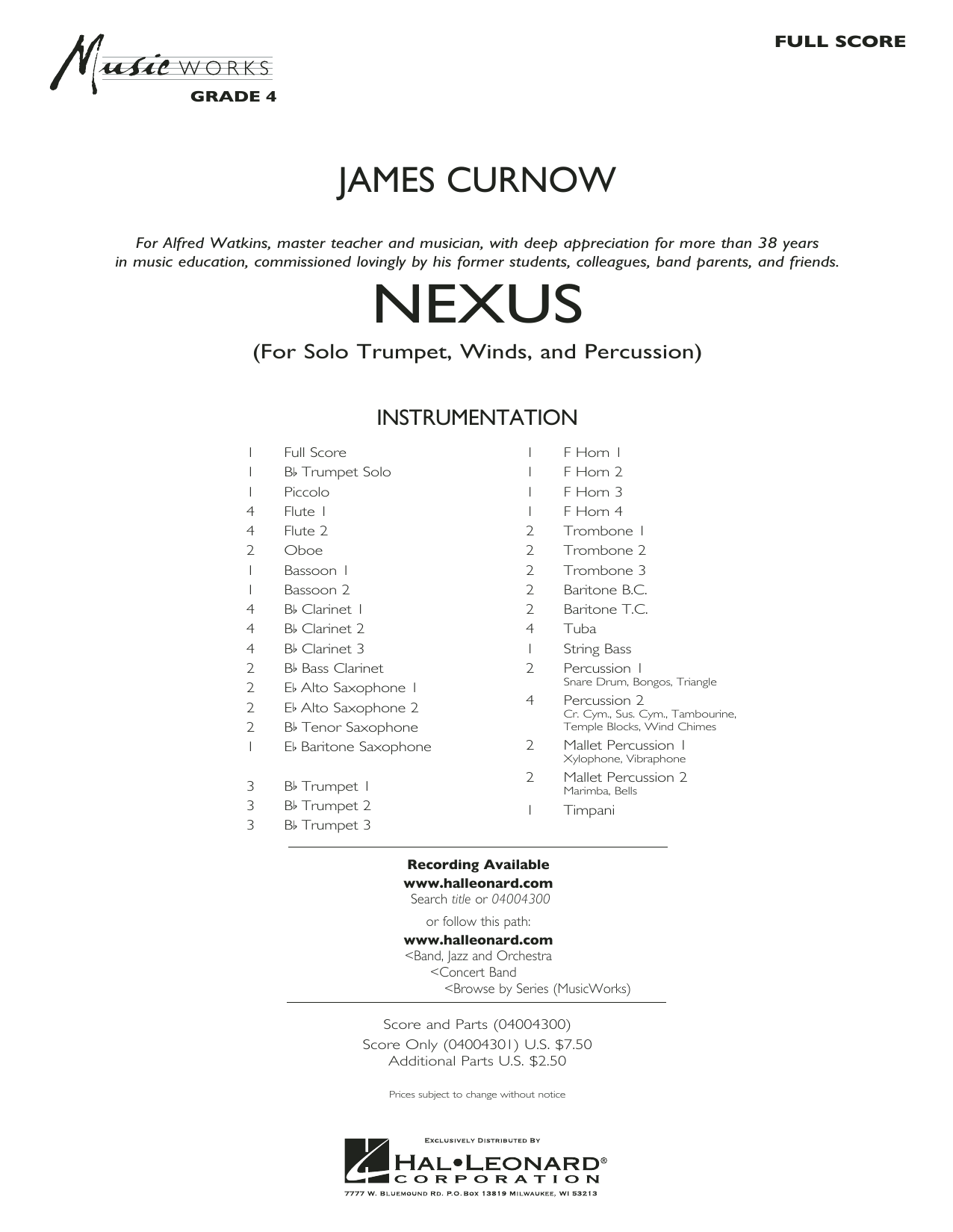

Nexus: Concert Band Conductor Score & Parts
By James Curnow
Grade: 4
Item: 35-PK00311693
$85.00
Pickup currently not available
Buy Extra Parts (Digital PDF Download)
| Product | Price | Quantity |
|---|---|---|
| Nexus - Conductor Score (Full Score) | $7.50 | |
| Nexus - Bb Trumpet Solo | $6.00 | |
| Nexus - Piccolo | $6.00 | |
| Nexus - Flute 1 | $6.00 | |
| Nexus - Flute 2 | $6.00 | |
| Nexus - Oboe | $6.00 | |
| Nexus - Bassoon 1 | $6.00 | |
| Nexus - Bassoon 2 | $6.00 | |
| Nexus - Bb Clarinet 1 | $6.00 | |
| Nexus - Bb Clarinet 2 | $6.00 | |
| Nexus - Bb Clarinet 3 | $6.00 | |
| Nexus - Bb Bass Clarinet | $6.00 | |
| Nexus - Eb Alto Saxophone 1 | $6.00 | |
| Nexus - Eb Alto Saxophone 2 | $6.00 | |
| Nexus - Bb Tenor Saxophone | $6.00 | |
| Nexus - Eb Baritone Saxophone | $6.00 | |
| Nexus - Bb Trumpet 1 | $6.00 | |
| Nexus - Bb Trumpet 2 | $6.00 | |
| Nexus - Bb Trumpet 3 | $6.00 | |
| Nexus - F Horn 1 | $6.00 | |
| Nexus - F Horn 2 | $6.00 | |
| Nexus - F Horn 3 | $6.00 | |
| Nexus - F Horn 4 | $6.00 | |
| Nexus - Trombone 1 | $6.00 | |
| Nexus - Trombone 2 | $6.00 | |
| Nexus - Trombone 3 | $6.00 | |
| Nexus - Baritone B.C. | $6.00 | |
| Nexus - Baritone T.C. | $6.00 | |
| Nexus - Tuba | $6.00 | |
| Nexus - String Bass | $6.00 | |
| Nexus - Percussion 1 | $6.00 | |
| Nexus - Percussion 2 | $6.00 | |
| Nexus - Mallet Percussion 1 | $6.00 | |
| Nexus - Mallet Percussion 2 | $6.00 | |
| Nexus - Timpani | $6.00 |
Parts Added to Cart!
Description
The word "nexus" is defined as a tie or link between people and events. "Nexus", for solo trumpet and band, includes several links between composer James Curnow and educator Alfred Watkins, to whom the work is dedicated. A well-known theme (particularly to Mr. Watkins' students) is drawn upon as the piece utilizes two primary musical settings -an energetic and agile scherzo that appears in the beginning and again at the end, contrasted with an expressive "Ballad" theme.
The soloist at the premiere (and on the recording) is Christopher Watkins, Alfred's son. This is a well-crafted and rewarding work for soloist and band alike.
Dur: 6:00


Nexus: Concert Band Conductor Score & Parts isn't in MakeMusic Cloud just yet...but it could be. Let us know you'd like to see it, and you'll help shape what comes next. In the meantime, start a free trial and dive into thousands of interactive titles your students can play along with today.
Request This Title
Tell us you want it.
Start Your Free Trial
Explore everything that's ready to play right now.
Sample Audio
No sample audio found.
Sample Video
No sample videos found.
Additional Details
Publisher:
Hal Leonard
SKU:
35-PK00311693
More about this title
About the Composer: James Curnow
James Curnow is a prolific composer and arranger whose catalog spans concert band, wind ensemble, orchestra, and chamber music. His works are performed internationally and appear regularly on festival and contest programs. Curnow has distinguished himself through clear orchestration, memorable thematic writing, and pieces that challenge musicians while remaining teachable at their intended levels.
Why we love this
Curnow structures this work as a genuine partnership between soloist and ensemble, never relegating the band to accompaniment role. The scherzo and ballad frame creates natural dramatic arc, and the fact that it draws on a theme meaningful to the dedicatee Alfred Watkins adds real humanity to the piece. Your trumpet section and your lead player both get satisfying musical material.
What to expect
Bright and athletic in the outer scherzo sections, with sharp rhythmic articulation and spiraling trumpet lines that demand precision and clarity. The central ballad pulls back into intimate territory, letting the soloist sing over warm band harmonies before the return to that energetic opening feel. The overall effect is one of connection and contrast, balancing virtuosity with genuine lyricism.
Who it's for
Bands at the Grade 4 level fielding a strong principal trumpet player. This work assumes technical security from the lead trumpet but is equally rewarding as a confidence builder for a capable soloist stepping into a longer, more dramatically complex role. It works well for ensembles preparing for festival performance.
How to get the most out of it
- Prepare the trumpet soloist separately on the ballad section first. The lyricism there sets the emotional anchor for the entire work, so secure that before tackling the scherzo's agility.
- Balance the band texture during the scherzo so the trumpet line cuts through cleanly without the ensemble drowning it out. This is a feature moment, not a tutti.
- Let the ballad breathe. Resist the urge to rush the tempo. Curnow's expressive writing rewards patience and support from the band.
- Use the recorded accompaniment track to help the soloist internalize the relationships between the scherzo sections and understand how the band colors shift around the trumpet line.
How to use it
This fits naturally on a concert exploring the soloist tradition in band music, pairing well with other concertante works. Its six-minute duration makes it an ideal centerpiece for a program that builds from simpler ensemble work into more ambitious territory. Consider programming it as your feature piece in the second half once the band is warmed up and focused.
Skills your students will build
- Balancing transparent orchestration with clear solo line projection
- Executing rapid scalar and arpeggio figures (trumpet) with rhythmic precision
- Sustaining legato phrasing across longer melodic statements
- Responding to tempo and style shifts between contrasting formal sections
- Ensemble listening when the solo instrument carries primary melodic interest