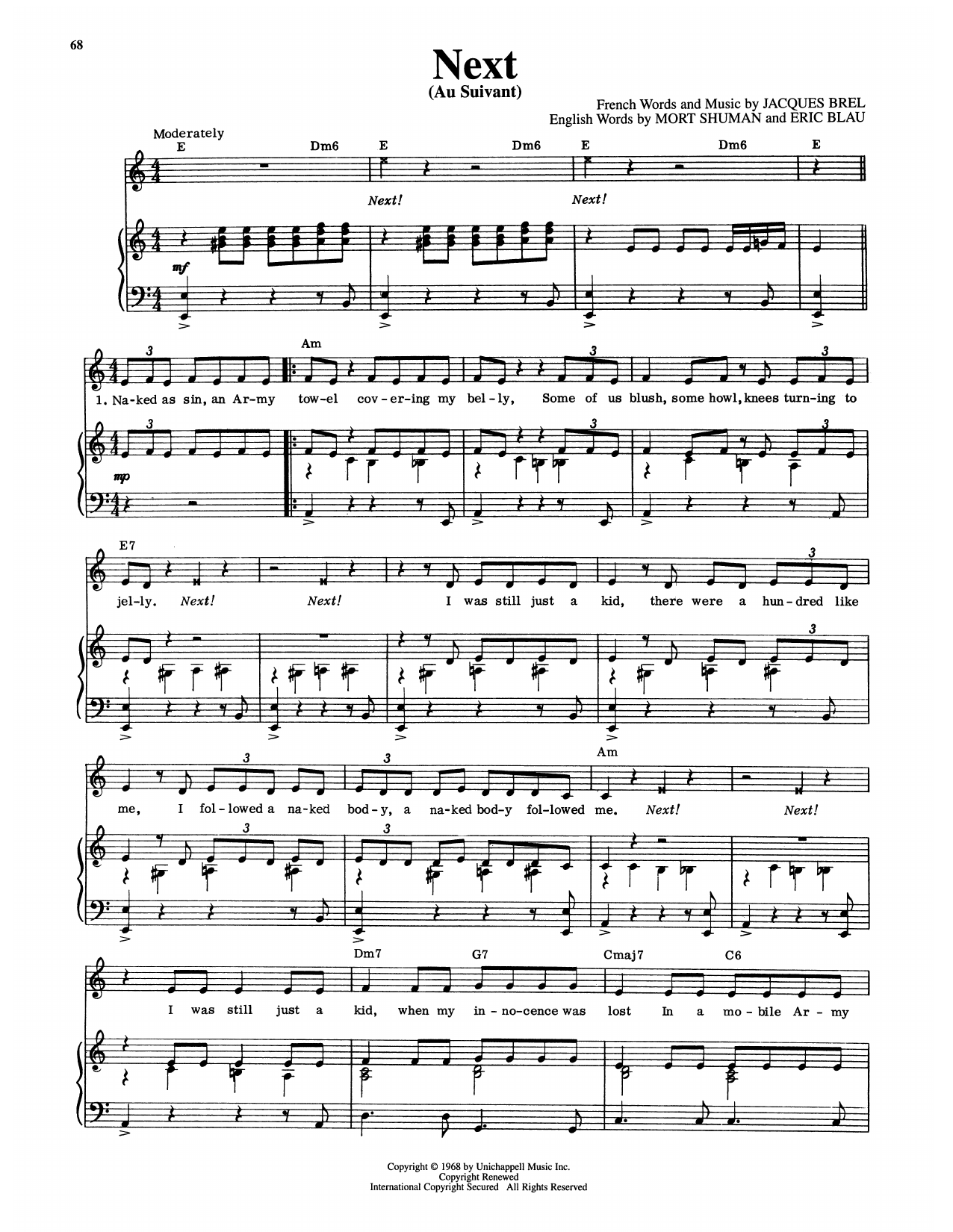
Next (Au Suivant) (from Jacques Brel Is Alive And Well And Living In Paris) Sheet Music Preview

Next (Au Suivant) (from Jacques Brel Is Alive And Well And Living In Paris): Piano Vocal

By Jacques Brel / As performed by Eric Blau

Item: 35-DS01740740

Digital Download
$5.99
Description

Next (Au Suivant) (from Jacques Brel Is Alive And Well And Living In Paris): Piano Vocal isn't in MakeMusic Cloud just yet...but it could be. Let us know you'd like to see it, and you'll help shape what comes next. In the meantime, start a free trial and dive into thousands of interactive titles your students can play along with today.

Sample Audio
No sample audio found.
Sample Video
Additional Details
Publisher: Hal Leonard
Page Count: 2
SKU: 35-DS01740740

More about this title

About the Composer: Jacques Brel

Jacques Brel was a Belgian-French singer, songwriter, and actor whose work fundamentally shaped the modern chanson. Writing primarily in French, he crafted songs of remarkable emotional depth that explored themes of love, loss, social alienation, and human connection with unflinching honesty. His influence extends far beyond the cabaret stages where he first performed; his compositions have been adapted into concert pieces, Broadway productions, and arrangements across genres, making him one of the most recorded songwriters in history.

Brel's theatrical sensibility and poetic sophistication made him a natural fit for staged musical work. The 1968 off-Broadway revue Jacques Brel Is Alive And Well And Living In Paris introduced English-speaking audiences to his catalog through English lyrics by Eric Blau and Mort Shuman. That production remains a cornerstone of musical theater education, offering singers and directors access to Brel's profound artistry while demonstrating how translation and theatrical adaptation can honor a composer's original vision.

Why we love this

This piece carries the weight of Brel's most distinctive gift: the ability to excavate genuine emotion from simple, direct language. The piano accompaniment sits comfortably within reach of developing musicians while the vocal line demands real interpretive maturity, making it an ideal anchor for a mature cabaret program or a recital exploring songs of consequence.

What to expect

The song unfolds with quiet intensity, creating moments of vulnerability punctuated by underlying tension. There's a conversational quality to the melody, as if Brel is speaking directly to you across a small table in a dimly lit room, sharing something he's never quite managed to say before.

Who it's for

Advanced high school vocalists, college singers, and professional performers who are ready to engage with mature theatrical material and who understand that Brel's work requires emotional honesty over technical display. This works equally well in a recital setting, a cabaret program, or as part of a dedicated Jacques Brel evening.

How to get the most out of it

  • Resist the urge to push the tempo. Brel's songs live in stillness and restraint; clarity and breath matter more than forward momentum.
  • Shape the text with the same attention you'd give a poem. Word stress and phrasing come before vocal production.
  • Let the piano part breathe independently. This isn't accompaniment in the traditional sense but rather a conversation between voice and instrument.
  • Study recordings of Brel himself or singers deeply familiar with his idiom (such as Damien Sargue or Rufus Wainwright) to absorb the emotional architecture beneath the surface.

How to use it

Pair this with other songs from the Jacques Brel revue to create a self-contained program focused on a single composer's vision, or use it as a centerpiece in a cabaret or art song recital alongside other 20th-century song cycles. Its emotional weight makes it particularly effective as the closing number of an evening.

Skills your students will build

  • Interpretive phrasing rooted in text and emotional truth rather than melodic shape alone
  • Sustaining vulnerability in performance without technical display
  • Collaborative listening between vocalist and accompanist
  • Understanding translation and adaptation in musical theater context

You May Also Like