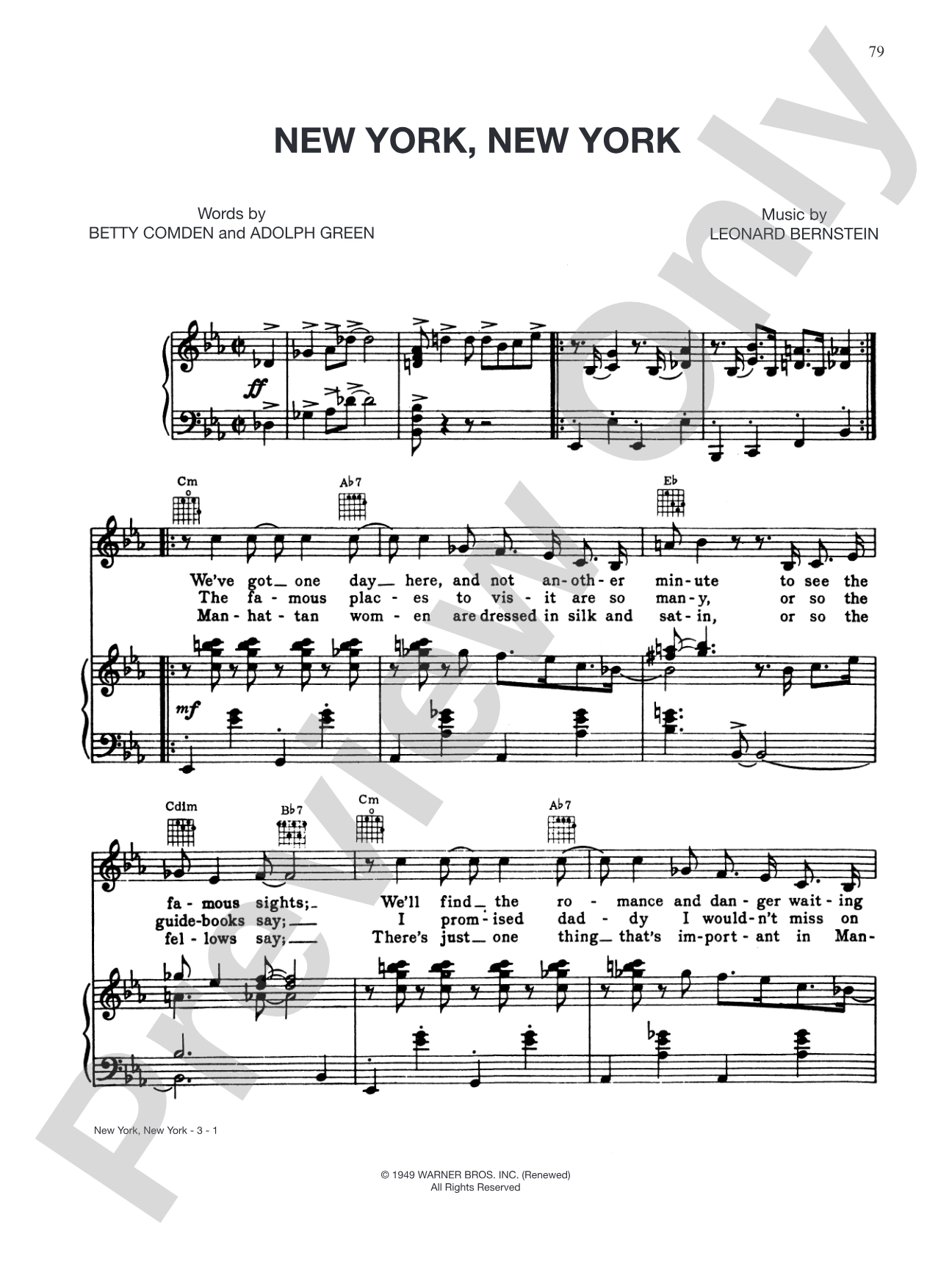
New York, New York Sheet Music Preview

New York, New York: Piano/Vocal/Chords

By Leonard Bernstein

Item: 00-PIP-000086

Digital Download
$3.99

One moment…

Description

New York, New York: Piano/Vocal/Chords isn't in MakeMusic Cloud just yet...but it could be. Let us know you'd like to see it, and you'll help shape what comes next. In the meantime, start a free trial and dive into thousands of interactive titles your students can play along with today.

Sample Audio
No sample audio found.
Sample Video
Additional Details
Series: Deluxe Edition
Publisher: Alfred Music
Page Count: 4
SKU: 00-PIP-000086

More about this title

About the Composer: Leonard Bernstein

Leonard Bernstein (1918-1990) was an American conductor, composer, and educator whose influence shaped twentieth-century musical life. He composed for Broadway, the concert hall, and film with equal facility, earning three Emmy Awards and a Grammy Lifetime Achievement Award. His gift for melody and his ability to blend vernacular American idioms with sophisticated orchestration made him a composer that performers and audiences alike embraced.

Why we love this

This is the definitive song from On the Town, and Bernstein's melody sits perfectly in the vocal range with a piano part that sings without overwhelming the singer. The arrangement captures the exuberance of the original orchestration while remaining accessible for accompaniment, making it equally effective in a recital, pops concert, or jazz ensemble setting.

What to expect

Infectious energy and New York swagger. The melody bounces with optimism and theatrical flair, while the harmonic movement beneath it suggests the urban sophistication Bernstein evoked in everything he wrote. It's a song that makes singers want to move and audiences want to sing along.

Who it's for

Singers preparing audition material, pops concert soloists, and jazz vocalists will find this arrangement immediately useful. Pianists accompanying voice students or recital performers need a version that honors both Bernstein's harmonic language and the practical demands of accompaniment.

How to get the most out of it

  • Approach the rhythmic character with natural swing and bounce; the energy comes from articulation and phrasing, not rushed tempo.
  • Balance the piano left hand to support harmonic motion without clouding the vocal line.
  • Lean into the chord symbols for interpretation; jazz voicings and reharmonization choices are characteristic of the style.
  • Shape the familiar melody with attention to lyrical intention; this song rewards singers who commit emotionally to the character and place.

How to use it

Program this as a finale to a musical theatre set, or use it to open a pops concert with immediate theatrical impact. It pairs well with other American songbook standards and works beautifully as a bridge between classical and contemporary repertoire in mixed programming.

Skills your students will build

  • Reading and interpreting jazz chord symbols
  • Balancing vocal line with piano accompaniment in chamber performance
  • Navigating syncopated rhythms in American musical theatre idiom
  • Stylistic interpretation of twentieth-century popular music within classical contexts

You May Also Like