
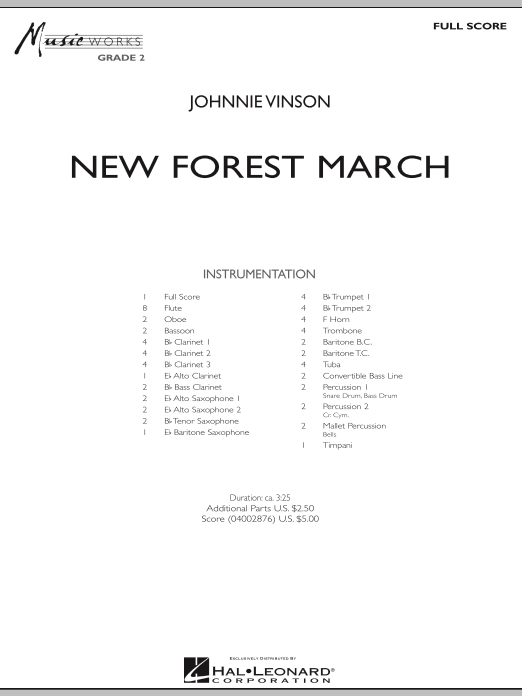

New Forest March: Concert Band Conductor Score & Parts
Arranged by Johnnie Vinson
Grade: 2
Item: 35-PK00125084
$65.00
Pickup currently not available
Buy Extra Parts (Digital PDF Download)
| Product | Price | Quantity |
|---|---|---|
| New Forest March - Full Score | $7.50 | |
| New Forest March - Flute | $6.00 | |
| New Forest March - Oboe | $6.00 | |
| New Forest March - Bassoon | $6.00 | |
| New Forest March - Bb Clarinet 1 | $6.00 | |
| New Forest March - Bb Clarinet 2 | $6.00 | |
| New Forest March - Bb Clarinet 3 | $6.00 | |
| New Forest March - Eb Alto Clarinet | $6.00 | |
| New Forest March - Bb Bass Clarinet | $6.00 | |
| New Forest March - Eb Alto Saxophone 1 | $6.00 | |
| New Forest March - Eb Alto Saxophone 2 | $6.00 | |
| New Forest March - Bb Tenor Saxophone | $6.00 | |
| New Forest March - Eb Baritone Saxophone | $6.00 | |
| New Forest March - Bb Trumpet 1 | $6.00 | |
| New Forest March - Bb Trumpet 2 | $6.00 | |
| New Forest March - F Horn | $6.00 | |
| New Forest March - Trombone | $6.00 | |
| New Forest March - Baritone B.C. | $6.00 | |
| New Forest March - Baritone T.C. | $6.00 | |
| New Forest March - Tuba | $6.00 | |
| New Forest March - Convertible Bass Line | $6.00 | |
| New Forest March - Percussion 1 | $6.00 | |
| New Forest March - Percussion 2 | $6.00 | |
| New Forest March - Mallet Percussion | $6.00 | |
| New Forest March - Timpani | $6.00 |
Parts Added to Cart!
Description
Here is a terrific march for young players written in the traditional British style. The opening strains are folk-like in nature with underlying modal harmonies, while the stately trio is reminiscent of the processional style of Elgar and other British composers. The "New Forest" refers to a region in southern England established as a royal hunting preserve by William the Conqueror around the year 1079, which has remained largely unchanged since ancient times. Dur: 2:10


New Forest March: Concert Band Conductor Score & Parts isn't in MakeMusic Cloud just yet...but it could be. Let us know you'd like to see it, and you'll help shape what comes next. In the meantime, start a free trial and dive into thousands of interactive titles your students can play along with today.
Request This Title
Tell us you want it.
Start Your Free Trial
Explore everything that's ready to play right now.
Sample Audio
No sample audio found.
Sample Video
No sample videos found.
Additional Details
Publisher:
Hal Leonard
SKU:
35-PK00125084
More about this title
About the Arranger: Johnnie Vinson
Johnnie Vinson is a prolific composer and arranger whose work spans concert band, wind ensemble, and choral settings. His arrangements are known for respecting the pedagogical needs of developing ensembles while maintaining musical substance and authentic stylistic voice.
Vinson has built a reputation for crafting accessible pieces that don't condescend to younger players. His understanding of what works on the concert band stage comes through in carefully voiced scoring and gratifying melodic writing.
Why we love this
Young bands need marches with real character, and this one delivers without oversimplifying the British idiom. The modal folk flavoring in the opening gives students something genuinely interesting to listen for, while the trio's stately processional quality teaches restraint and elegance. At Grade 2, it's accessible enough for developing players but sophisticated enough that your upper sections will feel challenged.
What to expect
The piece evokes a stroll through ancient woodland, neither rushed nor mournful. Its opening carries the unhurried quality of a folk melody, supported by rich but gentle harmonies that suggest age and tradition. When the trio arrives, the music straightens and deepens into processional dignity, the kind of measured formality you'd hear in an Edwardian ceremonial.
Who it's for
Grade 2 concert bands seeking a genuine march with historical flavor. This works equally well for ensembles in their first or second year of playing marches, or for any band that wants to program British wind music without requiring advanced musicianship.
How to get the most out of it
- Shape the opening folk melody with subtle dynamic swells rather than constant forte; let the underlying modal harmonies breathe and create harmonic interest on their own.
- The trio needs a clear tempo shift in feel. Even if the actual tempo doesn't change dramatically, approach it with a more deliberate, ceremonial character than the opening section.
- Balance the lower woodwinds and brass carefully in the march sections. The harmonies are built on those middle voices; if they're covered, the folk-like quality collapses.
- Rehearse the transition back from trio to opening material; students often rush when returning from a contrasting section, disrupting the march's processional dignity.
How to use it
Position this as your concert opener to set a sophisticated tone, or use it alongside other British compositions to build a thematic program around the music of Britain. Its two-minute-ten duration makes it an ideal companion piece in a mixed concert format, particularly in the fall season when marches feel seasonally fitting.
Skills your students will build
- Phrasing modal melodic lines with appropriate harmonic awareness
- Balancing inner voices to support harmonic color
- Shifting interpretive approach between march and processional styles
- Maintaining articulation clarity in folk-style melodic passages
- Reading and executing score-indicated tempo and character changes