
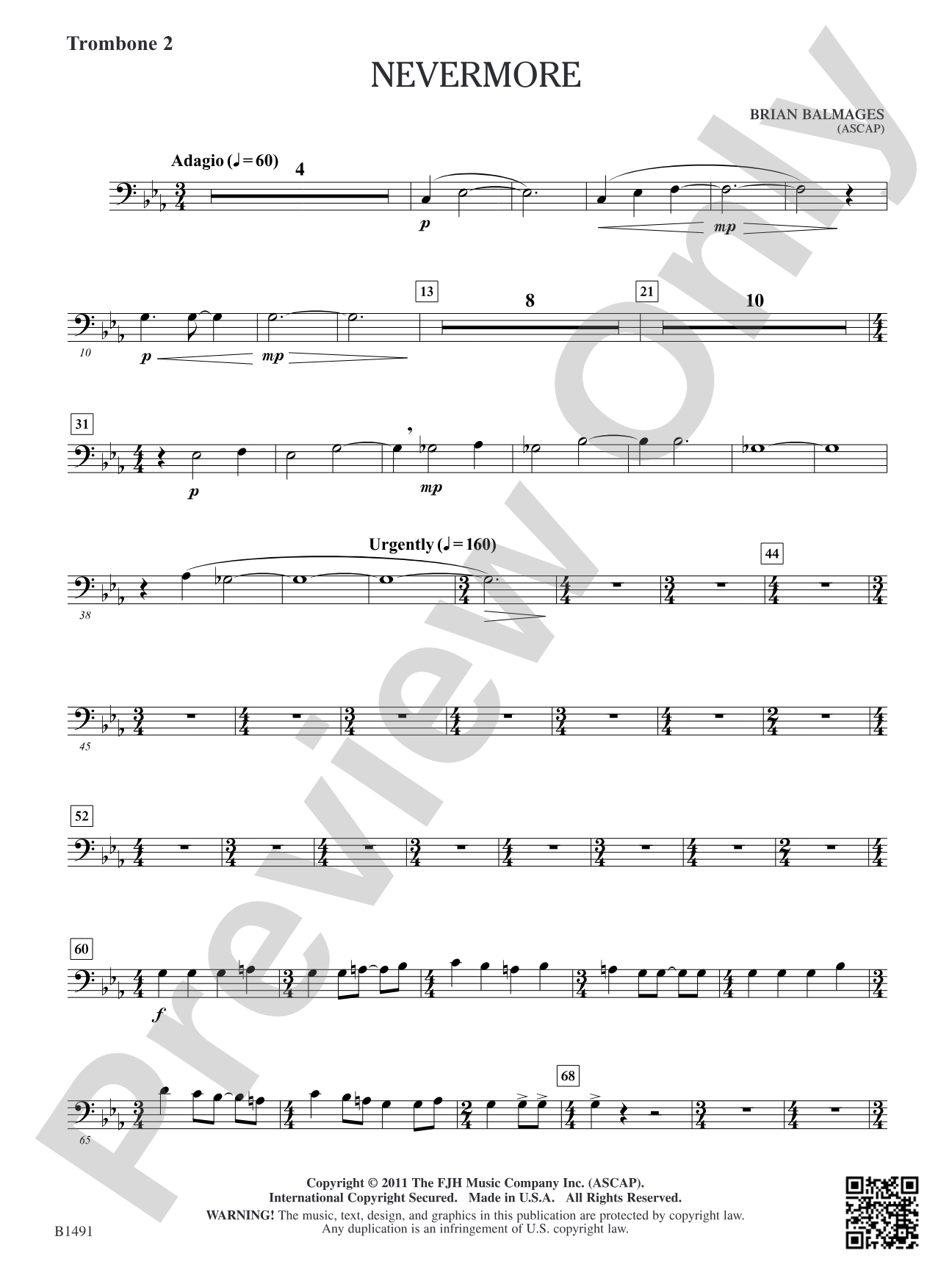

Nevermore: Trombone 2
By Brian Balmages
Grade: 3
Item: 98-PC-DB1491_TN2
$7.00
Pickup currently not available
Description
This contemporary work based on Edgar Allan Poe’s "The Raven" tells the eerie story of a man confronted by a raven, and his slow descent into utter madness. A haunting piano line supports the opening melody in alto saxophone, surrounded by contemporary effects and textures. As the man becomes more irritated, the music picks up in tempo and becomes increasingly dissonant and violent until it errupts in a cacophony of chaos. Finally, the man “breaks,” and the unsettling sounds of the opening piano return. Absolutely stunning.


Don't just read it, hear it, play along with it, and watch your students grow with it. In MakeMusic Cloud, Nevermore: Trombone 2 comes alive with professional accompaniment, adjustable tempo, and built-in practice tools that turn solo practice into real progress.
Open in the Player
Jump straight in and assign it today.
Start Your Free Trial
Open this title and explore the full library in minutes.
Sample Audio
1
Audio File
--:--
0:00
0:00
Sample Video
No sample videos found.
Additional Details
Series:
FJH Concert Band
Publisher:
The FJH Music Company, Inc.
SKU:
98-PC-DB1491_TN2
More about this title
About the Composer: Brian Balmages

Brian Balmages has established himself as a prolific composer and conductor whose work spans orchestral, band, and chamber music at every level. His compositions have been performed by professional ensembles at Carnegie Hall, the Kennedy Center, and the Sydney Opera House, as well as by school bands nationwide. He holds membership in the American Bandmasters Association and received the A. Austin Harding Award from the American School Band Directors Association, along with the 2020 NBA William D. Revelli Composition Contest award for Love and Light.
Balmages has guest conducted at the Midwest Clinic, Western International Band Clinic, and numerous all-state and regional ensembles globally. He was honored with the inaugural James Madison University Distinguished Alumni Award and later commissioned by the University of Miami to compose for the presidential inauguration of Dr. Julio Frenk. His work has also been performed at high-profile national events, including the 2013 Presidential Inaugural Prayer Service. Currently, he serves as Director of MakeMusic Publications and Digital Education for Alfred and MakeMusic.
Why we love this
This is a rare Grade 3 work that doesn't compromise on musical storytelling or dramatic arc. Balmages builds genuine psychological tension through orchestration and texture rather than relying on cheap effects, and the proportional increase in dissonance and tempo mirrors Poe's narrative so effectively that students immediately grasp why the music unfolds as it does. Directors looking for a contemporary piece with real substance that also works for contest and festival adjudication will find this delivers on both counts.
What to expect
The opening establishes an eerie, almost hypnotic mood through the interplay of solo piano and alto saxophone, immediately pulling listeners into Poe's dark world. As the narrative intensifies, the music becomes increasingly turbulent and dissonant, creating visceral tension before erupting into a cacophonous peak that feels genuinely unsettling. The return to those opening sounds leaves a haunting, unresolved quality that lingers long after the final note.
Who it's for
Band directors seeking Grade 3 repertoire with genuine dramatic depth and literary grounding will find a sophisticated option here. This work engages students in narrative-driven composition without condescension, making it ideal for programs that value contemporary concert band literature and strong programming choices.
How to get the most out of it
- Establish the unsettling opening piano line with absolute clarity; this becomes the emotional anchor that returns at the end, so the ensemble must hear it as a distinctive voice even when surrounded by band texture.
- Track the gradual dissonance buildup as the man's agitation increases. Resist the urge to make the chaotic section uniform; instead, highlight how different instrumental families contribute layers of intentional 'ugliness' that peak just before the break.
- Balance contemporary effects and textures carefully so they enhance mood rather than obscure line and intonation. These colors should be heard as orchestration choices, not accidents.
- Let the return to unsettling sounds land with weight. This moment is about exhaustion and defeat, not relief. Slow down mentally and allow the silence between ideas to breathe.
How to use it
This programmatic work functions effectively as a standout contemporary selection on a full concert or festival adjudication program, particularly when placed where its dramatic arc can anchor a section or close a set with impact. Its literary foundation also makes it a natural choice for interdisciplinary programming alongside humanities or English department initiatives.
Skills your students will build
- Interpreting programmatic music and connecting compositional choices to narrative structure
- Balancing modern compositional techniques (dissonance, contemporary textures, effects) with traditional ensemble cohesion
- Controlling dynamic range across a wide emotional spectrum, from unsettling restraint to chaotic intensity
- Sustaining intonation and line clarity through unconventional harmonic language
- Responding to conductor as the primary interpreter of dramatic arc rather than relying on traditional harmonic landmarks