Never On Sunday Sheet Music Preview

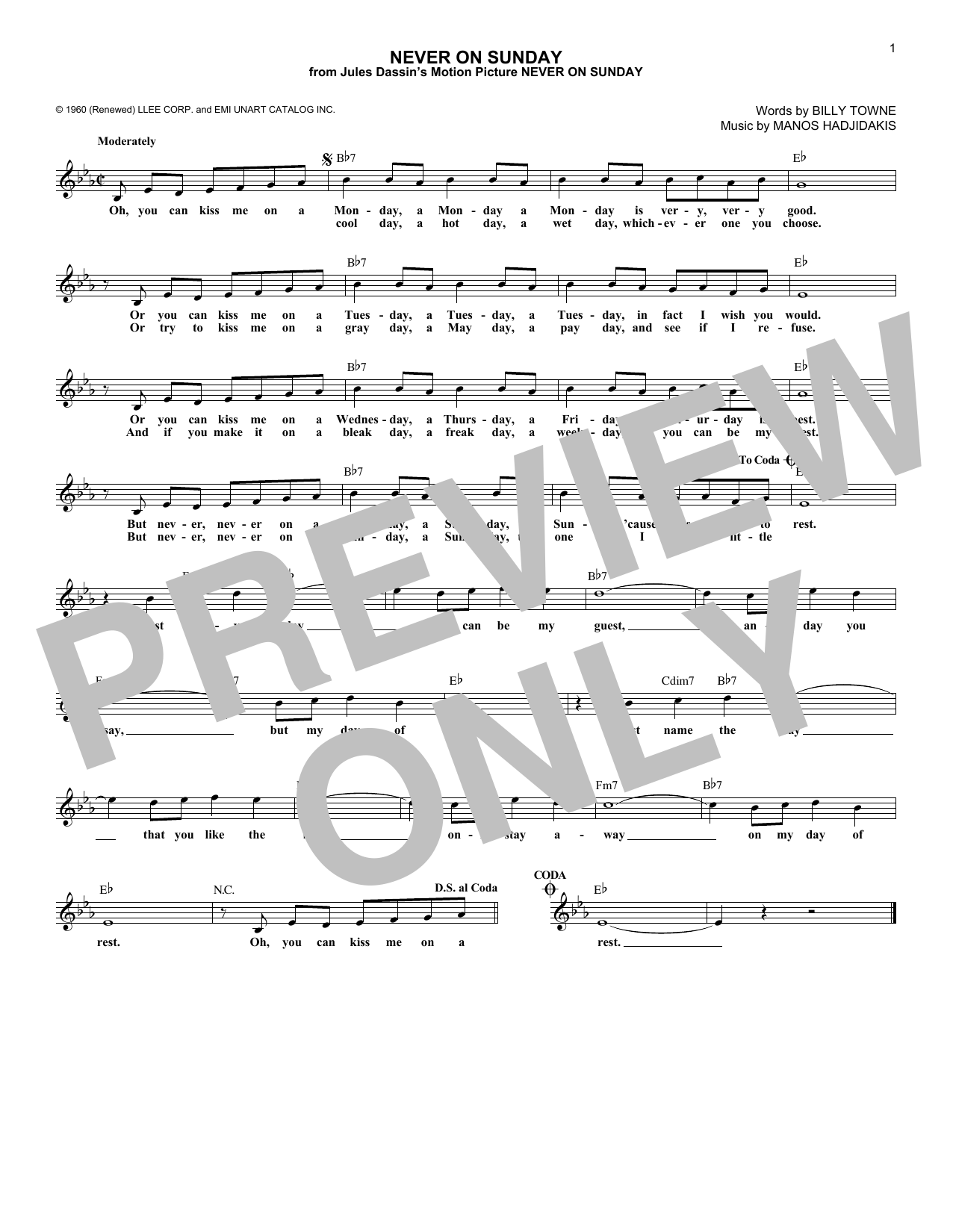
Never On Sunday: Lead Sheet / Fake Book

As performed by Manos Hadjidakis

Item: 35-DS00440531

Digital Download
$3.99
Description

Never On Sunday: Lead Sheet / Fake Book isn't in MakeMusic Cloud just yet...but it could be. Let us know you'd like to see it, and you'll help shape what comes next. In the meantime, start a free trial and dive into thousands of interactive titles your students can play along with today.

Sample Audio
No sample audio found.
Sample Video
Additional Details
Publisher: Hal Leonard
Page Count: 1
SKU: 35-DS00440531

More about this title

About the Artist: Manos Hadjidakis

Manos Hadjidakis (1925-1994) was a Greek composer who shaped the sound of modern Mediterranean music. His work bridged classical training with popular idiom, creating melodies that felt both sophisticated and immediately singable. "Never On Sunday," the title track from the 1960 film of the same name, became his international calling card and won the Academy Award for Best Original Song.

Why we love this

This lead sheet captures one of the most infectious melodies of the 20th century in a form that lets your musicians own it. The straightforward chord changes and memorable tune make it accessible for singers and keyboardists at various levels, yet the modal inflections and Latin rhythmic feel reward careful listening and authentic interpretation.

What to expect

Sunny and slightly melancholic at once. The melody dances with a Mediterranean warmth, yet the harmony carries just enough minor inflection to suggest longing beneath the joy. It's the musical equivalent of a seaside taverna at golden hour.

Who it's for

Keyboardists building a jazz standards repertoire, vocalists exploring popular song literature, and any ensemble wanting a genuine crowd pleaser with harmonic substance. It works equally well in a jazz combo setting or as a solo piano feature.

How to get the most out of it

  • Anchor the groove with a steady Latin rhythm. The song breathes best when the accompaniment locks into a relaxed, propulsive feel rather than rushing through the changes.
  • Treat the melody with simplicity. Hadjidakis's gift was writing lines that don't need embellishment; let the tune speak clearly and trust its natural contour.
  • Color the harmony with your voicings. The chords are straightforward, but how you voice them (open vs. close, bright vs. warm) shapes whether this feels playful or wistful.
  • If you're accompanying a vocalist, give them room to phrase. This song benefits from slight rhythmic flexibility and expressive breathing, especially on the longer melodic phrases.

How to use it

Pair this with other standards of the 1960s for a retro evening, or feature it as an intermission solo to lighten the mood between heavier classical works. It's also an ideal choice for student recitals where you want something recognizable that still demonstrates musicianship.

Skills your students will build

  • Reading and interpreting lead sheet notation
  • Comping with jazz and Latin chord voicings
  • Phrasing and expression in popular song
  • Modal melody recognition and interpretation
  • Rhythmic flexibility and groove awareness

You May Also Like