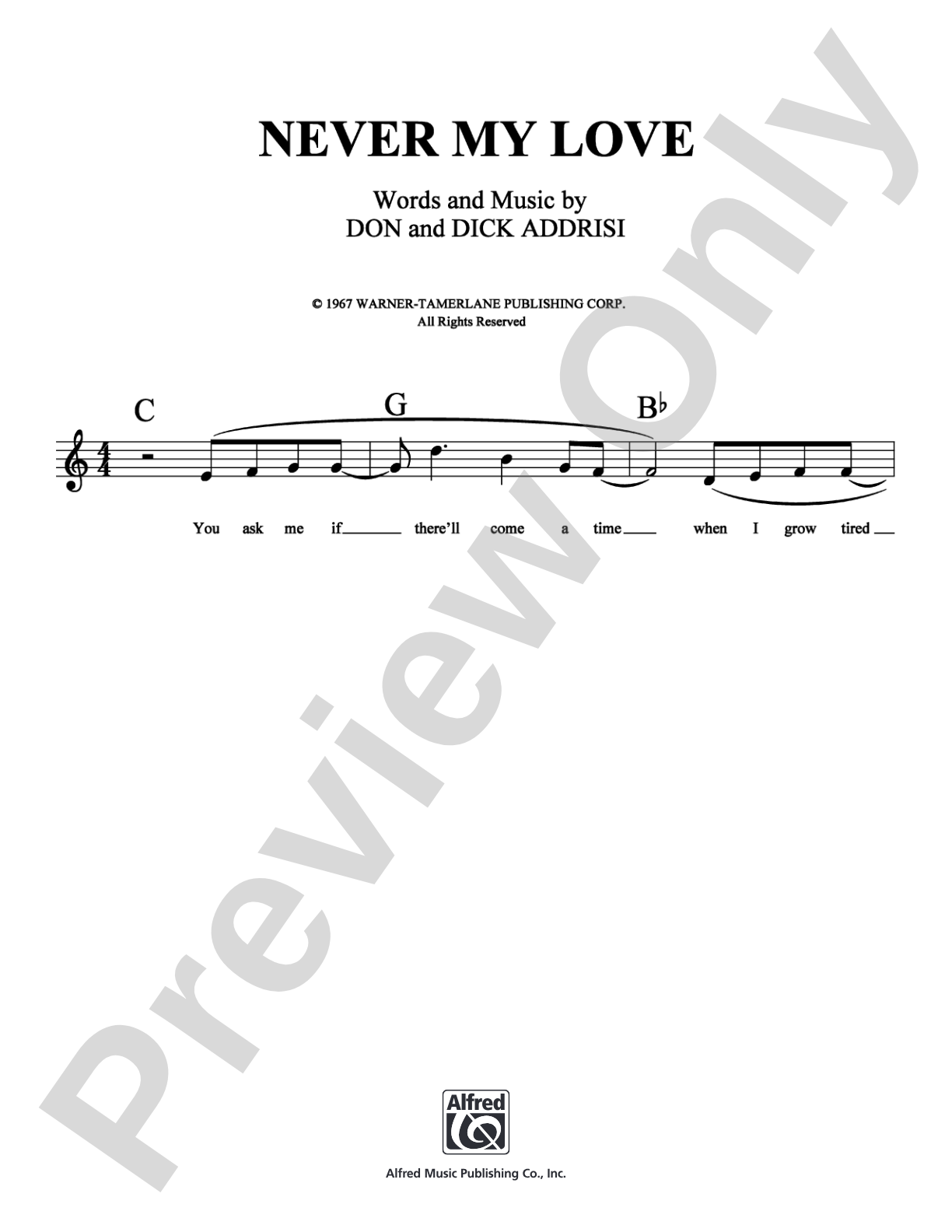
Never My Love: Lead Sheet Digital Sheet Music

Never My Love: Lead Sheet Digital Sheet Music

Don Addrisi, Vern Gosdin, Dick Addrisi

Item: 00-PS-0002281

Digital Download
$1.99
Description

Never My Love: Lead Sheet Digital Sheet Music isn't in MakeMusic Cloud just yet...but it could be. Let us know you'd like to see it, and you'll help shape what comes next. In the meantime, start a free trial and dive into thousands of interactive titles your students can play along with today.

Sample Audio
No sample audio found.
Sample Video
Additional Details
SKU: 00-PS-0002281

More about this title

About the Artist: Vern Gosdin

Vern Gosdin (1934–2009) was an American country and pop rock vocalist whose smooth baritone defined the crossover sound of the 1960s and 1970s. Born in Alabama and raised in a musical family, Gosdin first found success as a member of The Gosdin Brothers before launching a solo career that blended country roots with pop sensibilities. His work brought country music into mainstream pop consciousness during an era when such crossover was still relatively uncommon.

Gosdin's artistry centered on emotional authenticity and vocal control. Whether performing his own compositions or interpreting standards, he brought a warm, conversational quality that made complex emotions feel immediate and personal. For music educators, his recordings offer clear examples of how country and pop idioms can coexist in a single performance, and how restraint and phrasing can carry more weight than technical display.

Why we love this

Lead sheets capture the essential melody and harmony of a song without overdetermining every interpretive choice, and 'Never My Love' gives performers real freedom to shape phrasing and dynamics according to their own sensibility. The tune has an immediate, conversational quality that works equally well in jazz ensembles, vocal jazz classes, or as a study in pop-rock song structure. It's a track that sounds effortless when done well, which makes it perfect for teaching the discipline required beneath apparent ease.

What to expect

Warm, introspective, and quietly confident. The melody settles into a conversational register, neither soaring nor diving; it feels like someone speaking from genuine experience rather than performing for effect. The harmonic movement suggests both vulnerability and resolve, creating space for a performer to find their own emotional truth within the song's structure.

Who it's for

Jazz ensemble vocalists, pianists exploring pop-rock standards, and singers building a contemporary repertoire will find this lead sheet invaluable. It also works for intermediate-to-advanced students in music theory or arranging courses who want to study how a memorable melody interacts with chord progressions. Music educators can use it to teach song analysis or as a foundation for student arrangements.

How to get the most out of it

  • Let the melody breathe. Resist the urge to fill every space with ornamentation; the strength of this tune lies in its simplicity and emotional directness.
  • Pay attention to the harmonic rhythm. The chord changes support moments of vulnerability, so honor them through deliberate voice leading rather than rushing past them.
  • Use dynamics to tell the emotional story. A lead sheet gives you the freedom to start quietly and build, or to pull back at moments of peak intensity for dramatic effect.
  • Consider the rhythmic pocket. This track sits comfortably in a relaxed, swung feel; lock into that groove rather than playing mechanically straight.

How to use it

Include this as a feature in a jazz or pop vocal concert, pairing it with other standards that showcase restraint and emotional nuance. It works particularly well in recital programs that mix genres, offering a bridge between traditional jazz and contemporary pop-rock sensibilities. Consider it also as a classroom example when teaching students about song form, melody-harmony relationships, or the craft of interpretation.

Skills your students will build

  • Reading melody and chord changes from a lead sheet
  • Understanding song form and harmonic structure
  • Developing interpretive choices independent of a recorded version
  • Balancing phrasing with harmonic rhythm
  • Singing or playing with emotional authenticity while respecting the composer's intent

You May Also Like