Never Let Up: Viola Sheet Music Preview

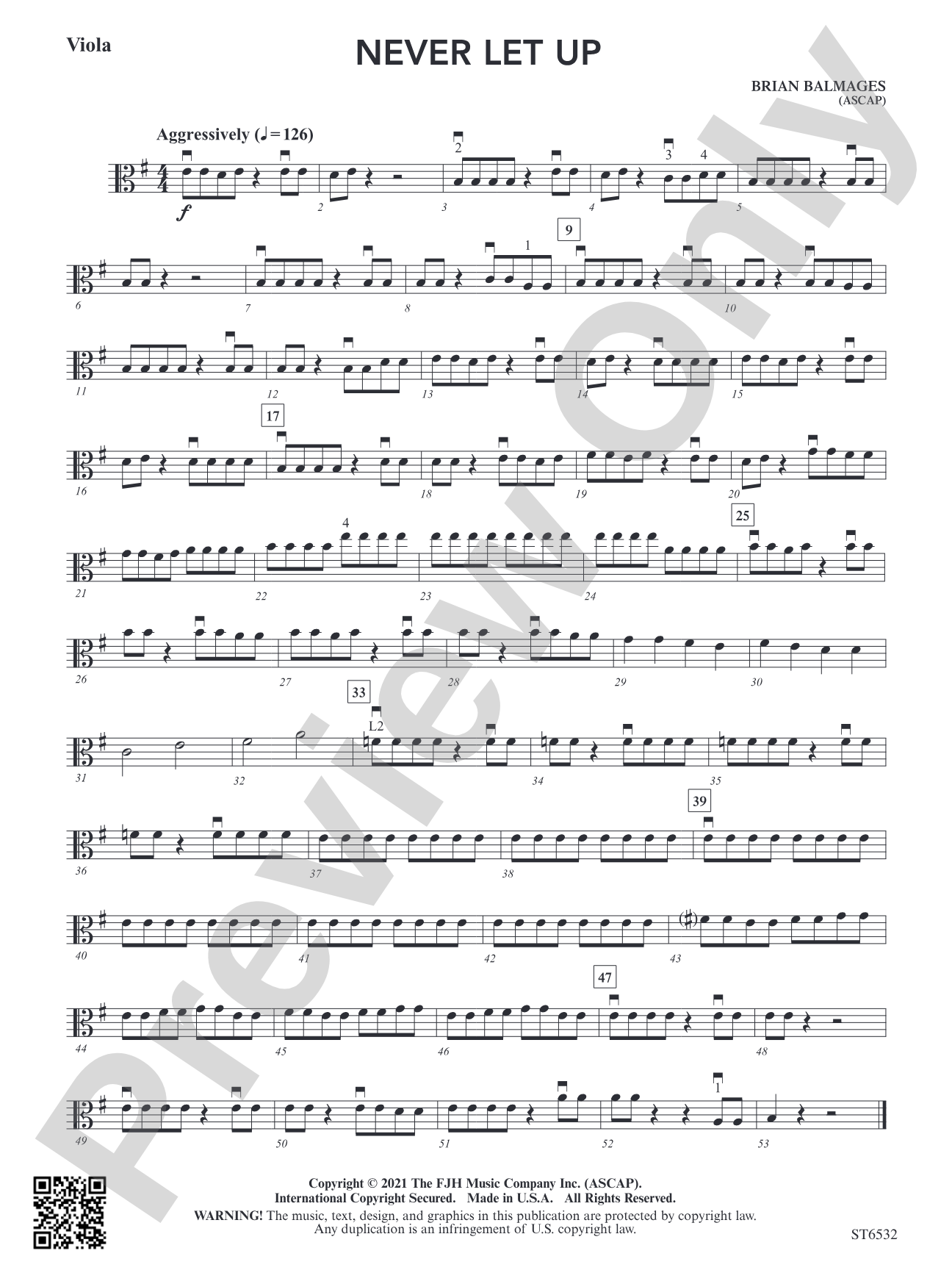
Never Let Up: Viola

By Brian Balmages

Grade: 1

Item: 98-PC-DST6532_VA1

Digital Download
$7.00
Description
Persistence, dedication, intention and drive. Exploring the dynamics of human resiliency, this aggressive work relies on driving rhythmic elements, stately melodic lines and intense harmonic moments. Heroic and powerful from start to finish!

Don't just read it, hear it, play along with it, and watch your students grow with it. In MakeMusic Cloud, Never Let Up: Viola comes alive with professional accompaniment, adjustable tempo, and built-in practice tools that turn solo practice into real progress.

Sample Audio
0:00
0:00
Sample Video
Additional Details
Series: FJH Beginning Strings
Publisher: The FJH Music Company, Inc.
SKU: 98-PC-DST6532_VA1

More about this title

About the Composer: Brian Balmages

Brian Balmages

Brian Balmages composes across orchestral, band, and chamber idioms with equal fluency, and his works have been heard in premier venues including Carnegie Hall, the Kennedy Center, and the Sydney Opera House. His accolades include the A. Austin Harding Award from the American School Band Directors Association, the 2020 NBA William D. Revelli Composition Contest for Love and Light, and membership in the American Bandmasters Association.

As both composer and conductor, Balmages maintains an active schedule guest conducting at all-state ensembles, university groups, and international conferences. He has received commissions from major institutions, including one from the University of Miami for the presidential inauguration, and his music was performed at the 2013 Presidential Inaugural Prayer Service. He currently serves as Director of MakeMusic Publications and Digital Education for Alfred and MakeMusic.

Why we love this

Grade 1 doesn't usually mean aggressive or heroic, but Balmages refuses to condescend. The rhythmic drive and stately melodic writing give young string players genuinely substantial material to sink their teeth into, making this ideal for ensembles ready to showcase something with real character at contests and festivals.

What to expect

Relentless forward motion drives this piece. Driving rhythms power stately melodic lines forward while intense harmonic moments punch through, creating a heroic arc that feels unstoppable from first note to last. The overall effect is one of determination and resilience without a moment of hesitation.

Who it's for

String orchestras in their first year of serious repertoire study who are ready to step beyond simple folk songs and exercises. This work suits ensembles preparing for contest or festival performance and whose directors want to program something with genuine musical substance at Grade 1 level.

How to get the most out of it

  • Establish a clear pulse in rehearsal before tackling the rhythmic figures. Young string players often lock onto the conductor's beat rather than their stand partner's bow, so isolate sections and have them count through the driving patterns independently first.
  • Balance the stately melodic lines by keeping vibrato subtle and consistent across the section. This prevents the melody from sounding overly sentimental and preserves the work's intensity.
  • Shape dynamics boldly. Balmages writes aggressive moments that demand conviction; hesitant crescendos will undercut the piece's power.
  • Mark all entrances and cutoffs clearly in the parts during the first read-through. The rhythmic drive can mask ensemble coordination issues if players aren't anchored to specific visual cues from the conductor.

How to use it

Program this as a concert opener or centerpiece when you want to announce that your young string ensemble is serious about the music they play. It pairs well with lyrical or lighter works on the same program, giving you a strong showcase moment before moving into contrasting fare.

Skills your students will build

  • Reading and executing driving rhythmic figures with precision
  • Maintaining a steady pulse across ensemble sections
  • Dynamic contrast and shaping (aggressive versus sustained passages)
  • Sectional independence while tracking a unified ensemble line
  • Responsive conducting interpretation and attention to conductor cues

You May Also Like