
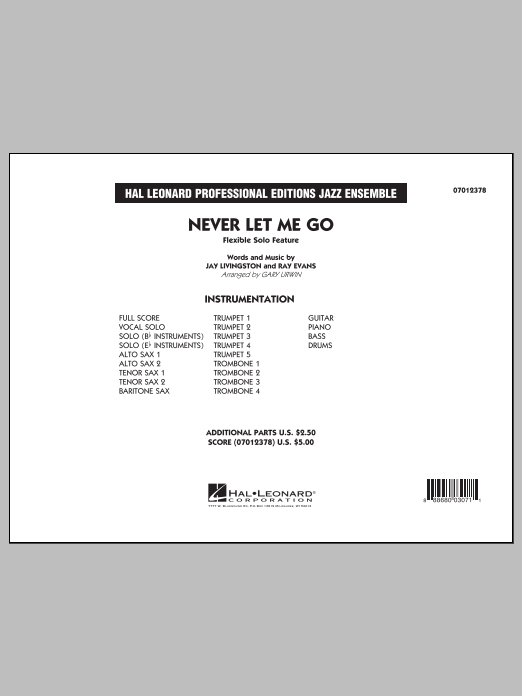

Never Let Me Go (Flexible Solo Feature): Jazz Ensemble Conductor Score & Parts
As performed by Dinah Washington / Arranged by Gary Urwin
Item: 35-PK00295088
$60.00
Pickup currently not available
Buy Extra Parts (Digital PDF Download)
Parts Added to Cart!
Description
Never Let Me Go (Flexible Solo Feature)


Never Let Me Go (Flexible Solo Feature): Jazz Ensemble Conductor Score & Parts isn't in MakeMusic Cloud just yet...but it could be. Let us know you'd like to see it, and you'll help shape what comes next. In the meantime, start a free trial and dive into thousands of interactive titles your students can play along with today.
Request This Title
Tell us you want it.
Start Your Free Trial
Explore everything that's ready to play right now.
Sample Audio
No sample audio found.
Sample Video
No sample videos found.
Additional Details
Publisher:
Hal Leonard
SKU:
35-PK00295088
More about this title
About the Artist: Dinah Washington
Dinah Washington (1924-1963) was a jazz and R&B vocalist whose technical command and interpretive depth earned her the title "Queen of the Blues." Her career spanned from big band vocals in the 1940s through sophisticated jazz standards and pop crossovers, making her one of the most recorded artists of her era.
Washington's influence on jazz pedagogy remains substantial. Her approach to phrasing, time placement, and emotional restraint within a swinging context serves as a masterclass for developing singers and ensemble musicians. Directors return to her recordings repeatedly because she demonstrates how to honor a song's structure while making it entirely her own.
Why we love this
This arrangement gives your ensemble the chance to explore what makes a jazz standard endure. The flexible solo feature means you can showcase different players across rehearsals and performances, keeping the material fresh and allowing multiple students to own the spotlight. Gary Urwin has crafted something that swings without requiring virtuoso chops from everyone, which means your whole section can groove together.
What to expect
Sophisticated yet warm. This is a song that feels like a conversation between old friends, unhurried and genuine. The arrangement invites players to breathe together, listen to each other, and find the pocket where swing lives. There's room for personality in every chair.
Who it's for
Jazz ensemble directors who want their students to experience a real jazz composition with flexibility built in for different solo voices and skill levels. This works equally well in high school jazz bands and college combo settings, and it's accessible enough that community bands can program it confidently.
How to get the most out of it
- Balance the solo voice against the ensemble so that phrasing and emotion come through. This isn't a feature buried under full orchestration; it's a conversation between soloist and band.
- Lock the rhythmic pulse with your rhythm section first, then layer in the horns. A relaxed, confident time feel transforms everything that happens on top of it.
- Study how Washington handles the melody in recordings. Notice her rhythmic liberties and where she sits behind or ahead of the beat; these details inform how your soloists should approach the feature.
- Take time on dynamics. Jazz standards live in the space between restraint and expression; let silence matter as much as sound.
How to use it
Consider this as a concert opener that establishes your ensemble's jazz credentials and immediately draws the audience in with a familiar, beloved melody. You can rotate different soloists through performances of the same arrangement, making it a recurring feature across multiple concerts in a season. It also pairs beautifully with other standards or with original jazz compositions that explore similar harmonic territory.
Skills your students will build
- Swing phrasing and rhythmic placement (behind, on, and ahead of the beat)
- Listening and responding to solo voices within an ensemble texture
- Balancing accompaniment dynamics to support rather than overshadow the feature
- Flexible part reading and adaptation for different soloists
- Interpreting jazz standards with attention to historical context and style