
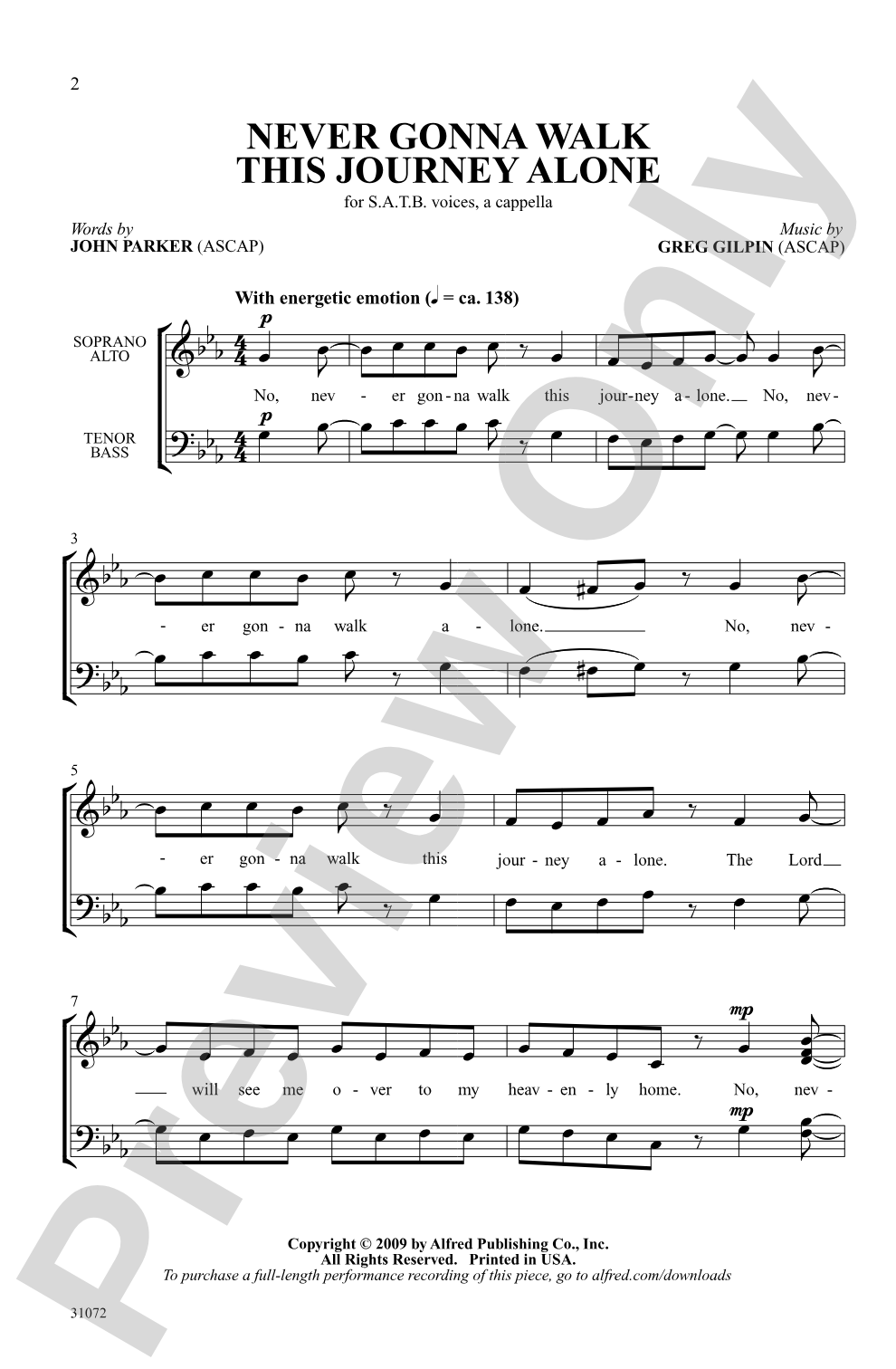
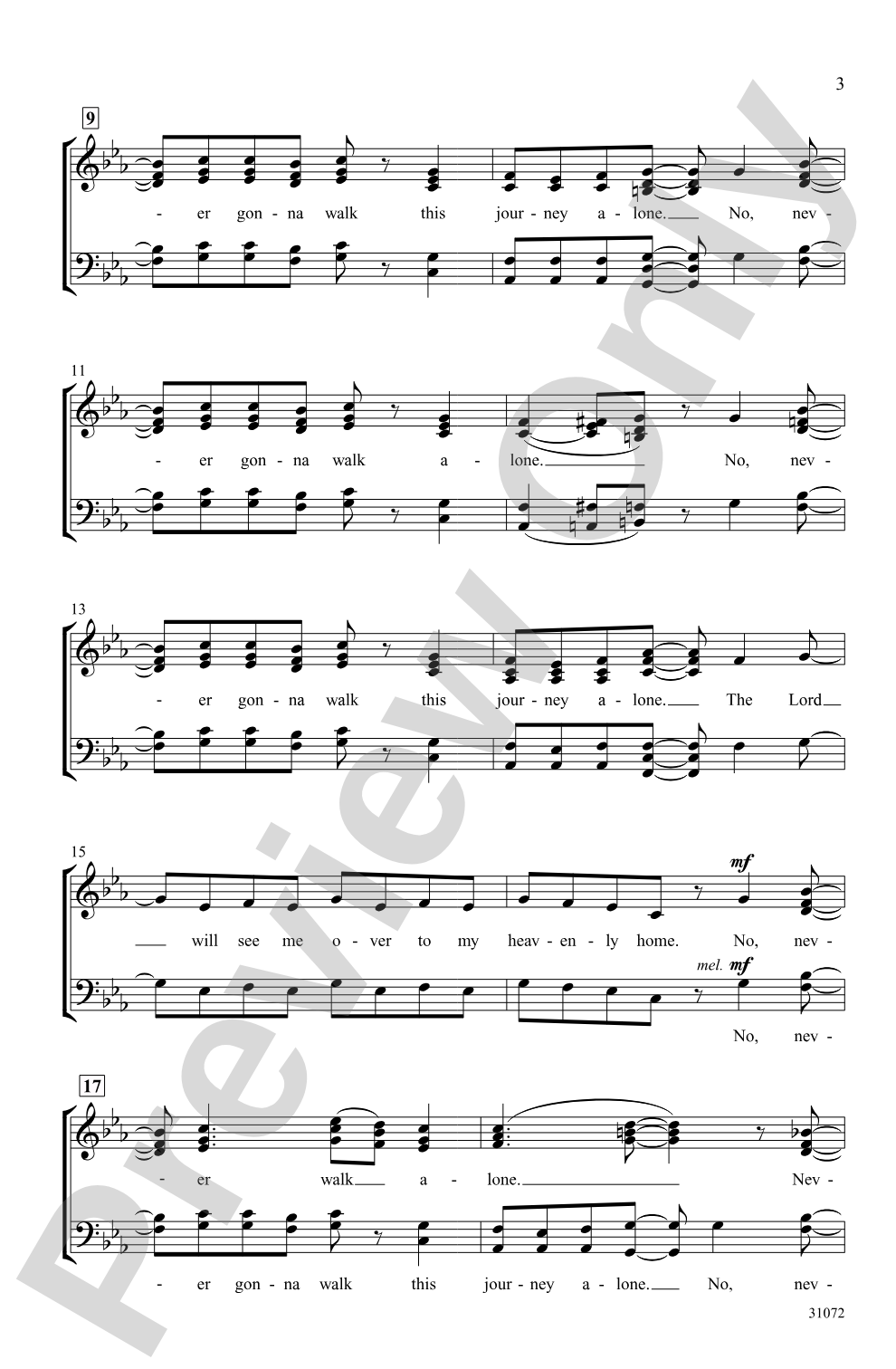
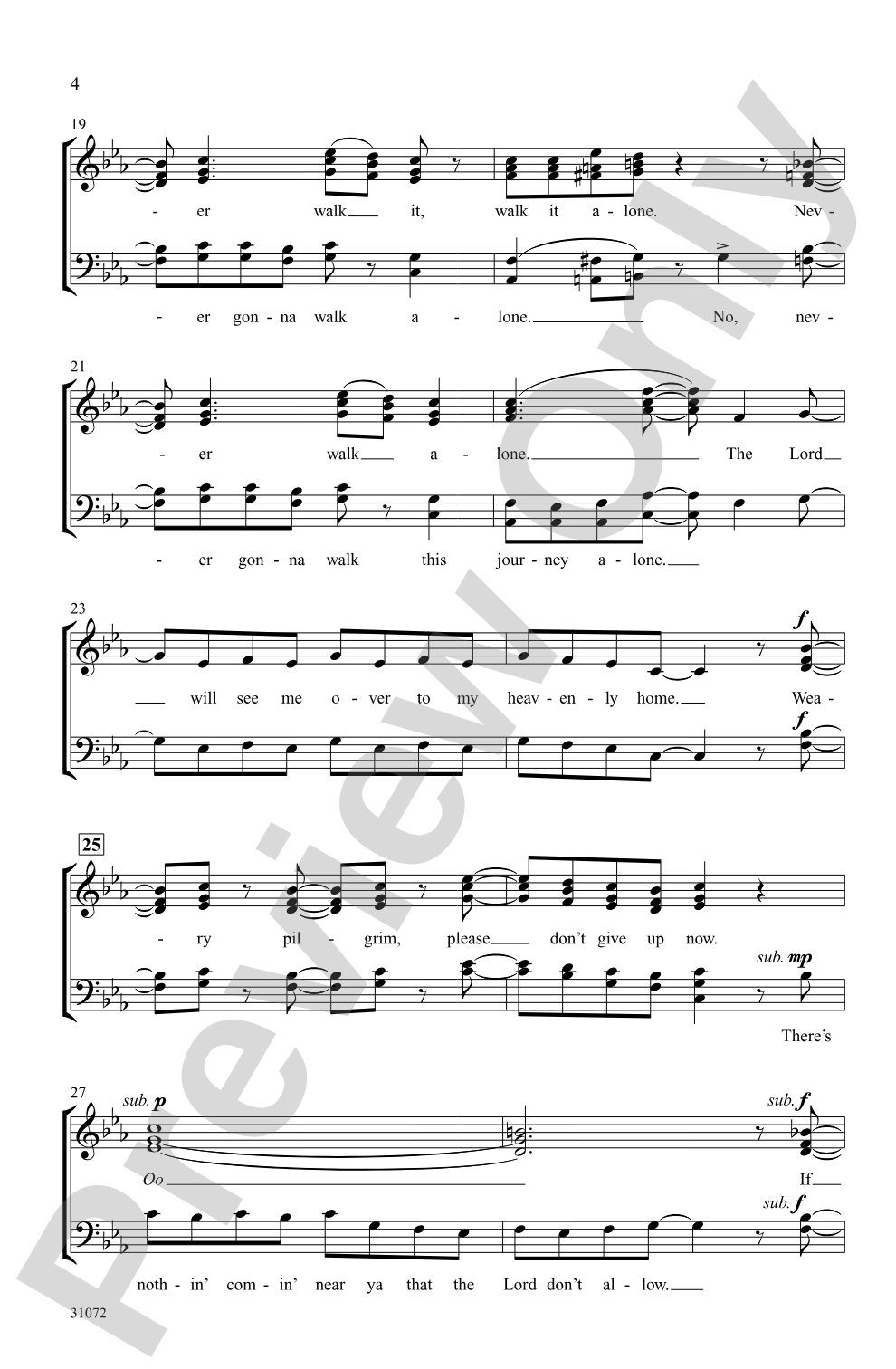

Never Gonna Walk This Journey Alone: SATB, a cappella Choral Octavo
Words by John Parker, music by Greg Gilpin
Item: 00-PO-0000768
$2.05
Minimum order quantity: 20 copies
Pickup currently not available
Related Items
Never Gonna Walk This Journey Alone: SATB, a cappella Choral Octavo |
$2.05
|
View |
Description
This original contemporary spiritual is a powerhouse, destined to be a staple in your choral library. The exciting rhythms, dramatic dynamics, and textured vocal lines grab your ear and stick with you as only the most exceptional a cappella works can. A standout.


Never Gonna Walk This Journey Alone: SATB, a cappella Choral Octavo isn't in MakeMusic Cloud just yet...but it could be. Let us know you'd like to see it, and you'll help shape what comes next. In the meantime, start a free trial and dive into thousands of interactive titles your students can play along with today.
Request This Title
Tell us you want it.
Start Your Free Trial
Explore everything that's ready to play right now.
Sample Audio
1
Audio File
--:--
0:00
0:00
Sample Video
No sample videos found.
Additional Details
Series:
Alfred Choral Designs
Publisher:
Alfred Music
Page Count:
12
SKU:
00-PO-0000768
More about this title
About the Composer: Greg Gilpin

Greg Gilpin stands among today's most performed choral composers, with his music heard across premier venues from Carnegie Hall and Lincoln Center to the Sydney Opera House and Royal Festival Hall. As an ASCAP award-winning composer and conductor, he has shaped the sound of American choral music while also serving as Director of Educational Choral Publications for Shawnee Press, where his influence on a new generation of choral writers continues to grow.
Beyond the concert hall, Gilpin has pursued parallel creative and entrepreneurial paths, scoring the award-winning film "Rosie's Rescue" and launching a professional organizing business. He remains deeply engaged in music education, holding membership in ACDA, NAfME, and Phi Mu Alpha Sinfonia, and continues to compose, conduct, and teach with undiminished energy.
Why we love this
Gilpin brings the urgency and emotional authenticity of contemporary spiritual tradition to concert choral writing. The rhythmic vitality and layered vocal textures make this piece immediately rewarding to learn and perform, while the a cappella format strips away distractions and lets your choir's voices do the storytelling. It's exactly the kind of original work that sticks in audiences' minds long after the final note.
What to expect
The piece pulses with rhythmic energy and builds through rich, layered harmonies that create a sense of movement and determination. Gilpin's dramatic dynamics and textured writing give it a contemporary feel while honoring the spiritual tradition, creating a work that feels both urgent and deeply grounded.
Who it's for
This piece works for intermediate to advanced choirs with solid rhythmic control and vocal independence. It's particularly suited to ensembles preparing for festivals or competitions, though its contemporary spiritual roots and emotional directness make it equally at home in church or concert settings.
How to get the most out of it
- Nail the rhythmic precision in the opening sections to establish the propulsive energy that carries the piece forward; sloppy rhythms will deflate the impact.
- Shape the dynamic arc across the full 12 pages; resist the urge to peak early and instead build gradually toward the climactic moments that Gilpin has written.
- Balance the textured vocal lines by listening across all four parts during sectional rehearsals; individual voice parts are woven tightly and need clarity even when parts overlap.
- Consider how breath points in the text reinforce meaning as well as musical line, especially in slower sections where a well-placed breath lifts the phrase.
How to use it
Program this as a centerpiece in a set focused on American spirituals or contemporary sacred music, where its originality provides fresh perspective alongside traditional spirituals. The a cappella setting also makes it an excellent showcase for a concert finale, allowing your choir to demonstrate vocal blend and control without instrumental accompaniment.
Skills your students will build
- Rhythmic independence across four parts, including syncopated and layered patterns
- Dynamic control and ensemble balance in thick, textured vocal writing
- Phrase shaping and breath management in longer musical lines
- Part independence and attention to inner voices in a cappella context
- Stylistic flexibility in blending contemporary and spiritual idioms