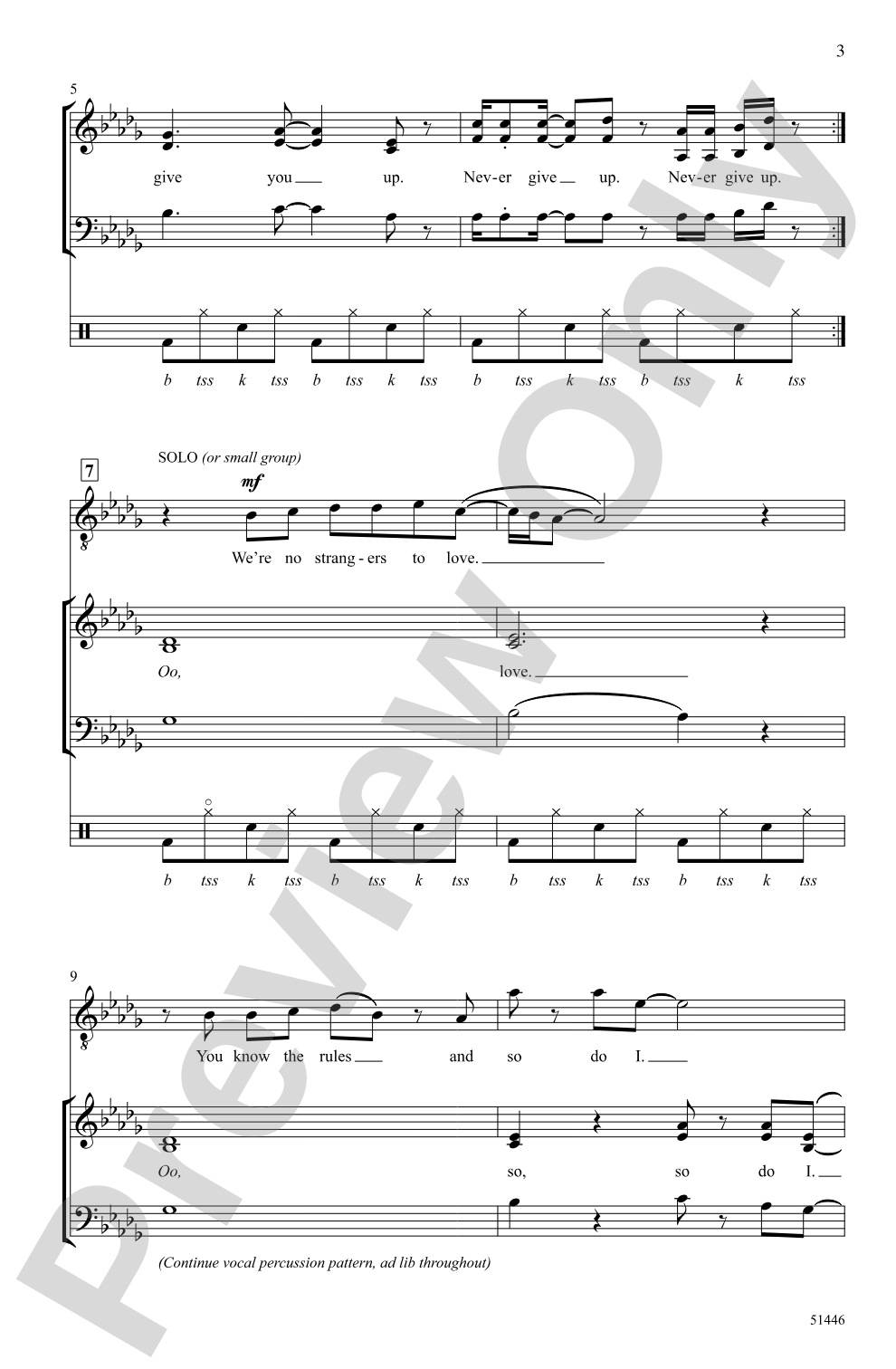
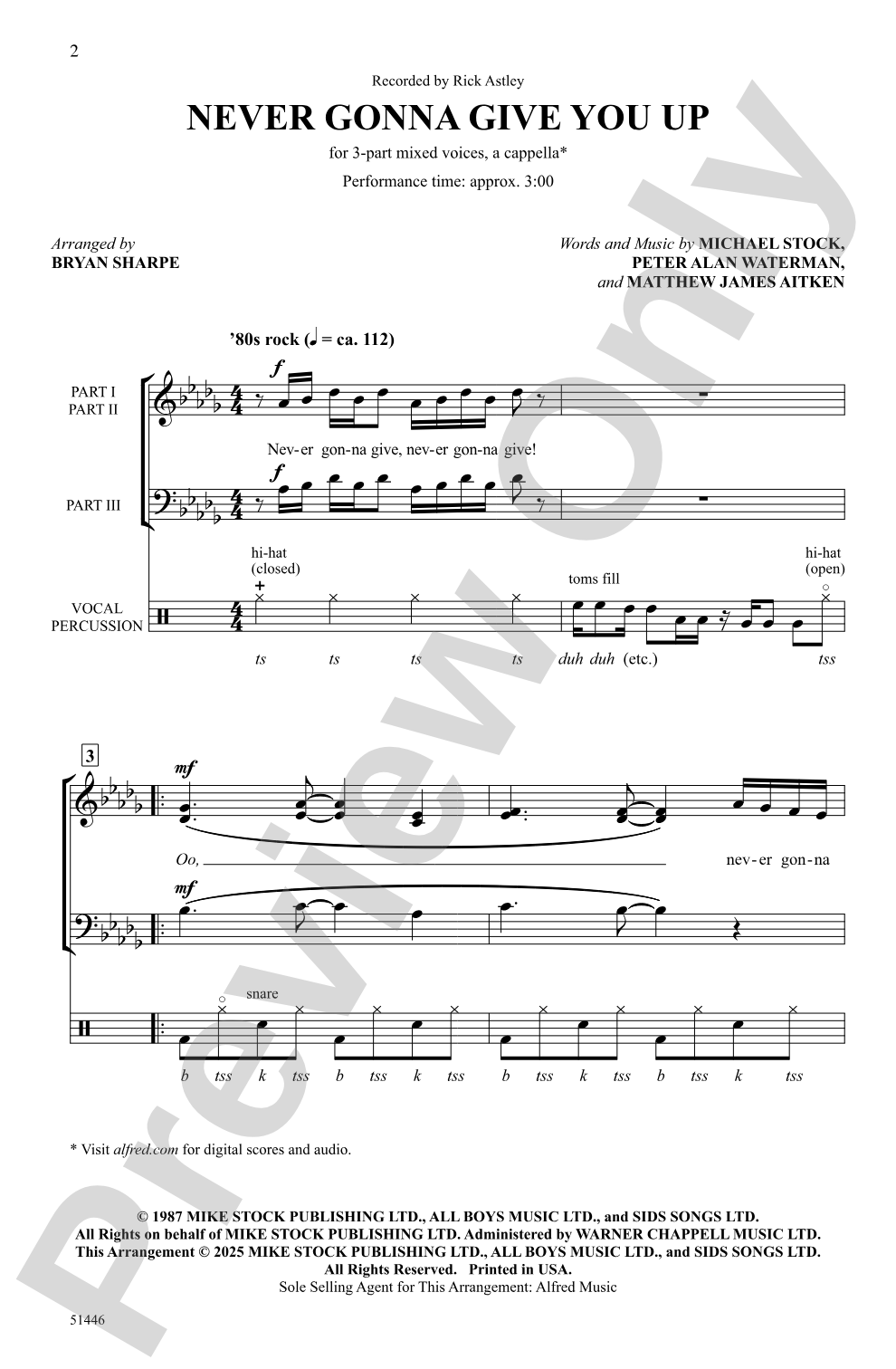
Never Gonna Give You Up Sheet Music Preview

Never Gonna Give You Up: 3-Part Mixed a cappella Choral Octavo

Words and music by Michael Stock, Peter Alan Waterman, and Matthew James Aitken / arr. Bryan Sharpe

Item: 00-PO-0007482

Digital Download
$2.35

Minimum order quantity: 20 copies

One moment…

Description
Rickroll your audience with this contemporary a cappella arrangement of Rick Astley's 1980s hit and current pop culture meme! Any voice or combination of singers can be featured on the solo, with choral back-ups that are easy to sing and true to the original. Vocal percussion can be performed as written, or improvised by a more experienced beatboxer. Program as an encore or a special surprise on your set list!

Never Gonna Give You Up: 3-Part Mixed a cappella Choral Octavo isn't in MakeMusic Cloud just yet...but it could be. Let us know you'd like to see it, and you'll help shape what comes next. In the meantime, start a free trial and dive into thousands of interactive titles your students can play along with today.

Sample Audio
0:00
0:00
Sample Video
Additional Details
Series: Alfred Pop Choral Series
Publisher: Alfred Music
Page Count: 12
SKU: 00-PO-0007482

More about this title

About the Composer: Michael Stock

Michael Stock is a songwriter and producer who helped define the sound of 1980s pop music. Working alongside Pete Waterman and Matt Aitken as part of the Stock Aitken Waterman production team, Stock wrote and produced some of the decade's most enduring hits, including Rick Astley's "Never Gonna Give You Up." His work demonstrates a gift for crafting melodies that stick with listeners for decades.

Why we love this

Bryan Sharpe's arrangement captures everything that makes the original irresistible while making it genuinely singable for a 3-part mixed choir. The vocal percussion part adds textural interest without demanding a professional beatboxer, and the flexibility in solo assignment means any strong vocalist in your section can carry the lead. Your audience will recognize it instantly, but the stripped-down a cappella treatment gives it a freshness that feels respectful to both the source material and your singers.

What to expect

Energetic and playful, with the characteristic 80s production sensibility intact. The a cappella setting strips away the synths but preserves the song's infectious groove, creating a moment of pure vocal fun that feels both genuine and deliberately tongue-in-cheek.

Who it's for

Choirs looking for an accessible, high-energy encore that lands with contemporary audiences. SAB voicing works for mixed ensembles of any size, and the novelty element makes this ideal for holiday concerts, spring pops shows, or end-of-year celebrations where you want to surprise and delight.

How to get the most out of it

  • Start rehearsals with the original recording so singers internalize the groove. A cappella doesn't mean ignoring the rhythmic pocket that makes this song work.
  • Cast your solo strategically. The arrangement allows you to feature your best alto, tenor, or soprano, or rotate the part across multiple singers for different verses.
  • If your ensemble isn't ready for improvised beatboxing, sing the vocal percussion part as written. It's written idiomatically and will lock the rhythm section without requiring special skills.
  • Use unison or octave doublings in rehearsal to build confidence in the harmonic foundation before singers tackle their full parts.

How to use it

Save this for your finale or late in the set where the mood has been established and your audience is ready to have fun. The surprise factor works best when it's unexpected, so pair it with more traditional repertoire earlier in the concert to maximize the impact of the reveal.

Skills your students will build

  • Singing rhythmically independent lines within a pop/rock groove
  • Balancing melodic solos with choral backup support
  • Executing rhythmic precision in a cappella settings without instrumental anchor
  • Stylistic interpretation of contemporary music idioms
  • Flexible approach to arrangement options (improvised vs. written vocal percussion)

You May Also Like