
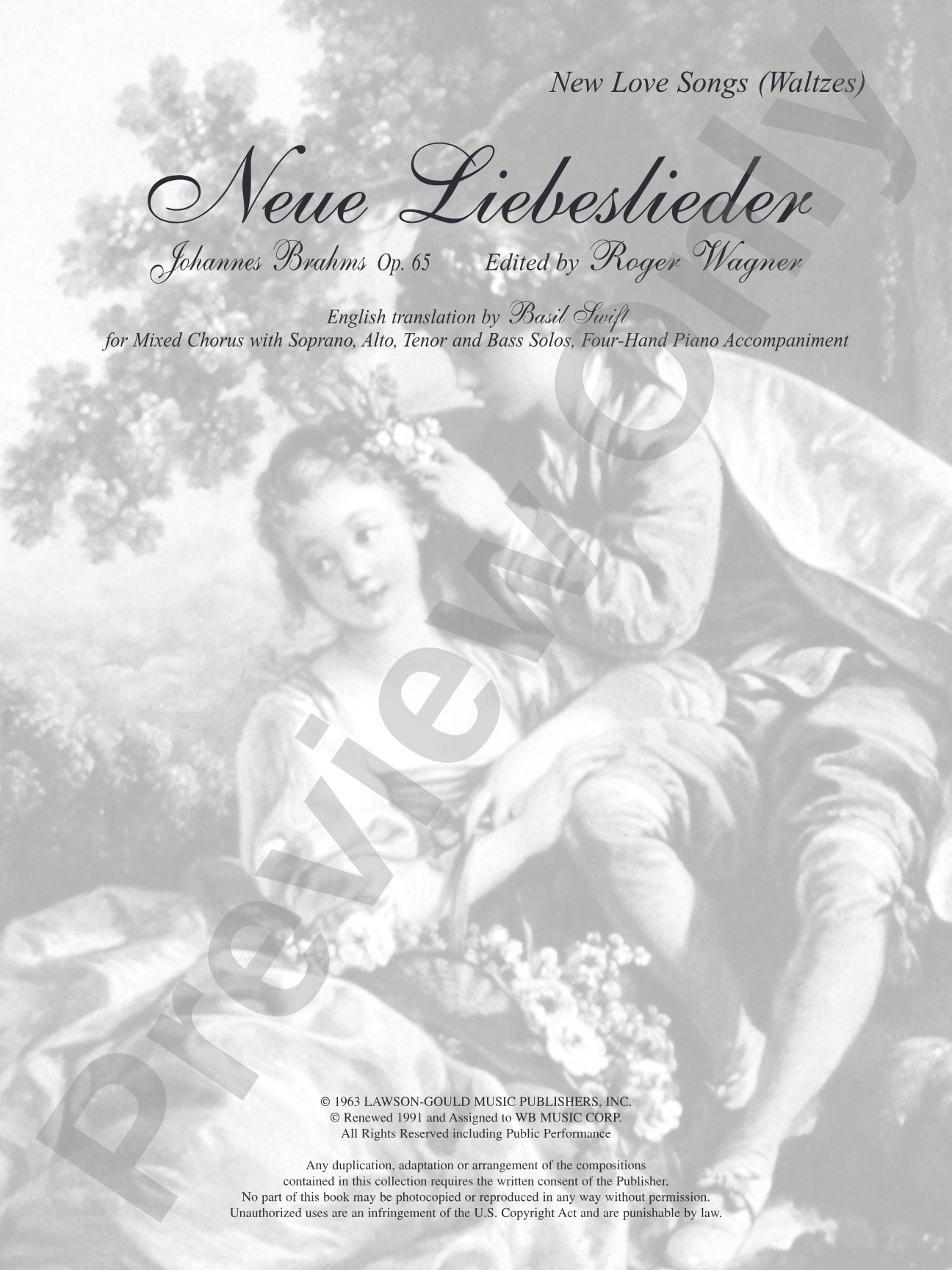


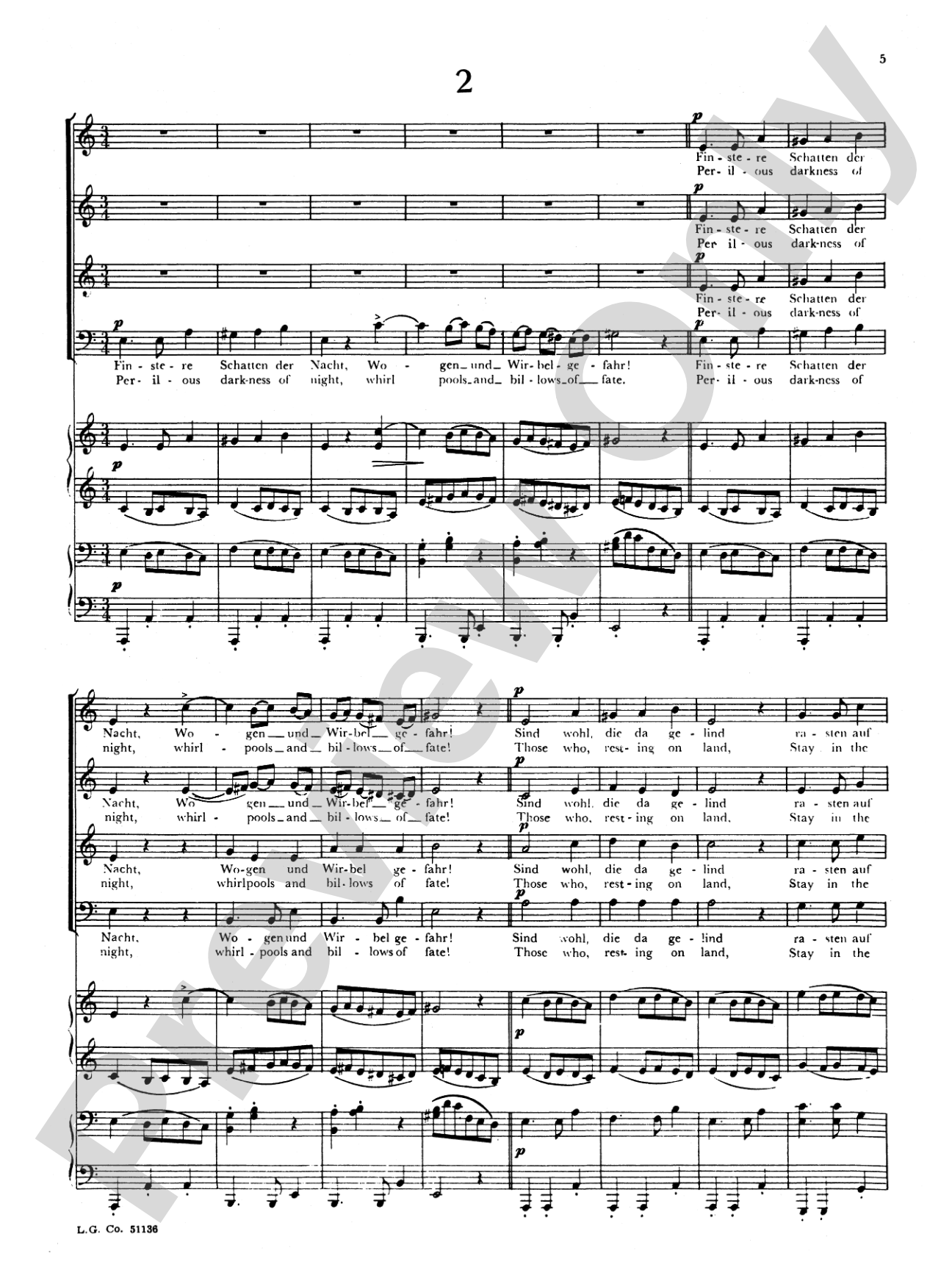
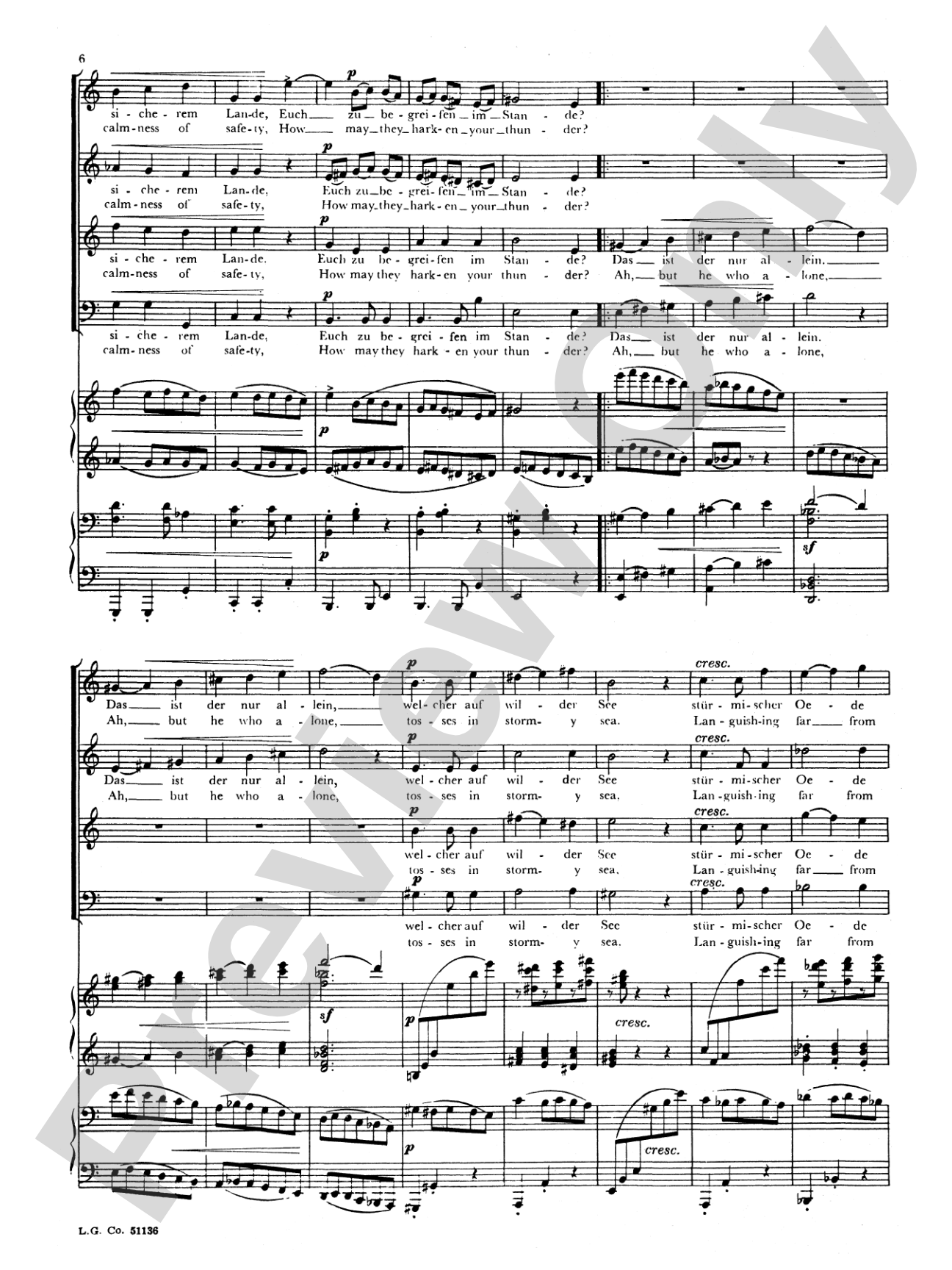
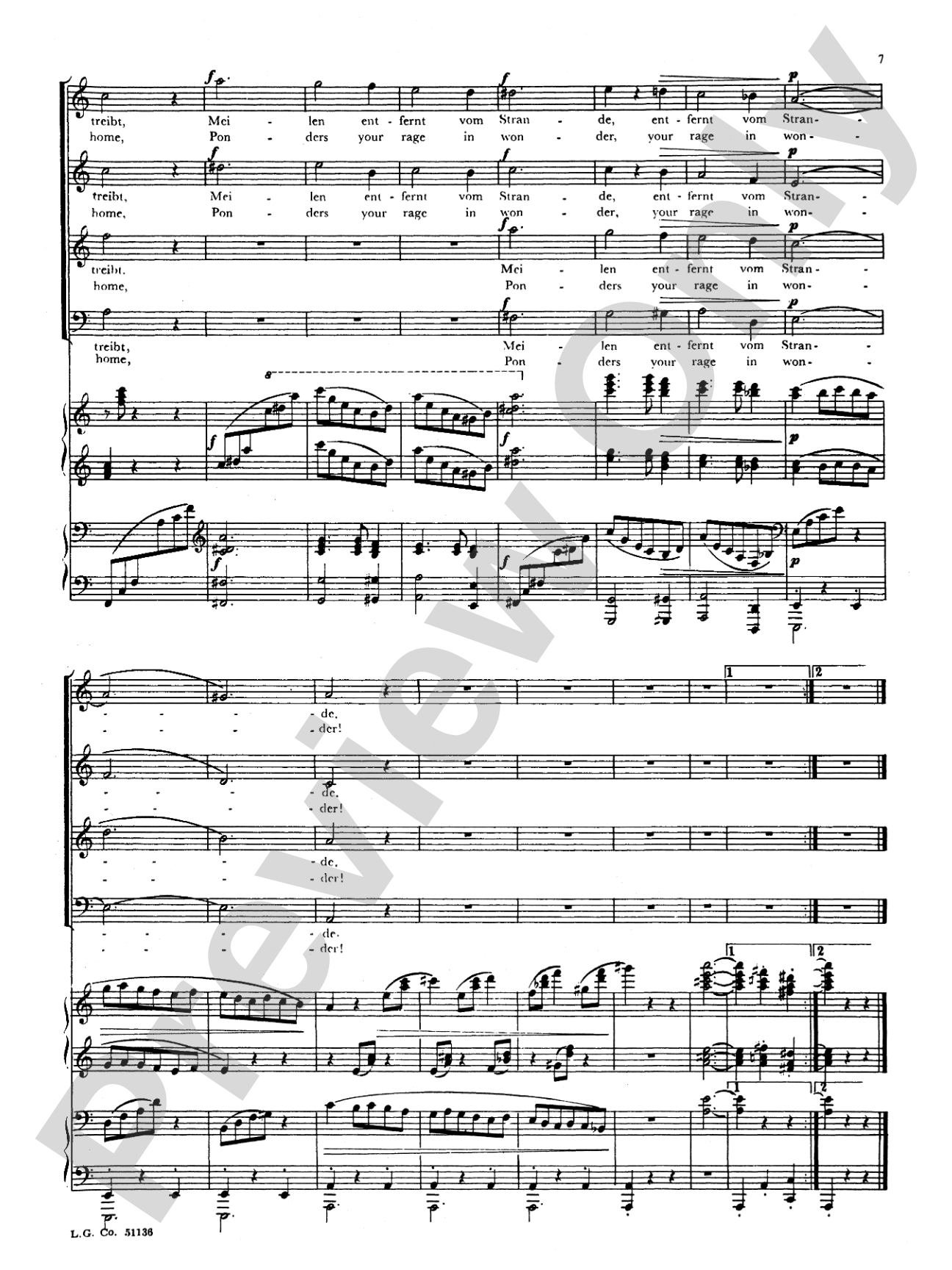

Neue Liebeslieder Walzer, Opus 65: Choir
By Johannes Brahms / ed. Roger Wagner
Item: 00-PB-0001147
$8.95
Pickup currently not available
Related Items
Neue Liebeslieder Walzer, Opus 65: SATB Choral Book |
$8.95
|
View |
Description
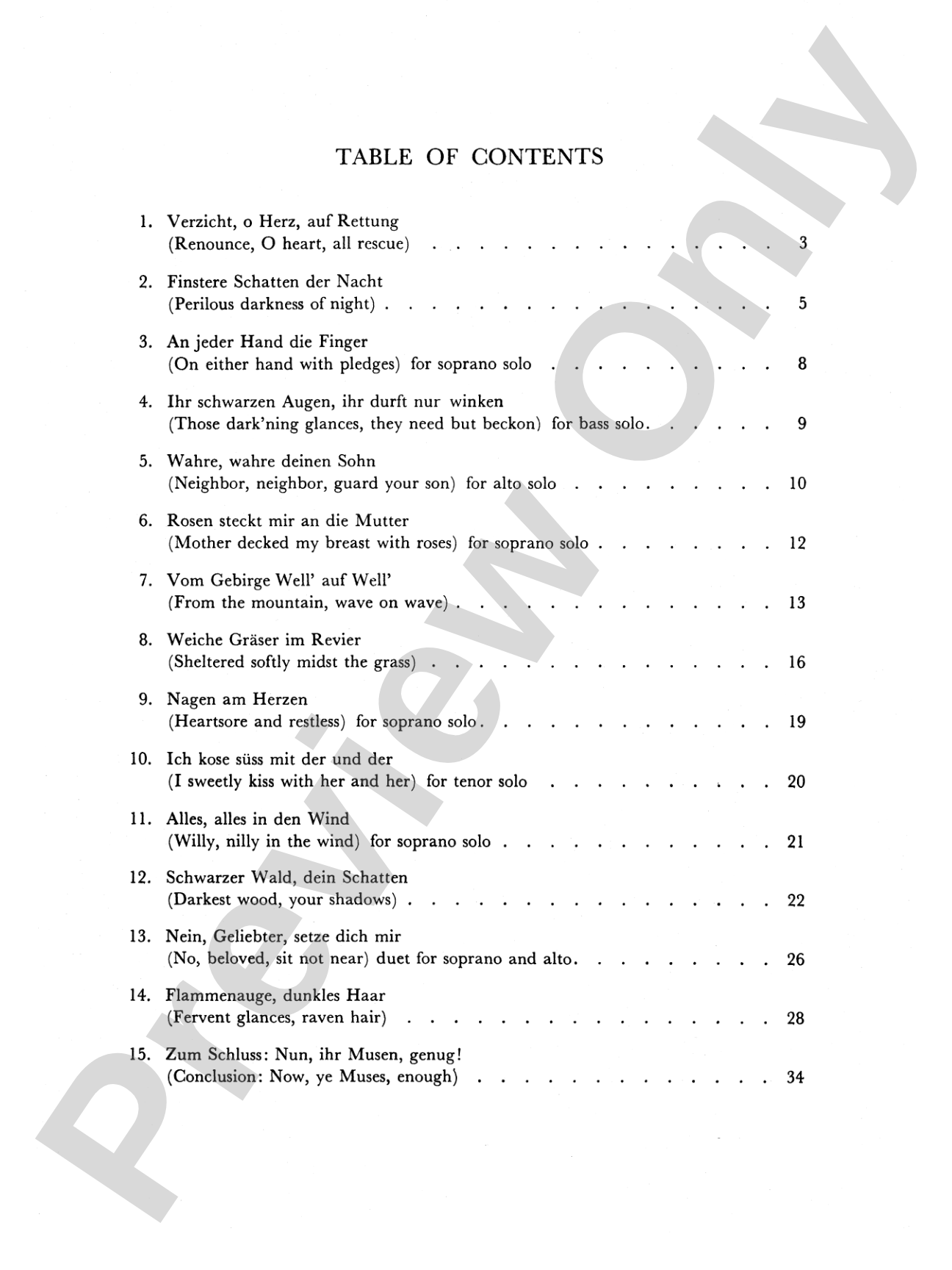
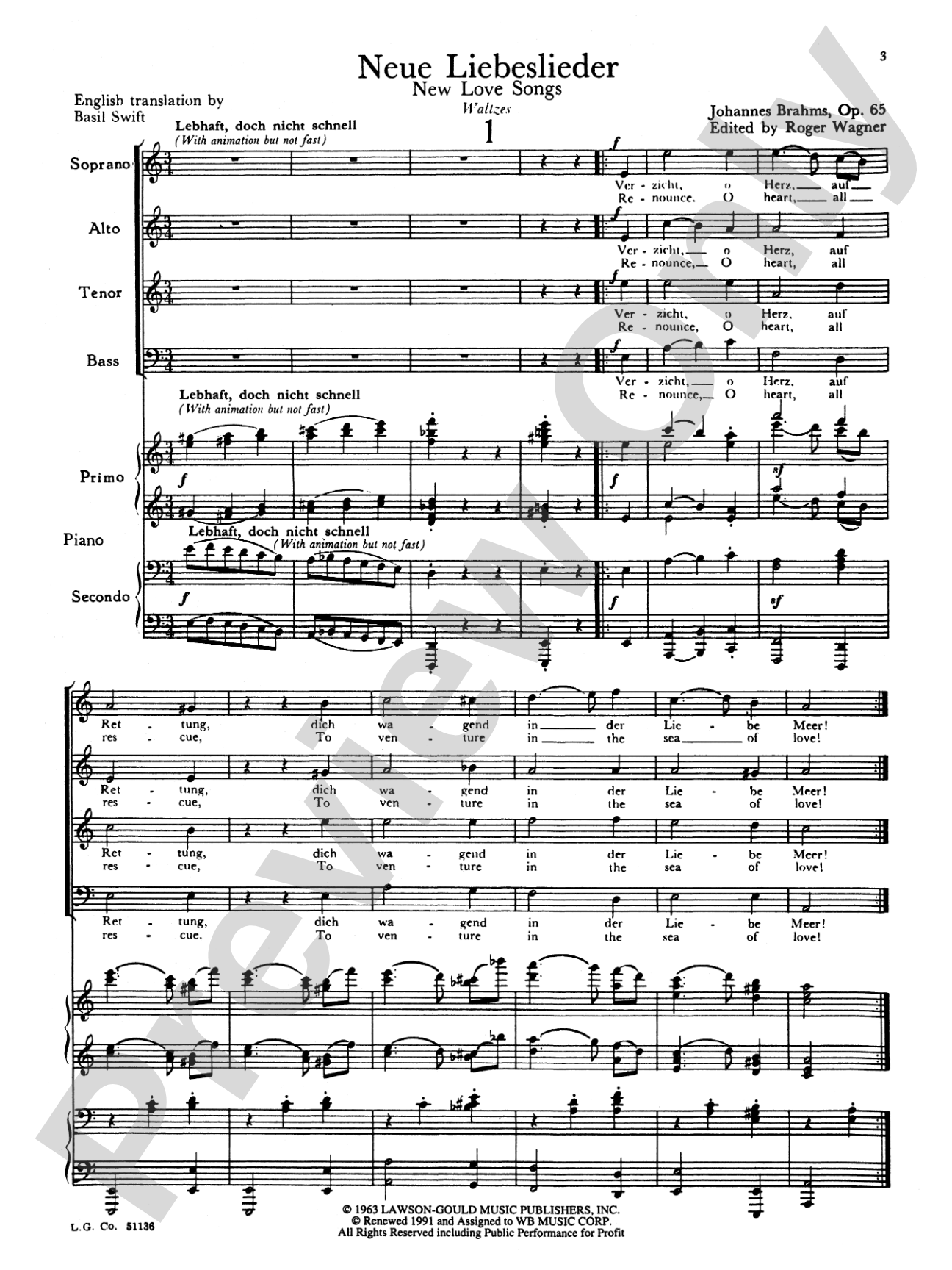
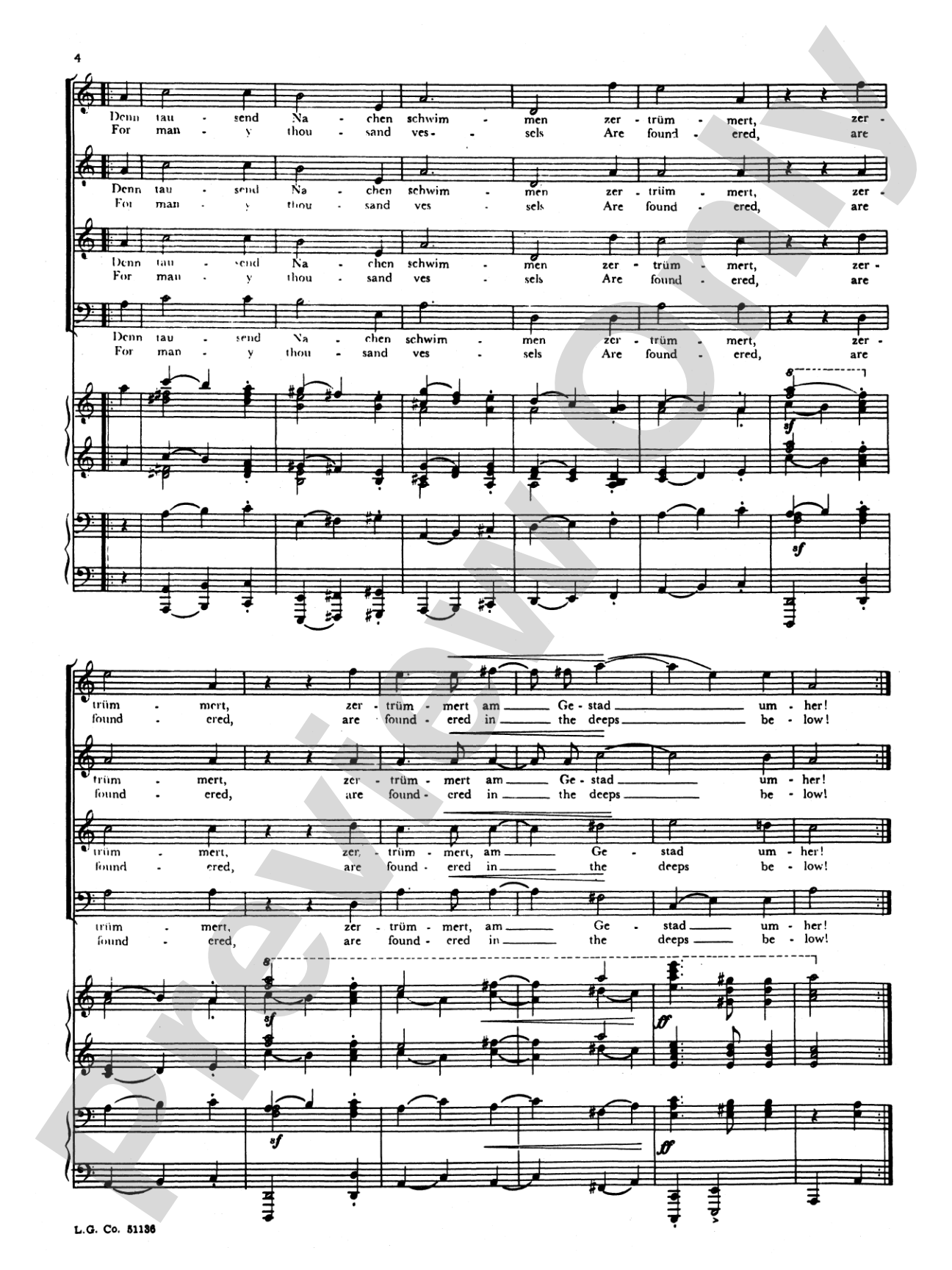
Edited by Roger Wagner, Neue Liebeslieder Walzer, Opus 65 presents 15 choral pieces in SATB voicing. Titles: Verzicht, o Herz, auf Rettung (Renounce, O heart, all rescue) * Finstere Schatten der Nacht (Perilous darkness of night) * An jeder Hand die Finger (On either hand with pledges) for soprano solo * Ihr schwarzen Augen, ihr durft nur winken (Thosse dark'ning glances, they need bu beckon) for bass solo * Wahre, wahre deinen sohn (Neighbor, neighbor, guard your son) for alto solo * Rosen steckts ir an die Mutter (Mother decked my breast with roses) for soprano solo * Vom Gebirge Well' auf Well' (From the mountain, wave on wave) * Weiche Gräser im Revier (Sheltered softly midst the grass) * Nagen am Herzen (Heartsore and restless) for soprano solo * Ich kose süss mit der und der (I seetly kiss with her and her) for tenor solo * Alles, alles in den Wind (Will, nilly in the wind) for soprano solo * Schwarzer Wald, dein Schatten (Darkest Wood, your shadows) * Nein, Gelibter, setze dich mir (No, beloved, sit not near) duet for soprano and alto * Flammenauge, dunkles Haar (Fervent glances, raven hair) * Zum Schluss: Nun, ihr Musen, genug! (Conclusion: Now, ye Muses, enough)


Neue Liebeslieder Walzer, Opus 65: Choir isn't in MakeMusic Cloud just yet...but it could be. Let us know you'd like to see it, and you'll help shape what comes next. In the meantime, start a free trial and dive into thousands of interactive titles your students can play along with today.
Request This Title
Tell us you want it.
Start Your Free Trial
Explore everything that's ready to play right now.
Sample Audio
No sample audio found.
Sample Video
No sample videos found.
Additional Details
Series:
Lawson-Gould
Publisher:
Alfred Music
Page Count:
44
SKU:
00-PB-0001147
More about this title
About the Composer: Johannes Brahms
Johannes Brahms (1833-1897) composed his Neue Liebeslieder Walzer late in his career, building on the success of his earlier Liebeslieder Walzer. A master of both large orchestral forms and intimate vocal writing, Brahms brought his characteristic harmonic sophistication and melodic gift to the waltz genre. His choral works remain cornerstones of the ensemble repertoire, demanding musicianship while remaining deeply rewarding to perform.
Brahms understood how to write for voices with extraordinary clarity. His choral textures balance transparent part-writing with rich harmonic color, and his approach to text-setting honors both the German language and the expressive demands of the poetry. The Neue Liebeslieder Walzer showcase these gifts across 15 movements of romantic charm and emotional depth.
Why we love this
The 15 movements give a director genuine programming flexibility: perform the entire cycle for maximum impact, or extract individual pieces for concerts needing shorter, self-contained works with solo opportunities. Brahms crafted each movement as a complete statement, so you're never performing fragments. The Roger Wagner edition provides the clarity singers need to navigate Brahms's harmonic language while the texts remain accessible for modern audiences.
What to expect
These waltzes evoke the intimate world of 19th-century Vienna, blending romance, melancholy, and gentle humor across 15 movements. The music breathes with Brahms's particular gift for making four-part harmony sing as naturally as speech, shifting between playful solo moments and warm collective sound. You move through landscapes of love, longing, and resilience without ever leaving the dance hall.
Who it's for
Advanced community and collegiate choirs seeking substantial yet accessible Romantic-era repertoire. Directors looking to program extended works that include multiple solo opportunities without requiring additional singers. This collection works well for ensembles comfortable with German diction and ready to tackle Brahms's harmonic language.
How to get the most out of it
- Keep the waltz character dancing; resist the urge to pull back tempos even in the slower pieces. The rhythmic lift comes from forward motion, not speed.
- Balance solo and choral sections carefully. When a soprano takes the lead in pieces like 'Nagen am Herzen,' the ensemble must support without overwhelming.
- Pay close attention to the inner voices in SATB sections. Brahms hides important harmonic movement and counter-melody in the alto and tenor lines.
- Use these pieces to develop ensemble precision around sudden dynamic shifts and textural changes. Brahms moves between intimate solos and full voicing rapidly.
How to use it
Construct an entire concert around the complete cycle for maximum dramatic arc, or select 4-6 movements to pair with complementary chamber works and smaller vocal ensemble pieces. Individual movements with soprano or bass solos integrate naturally into programs featuring other art songs or Romantic lieder. Consider programming the concluding movement separately as an encore for its celebratory character.
Skills your students will build
- Reading Brahms's harmonic language and identifying functional relationships in 19th-century waltz idiom
- Sustaining legit tone while navigating rapid harmonic changes and unexpected key areas
- Solo singing within an ensemble context, balancing projection with stylistic restraint
- German text-setting and expressive interpretation of romantic poetry
- Ensemble blend across multiple solo-plus-choir configurations within a single work