
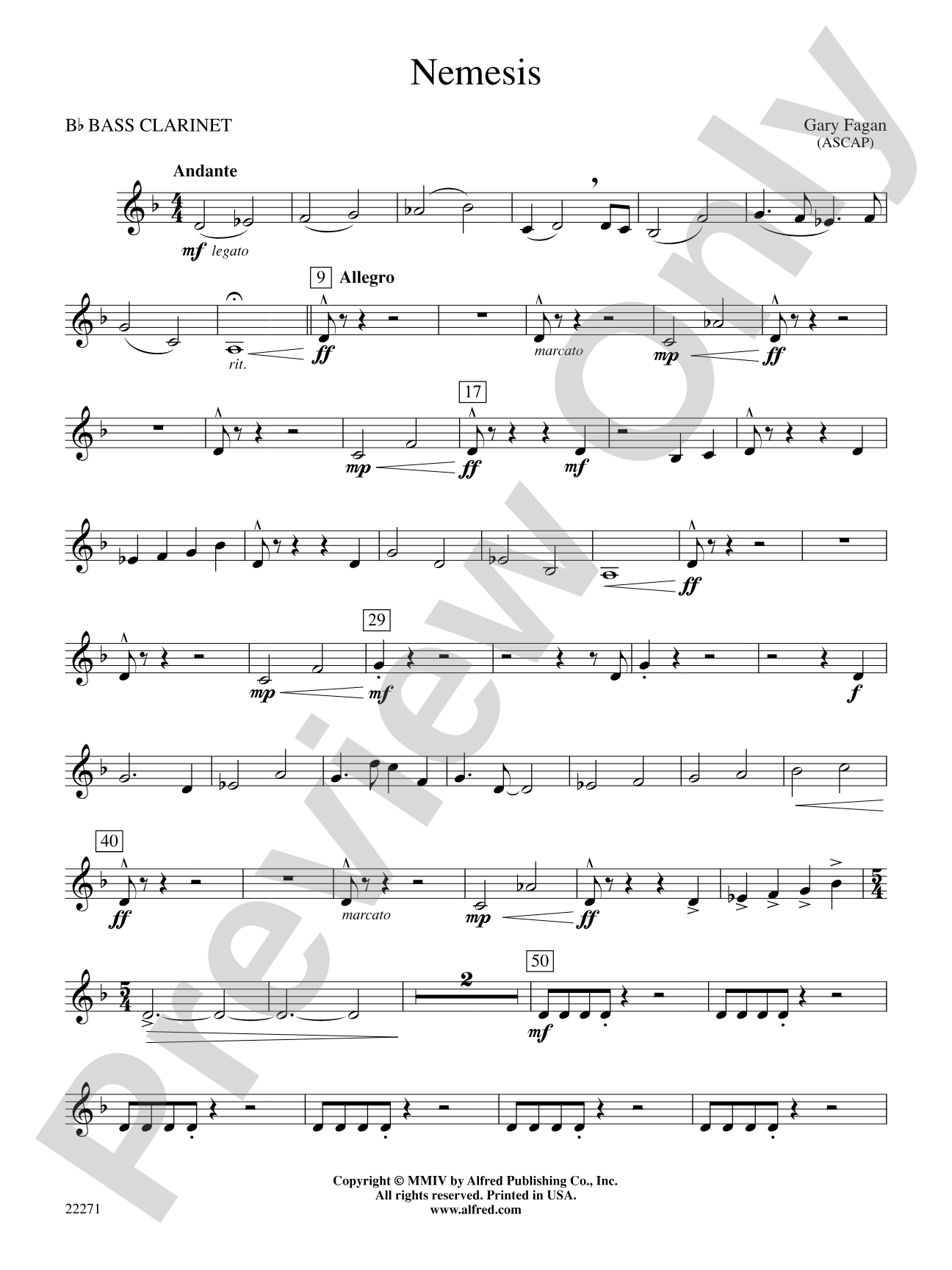

Nemesis: B-flat Bass Clarinet
By Gary Fagan
Grade: 2 (Medium Easy)
Item: 00-PC-0000525_CBC
$3.00
Pickup currently not available
Description
The dictionary defines the word "nemesis" as: 1. goddess of divine retribution; 2. one that inflicts retribution or vengeance; 3. a formidable and usually victorious rival. This piece was written to convey the sense of the definition. Although the piece begins serenely, it soon ventures into a driving storm of contemporary rhythms and harmonies that continues until the end of the piece. A feeling of conflict between formidable musical forces permeates the piece; creating an exciting new work for young bands. This title is available in MakeMusic Cloud.


Don't just read it, hear it, play along with it, and watch your students grow with it. In MakeMusic Cloud, Nemesis: B-flat Bass Clarinet comes alive with professional accompaniment, adjustable tempo, and built-in practice tools that turn solo practice into real progress.
Open in the Player
Jump straight in and assign it today.
Start Your Free Trial
Open this title and explore the full library in minutes.
Sample Audio
1
Audio File
--:--
0:00
0:00
Sample Video
No sample videos found.
Additional Details
Series:
Young Symphonic
Publisher:
Alfred Music
Page Count:
260
SKU:
00-PC-0000525_CBC
More about this title
About the Composer: Gary Fagan

Gary Fagan brings three decades of classroom experience to his work as a composer and arranger. A Virginia native educated at Bridgewater College and James Madison University, he spent 36 years directing bands in Albemarle County before transitioning to university supervision and adjunct teaching in arranging at JMU. His compositions and arrangements have reached audiences at prestigious venues including the Midwest Band and Orchestra Clinic, the White House, and gubernatorial ceremonies.
Recognized as an Outstanding Middle School Teacher by the University of Virginia's Phi Delta Kappa chapter and honored with educator awards from the Virginia Governor's School and the Piedmont Council of the Arts, Fagan remains deeply invested in music education through clinician work and adjudication. He serves as Assistant Director and percussionist with the Charlottesville Band, maintains membership in ASCAP and the National Band Association, and continues to compose and arrange for band and string orchestra.
Why we love this
Fagan understands young band repertoire from the inside out, and Nemesis proves it. The piece respects the technical limitations of Grade 2 ensembles while refusing to settle for musical timidity; it builds from a calm opening into genuine rhythmic and harmonic complexity that keeps both performers and audiences engaged. For a festival program, it delivers impact without demanding virtuosity.
What to expect
Nemesis begins in stillness, almost meditative. Then conflict erupts; angular rhythms and modern harmonies create a sense of struggle and inevitability, as if a distant storm has suddenly arrived. The energy sustains throughout, building a narrative arc that feels both sophisticated and unmistakably contemporary.
Who it's for
Young bands at the Grade 2 level who are ready to explore contemporary compositional techniques without overwhelming their developing technical skills. This piece works particularly well for groups preparing for festival or contest performances, where audiences expect polished musicianship in an accessible package.
How to get the most out of it
- Balance the contrast between the serene opening and the driving rhythmic material that follows by resisting the urge to rush during the calm sections; let the ensemble sit comfortably in the slower tempo so the transition feels earned rather than abrupt.
- Layer the contemporary harmonies carefully in the fast section, ensuring that inner voices maintain clarity even as the overall texture thickens; mark dynamic relationships among the parts during rehearsal so the work feels unified rather than scattered.
- Shape the rhythmic momentum of the fast material by subdividing the beat mentally at slower tempos during early rehearsals, allowing your students to lock the syncopations before pushing toward performance speed.
- Use the recorded accompaniment available through MakeMusic Cloud to help your band internalize the harmonic language of the contemporary sections, especially if your ensemble has limited experience with modern idioms.
How to use it
Program Nemesis as a centerpiece for a festival entry or as a contrast piece on a concert that balances traditional and contemporary works. Its dramatic arc makes it an excellent segue from lighter repertoire into a more substantial second half, and its Grade 2 accessibility means it won't overshadow developing ensembles on a mixed-level concert.
Skills your students will build
- Reading and executing contemporary rhythmic figures and syncopation patterns
- Balancing ensemble tone across modern harmonic language
- Managing dynamic contrast between lyrical and driving sections
- Maintaining rhythmic precision in complex ensemble textures
- Responding to directional shifts in style and energy within a single work