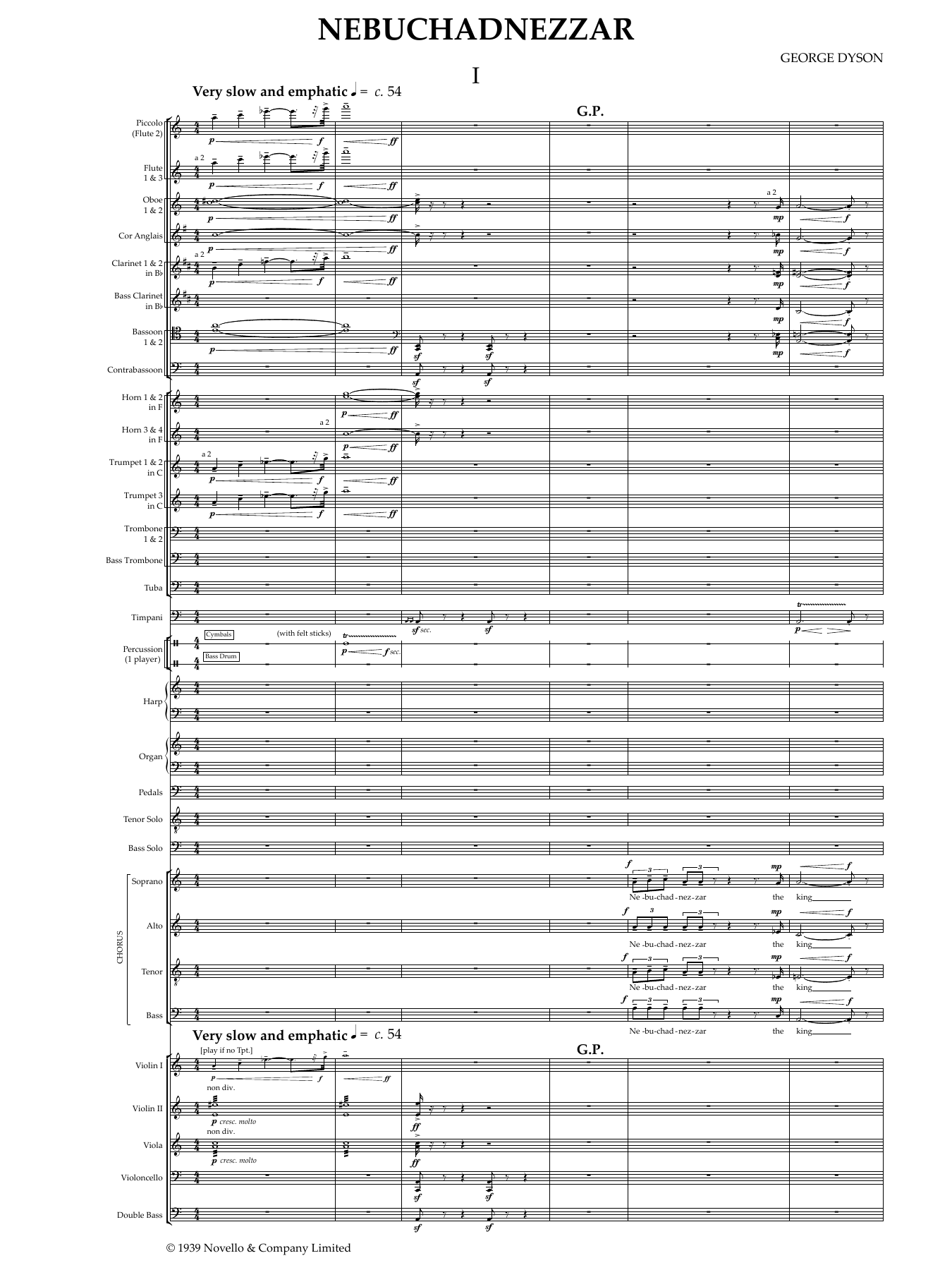
Nebuchadnezzar (Study Score) Sheet Music Preview

Nebuchadnezzar (Study Score): Full Orchestra Conductor Score & Parts

By George Dyson

Item: 35-PK01835117

Digital Download
$40.00

Buy Extra Parts (Digital PDF Download)

Product Price Quantity
Nebuchadnezzar - Full Score $40.00

Parts Added to Cart!

Description
Nebuchadnezzar (Study Score)

Nebuchadnezzar (Study Score): Full Orchestra Conductor Score & Parts isn't in MakeMusic Cloud just yet...but it could be. Let us know you'd like to see it, and you'll help shape what comes next. In the meantime, start a free trial and dive into thousands of interactive titles your students can play along with today.

Sample Audio
No sample audio found.
Sample Video
Additional Details
Publisher: Hal Leonard
SKU: 35-PK01835117

More about this title

About the Composer: George Dyson

George Dyson (1883-1964) was a British composer, organist, and educator whose career spanned nearly a century of English musical life. He served as Director of the Royal College of Music and composed prolifically across orchestral, choral, and chamber genres, establishing himself as a significant figure in early twentieth-century British composition.

Why we love this

Dyson's orchestration here is sophisticated without becoming overwrought, giving student musicians the chance to work with genuinely interesting harmonic language and textural variety. The piece rewards disciplined ensemble work and offers conductors a study score that reveals compositional craft without requiring a massive performing force.

What to expect

The music moves with purposeful elegance, rooted in harmonic traditions but inflected with the subtle chromaticism and orchestral colour that defines Dyson's generation. There's formality and architecture in the piece, yet moments of genuine lyricism emerge that draw the listener in.

Who it's for

Conductors leading orchestras at the high school or early undergraduate level who want repertoire with real compositional substance and historical weight. This score provides students with a window into twentieth-century British orchestral writing without the extremes of complexity found in more modernist works.

How to get the most out of it

  • Balance the inner voices carefully in passages where woodwinds carry the harmonic framework. Dyson writes underneath the principal melody line frequently, and clarity here prevents the texture from becoming murky.
  • Shape longer phrases by finding natural breath points rather than letting the meter dictate phrasing. This approach helps the piece breathe and connects the harmonic movement across bar lines.
  • Attend to the transition points between sections. Dyson's architectural choices reward clear articulation of form, which helps an ensemble understand the piece's larger design.
  • Give the principal lines to your best musicians. The exposed writing means part accuracy and musical maturity matter significantly.

How to use it

Position this as a serious concert work that anchors a program celebrating British orchestral music, or program it alongside other twentieth-century nationalist composers to show how different regions were approaching similar compositional questions. The study score format makes it ideal for educational settings where learning the score itself is part of the pedagogical value.

Skills your students will build

  • Reading and balancing complex orchestral textures with multiple independent lines
  • Responding to nuanced conducting gestures that shape harmonic progression
  • Understanding form and architecture in early twentieth-century British composition
  • Ensemble coordination across sections in passages where material is distributed unevenly
  • Sustaining musical line through harmonic movement rather than metrical accent alone

You May Also Like