Nashir L'nishmat Kol Sheim Sheet Music Preview

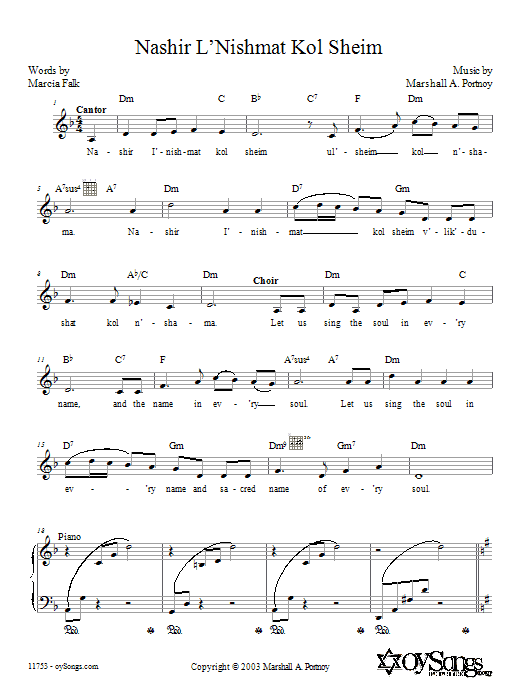
Nashir L'nishmat Kol Sheim: Lead Sheet / Fake Book

As performed by Marshall Portnoy

Item: 35-DS00090490

Digital Download
$3.99
Description

Nashir L'nishmat Kol Sheim: Lead Sheet / Fake Book isn't in MakeMusic Cloud just yet...but it could be. Let us know you'd like to see it, and you'll help shape what comes next. In the meantime, start a free trial and dive into thousands of interactive titles your students can play along with today.

Sample Audio
No sample audio found.
Sample Video
Additional Details
Publisher: Hal Leonard
Page Count: 2
SKU: 35-DS00090490

More about this title

Why we love this

A lead sheet opens this Hebrew text to improvisation and arrangement in ways a full score cannot. Pianists and vocalists gain immediate access to the melody and harmony without the weight of orchestration, making it ideal for accompanying singers in rehearsal or creating your own interpretive layers.

What to expect

The Hebrew text carries spiritual weight and deliberate pacing. A lead sheet arrangement invites personal expression while honoring the song's meditative character, letting the pianist breathe with the vocalist rather than lock into rigid patterns.

Who it's for

Vocalists studying Hebrew repertoire, pianists building skills in lead sheet reading and harmonic interpretation, and musicians preparing music for Jewish liturgical or educational settings. This works equally well for classroom accompaniment and ensemble rehearsal.

How to get the most out of it

  • Establish the relationship between melody and chord symbols before adding flourishes; the foundation matters most in lead sheet interpretation.
  • Explore rubato in the vocal line once the harmonic progression is secure; Hebrew liturgical music often breathes with flexibility.
  • Consider the voicing of chords in your left hand as an opportunity to shape dynamics and color rather than merely filling time.

How to use it

Include this alongside other Hebrew art songs or liturgical music in a concert exploring sacred vocal traditions. It pairs naturally with educational programs about Jewish music and culture, or as an accompaniment resource for voice students learning repertoire in translation.

Skills your students will build

  • Reading and interpreting lead sheet notation
  • Chord symbol recognition and harmonic analysis
  • Accompanying vocalists with flexible, responsive piano voicing
  • Understanding Hebrew pronunciation and musical phrasing in traditional song

You May Also Like