Nardis Sheet Music Preview

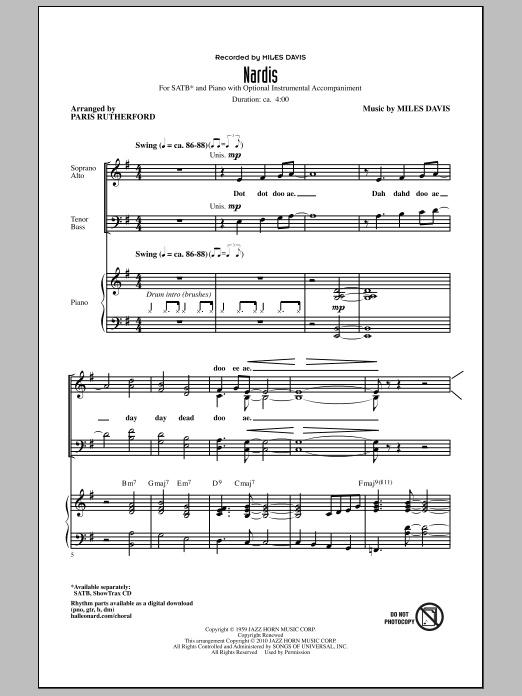
Nardis: SATB Choral Octavo

By Miles Davis / Arranged by Paris Rutherford

Item: 35-DS00151446

Digital Download
$2.99
Description

Nardis: SATB Choral Octavo isn't in MakeMusic Cloud just yet...but it could be. Let us know you'd like to see it, and you'll help shape what comes next. In the meantime, start a free trial and dive into thousands of interactive titles your students can play along with today.

Sample Audio
No sample audio found.
Sample Video
Additional Details
Publisher: Hal Leonard
Page Count: 14
SKU: 35-DS00151446

More about this title

About the Composer: Miles Davis

Miles Davis revolutionized jazz across seven decades, moving fluidly between bebop, cool jazz, modal exploration, and fusion. His harmonic innovations and restless creative drive established new standards for improvisation and ensemble interaction that ripple through jazz pedagogy today. For choral musicians, Davis's compositions offer windows into how jazz melody and harmony function at their most sophisticated, revealing the underpinnings of standards that shape contemporary vocal jazz.

Nardis exemplifies Davis's gift for writing themes that balance accessibility with harmonic depth. The piece draws from his work during the 1950s and 1960s, periods when his quintet and sextet recorded some of the most influential jazz of the century. Arranging Davis for choir requires singers to internalize rhythmic and harmonic sensibilities rooted in instrumental jazz, making his work invaluable for choral programs aiming to deepen students' understanding of jazz language.

Why we love this

Nardis gives choirs genuine access to Davis's harmonic vocabulary without requiring instrumental jazz chops. Paris Rutherford's arrangement respects the melody's elegance while building rich harmonic textures that reward careful voicing work, and the piece sits at a technical level that challenges solid singers without demanding fusion-era virtuosity.

What to expect

Nardis carries the quiet intensity of a late-night jazz set, with a melody that unfolds over subtle harmonic shifts. The arrangement draws listeners into Davis's world of modal thinking and space, where what you leave unsaid matters as much as the notes themselves.

Who it's for

Choirs with solid intonation and basic ensemble maturity can navigate this piece. It suits programs looking to program a single jazz standard without committing to a full jazz songbook, and it works equally well for concert choirs seeking to expand beyond classical European traditions.

How to get the most out of it

  • Establish the swing feel early in rehearsal by having the choir listen to a Miles Davis recording and tap the backbeat. The groove rides on precision rather than heaviness, so encourage rhythmic lift rather than laying into the beat.
  • Shape the phrase contours by thinking through the harmonic rhythm. These chords often resolve on the second half of beats or across bar lines, so mark those moments where voices need to breathe together rather than at obvious resting points.
  • Balance the soprano line as your primary melodic voice, but ensure the inner voices project the jazz harmony fully. Homophonic sections will feel thin if altos and tenors don't anchor their triadic color.
  • Drill the chromatic or unexpected harmonic moves in isolation. Jazz writing often sidesteps predictable voice leading, so sing these passages as four-part exercises before returning to the full context.

How to use it

Position this in a concert alongside other jazz or contemporary work to signal your choir's stylistic range. It also serves as an excellent capstone piece for a unit on jazz history, offering students a direct connection to one of jazz's foundational figures.

Skills your students will build

  • Singing swing rhythms and understanding backbeat placement
  • Hearing and balancing jazz harmony across four-part voicing
  • Interpreting phrase shapes that follow harmonic rhythm rather than text stress
  • Blending into ensemble while maintaining individual line integrity in chromatic voice leading

You May Also Like