
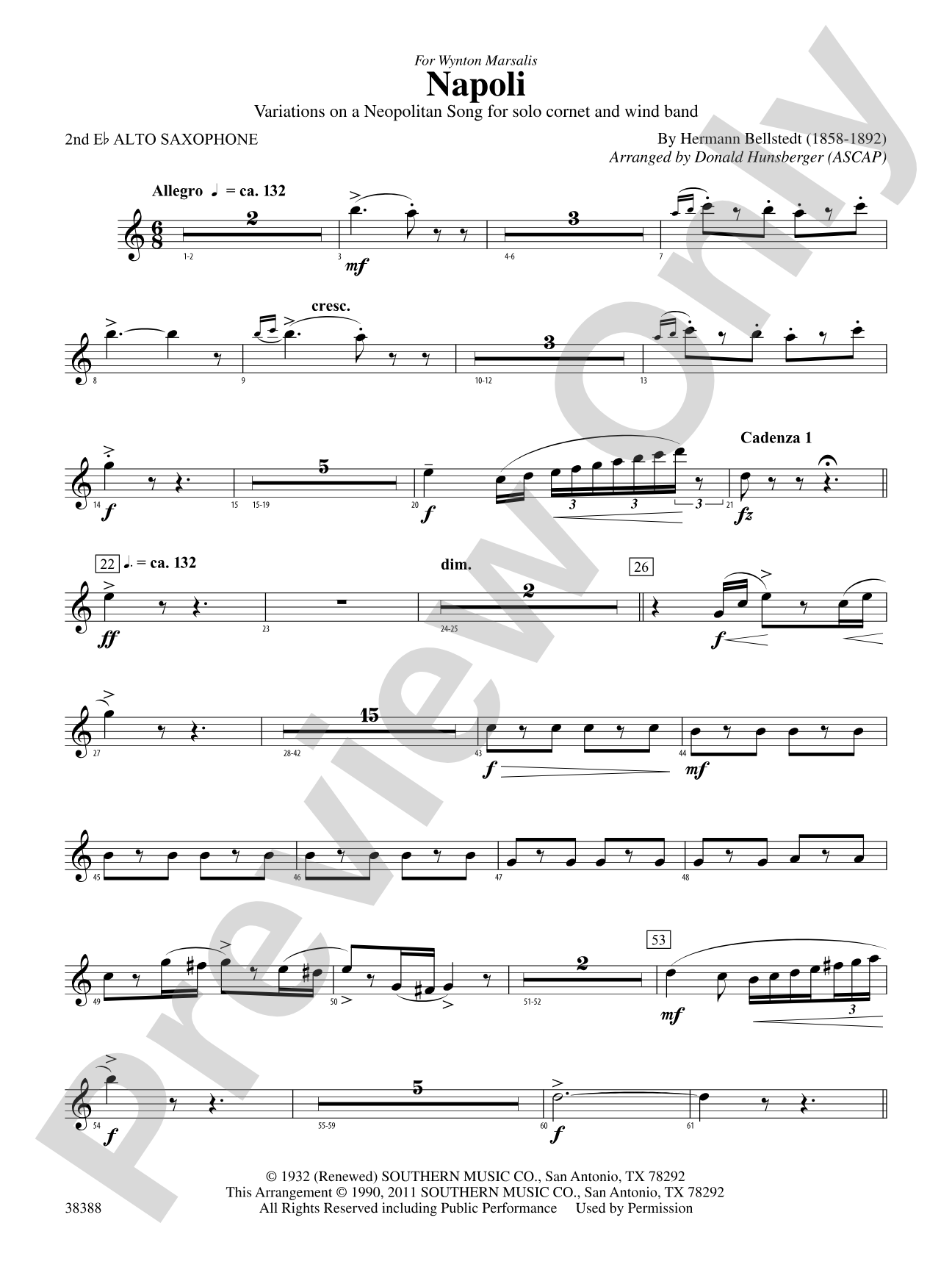
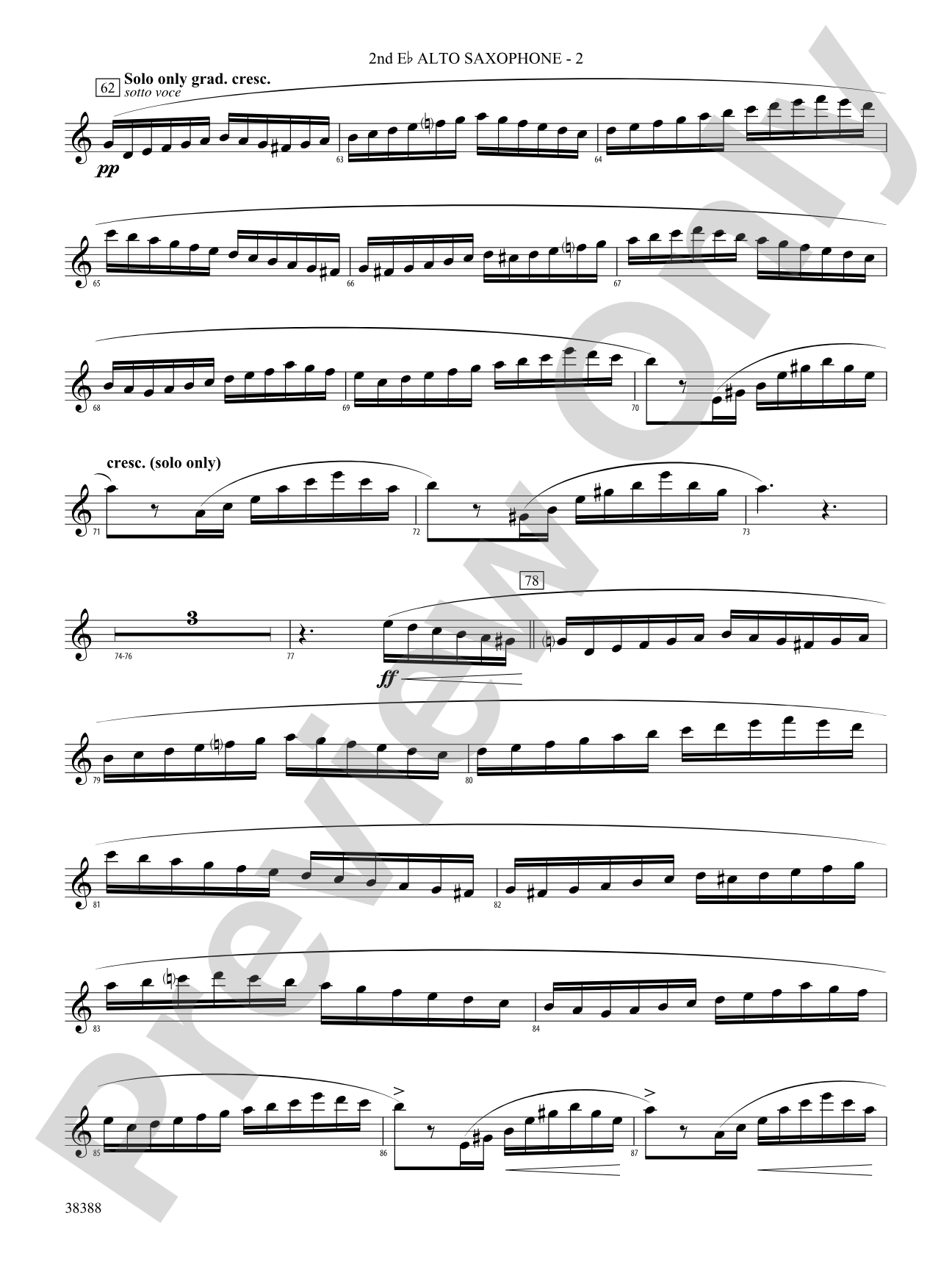

Napoli: 2nd E-flat Alto Saxophone
For Wynton Marsalis (Variations on a Neopolitan Song for Solo Cornet and Band)
By Hermann Bellstedt / arr. Donald Hunsberger
Grade: 3 (Medium Easy) (Solo 4)
Item: 00-PC-0015458_AX2
$3.00
Pickup currently not available
Description
Born in Germany, Hermann Bellstedt immigrated to America in 1867, where his family settled in Cincinnati. A prodigy on the cornet, he played with Patrick Gilmore as cornet soloist and assistant to the famous Ben Bolt, and, in 1904, joined the Sousa Band, playing alongside Walter Rogers and Herbert L. Clarke. Bellstedt's variations on Napoli feature the popular Neopolitan song "Finiculi, Finicula" (composed by Luigi Denza in 1880) that celebrated the funicular railway built up the side of Mt. Vesuvius in 1880. Other popular Amalfi Coast songs include "'O Solo Mio" and "Torna a Sorriento." A variety of solo textures, whimsical to intense, are demonstrated by this Donald Hunsberger arrangement dedicated to Wynton Marsalis as a part of the "Carnaval" project. A grandiose opportunity to feature your cornet or trumpet soloist! (5:45)


Don't just read it, hear it, play along with it, and watch your students grow with it. In MakeMusic Cloud, Napoli: 2nd E-flat Alto Saxophone comes alive with professional accompaniment, adjustable tempo, and built-in practice tools that turn solo practice into real progress.
Open in the Player
Jump straight in and assign it today.
Start Your Free Trial
Open this title and explore the full library in minutes.
Sample Audio
1
Audio File
--:--
0:00
0:00
Sample Video
Additional Details
Series:
Donald Hunsberger Wind Library
Publisher:
Alfred Music
Page Count:
348
SKU:
00-PC-0015458_AX2
More about this title
About the Composer: Hermann Bellstedt
Hermann Bellstedt (1858–1926) was a German-born cornet virtuoso who became one of America's most celebrated brass soloists. After immigrating to Cincinnati in 1867, he rose to prominence as a featured performer with Patrick Gilmore's band and later as a principal cornet soloist with John Philip Sousa's ensemble, where he performed alongside legendary brass players Walter Rogers and Herbert L. Clarke. Bellstedt's compositions and variations for cornet showcased the technical brilliance and lyrical expressiveness he demanded of the instrument, cementing his legacy as both a performer and composer who shaped American brass band tradition.
His variations on popular melodies, particularly those drawn from European folk songs and operatic themes, became staples of the concert band and brass solo repertoire. Bellstedt's writing balances virtuosic display with genuine musical substance, a quality that has kept his works in active performance nearly a century after his death.
Why we love this
This arrangement transforms a beloved 19th-century variation into a vehicle that works beautifully for modern concert bands while honoring the original soloist tradition. Hunsberger's orchestration gives your brass section real musical color around the feature, and the solo part itself remains highly rewarding without demanding a career-level virtuoso. The program note practically writes itself: a connection to Sousa, to cornet history, and to the enduring appeal of Italian melody.
What to expect
Spirited and celebratory, anchored in the sunny optimism of Neapolitan song. The variations move fluidly from playful and lilting to dramatically intense, with the cornet soaring above ensemble textures that range from supportive accompaniment to richly harmonic backdrop. There's pageantry here without pretension.
Who it's for
Band directors seeking a substantial solo feature that showcases a strong cornet or trumpet player without demanding soloistic temperament or extensive prior solo experience. This works equally well for programs wanting to highlight a developing soloist or to give a strong player a genuine showpiece with historical weight.
How to get the most out of it
- Shape the solo passages with vocal phrasing rather than mechanical precision; Bellstedt's variations invite lyrical storytelling alongside technical display.
- Balance the ensemble writing so the soloist emerges naturally without requiring extraordinary dynamics; Hunsberger's orchestration supports the cornet throughout.
- Establish a clear character for each variation section; the shift from whimsical to intense textures should feel intentional and theatrical rather than abrupt.
- Allow the soloist adequate rehearsal time with the full band to lock rhythmic figures, particularly in passages where the cornet navigates rapid articulation over active ensemble accompaniment.
How to use it
Program this as a concert centerpiece that stands on its own, or pair it with other works from the Sousa era to build a thematic program exploring American brass band history. The five-minute length and Grade 3 difficulty make it an excellent choice for a spring concert or invitational performance where you want to feature a soloist within a full ensemble context.
Skills your students will build
- Accompanying a featured soloist with rhythmic precision and textural awareness
- Executing rapid articulation and rhythmic subdivisions in ensemble passages
- Reading and performing lyrical, songlike passages with phrase direction
- Balancing ensemble support so a cornet or trumpet solo projects without excessive volume
- Interpreting stylistic contrasts from lyrical to virtuosic within a single work