
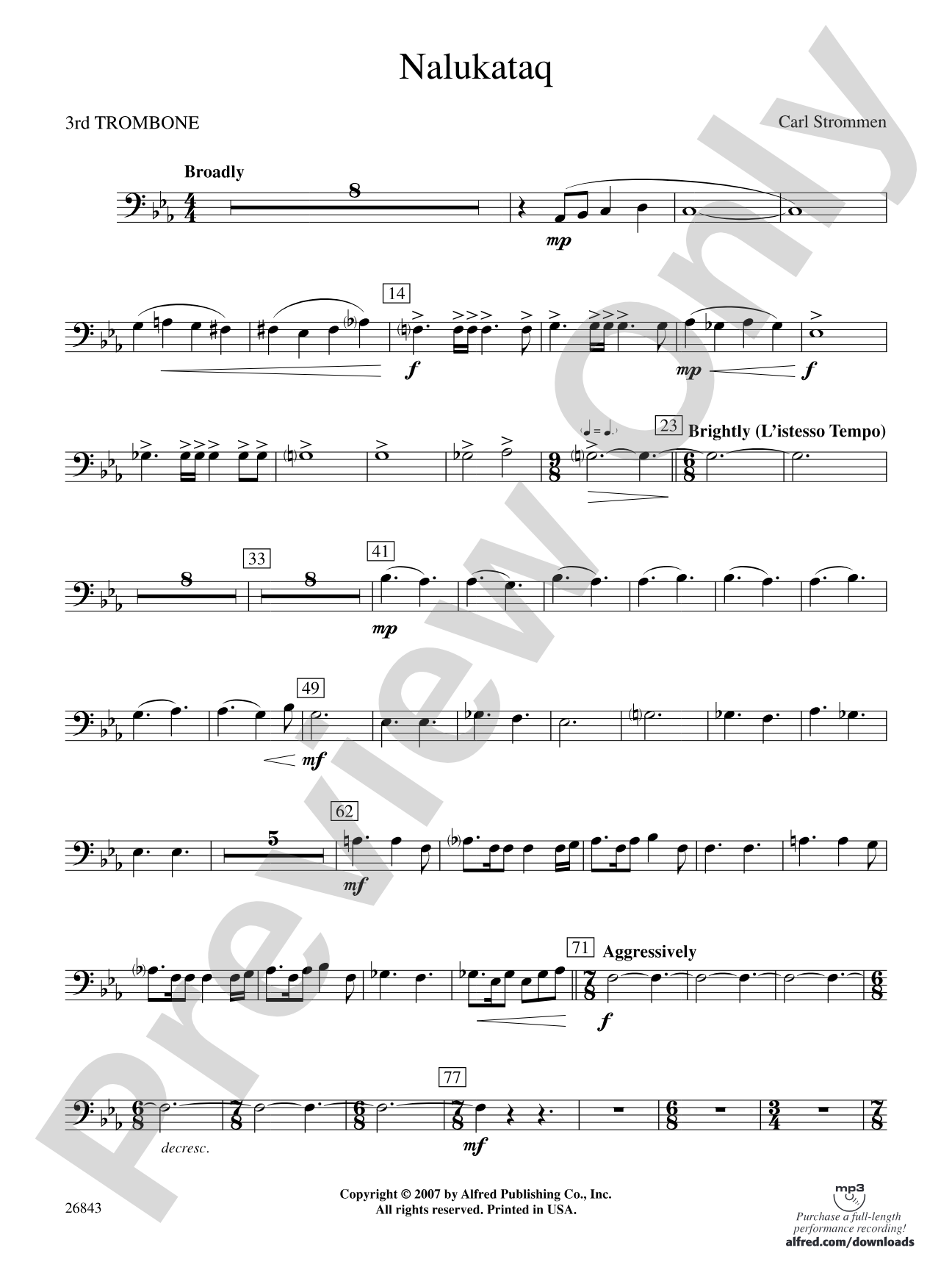

Nalukataq: 3rd Trombone
By Carl Strommen
Grade: 4.5 (Medium Difficult)
Item: 00-PC-0001281_TN3
$3.00
Pickup currently not available
Description
The festival of Nalukataq (Nah-loo'-ka-tahk) (the blanket toss) takes place in June and marks the end of a safe and successful whaling season. Nalukataq describes the events prior, during and after the hunt. Very exciting and uplifting! This title is available in MakeMusic Cloud.


Don't just read it, hear it, play along with it, and watch your students grow with it. In MakeMusic Cloud, Nalukataq: 3rd Trombone comes alive with professional accompaniment, adjustable tempo, and built-in practice tools that turn solo practice into real progress.
Open in the Player
Jump straight in and assign it today.
Start Your Free Trial
Open this title and explore the full library in minutes.
Sample Audio
1
Audio File
--:--
0:00
0:00
Sample Video
No sample videos found.
Additional Details
Series:
Alfred Concert Band
Publisher:
Alfred Music
Page Count:
249
SKU:
00-PC-0001281_TN3
More about this title
About the Composer: Carl Strommen

Carl Strommen stands among the most frequently performed composer-arrangers in contemporary music, with works spanning concert band, orchestra, jazz ensemble, and vocal literature. His scores appear regularly in concert halls, broadcasts, and film soundtracks, and his reputation as both clinician and commission writer keeps him engaged across the country and beyond.
A City College of New York graduate, Strommen has maintained strong ties to academic music education, serving as adjunct professor of orchestration and composition at C.W. Post Campus of Long Island University. His consistent output has earned him multiple ASCAP Standard Writers Awards, reflecting the breadth and quality of his catalogue. He divides his time between Long Island and Colorado with his family.
Why we love this
Strommen captures the authentic energy of an Inupiat cultural celebration without resorting to borrowed folk material or stereotypes. The piece moves through distinct sections that mirror the actual arc of the festival narrative, giving your band a dramatic shape to play and a real story to tell an audience. At Grade 4.5, it sits at that ideal sweet spot where you can demand serious musicianship without overextending your section leaders.
What to expect
You experience the progression from quiet preparation through the adrenaline and danger of the actual hunt, then burst into the jubilation of Nalukataq itself. The music captures both the spiritual significance of a successful season and the pure communal joy of celebration, shifting between moments of restraint and passages of undeniable excitement.
Who it's for
Directors programming concert or festival settings who want repertoire that educates audiences about living cultural traditions. This work engages intermediate to advanced high school bands and accomplished middle school ensembles that can handle both the technical demands and the interpretive responsibility of representing another culture authentically.
How to get the most out of it
- Shape the opening to establish the anticipation of the hunt; resist the urge to rush the early pacing, as tension builds through restraint rather than speed.
- Balance the melodic material between sections so that the story remains clear; one section should never drown out the narrative thread Strommen is developing.
- Treat dynamic changes as part of the storytelling arc (pre-hunt preparation, the intensity of the hunt itself, the celebration of Nalukataq) rather than technical exercises.
- The blanket toss itself calls for precision ensemble playing; lock your rhythmic attacks so the excitement reads as coordinated joy, not chaos.
How to use it
Program Nalukataq as a centerpiece for a concert focused on multicultural traditions or as a standalone feature that gives your band a distinctive voice in festival competitions. Its narrative clarity makes it an excellent choice when you want the audience to leave with a sense of having experienced something real rather than merely heard a concert piece.
Skills your students will build
- Sectional independence while maintaining ensemble cohesion across shifting textures
- Dynamic control from molto soft to full ensemble fortissimo
- Articulation precision in rhythmic figures that drive the narrative forward
- Balance and blending in passages where multiple sections carry equal thematic weight
- Stylistic sensitivity when interpreting music rooted in a specific cultural context