
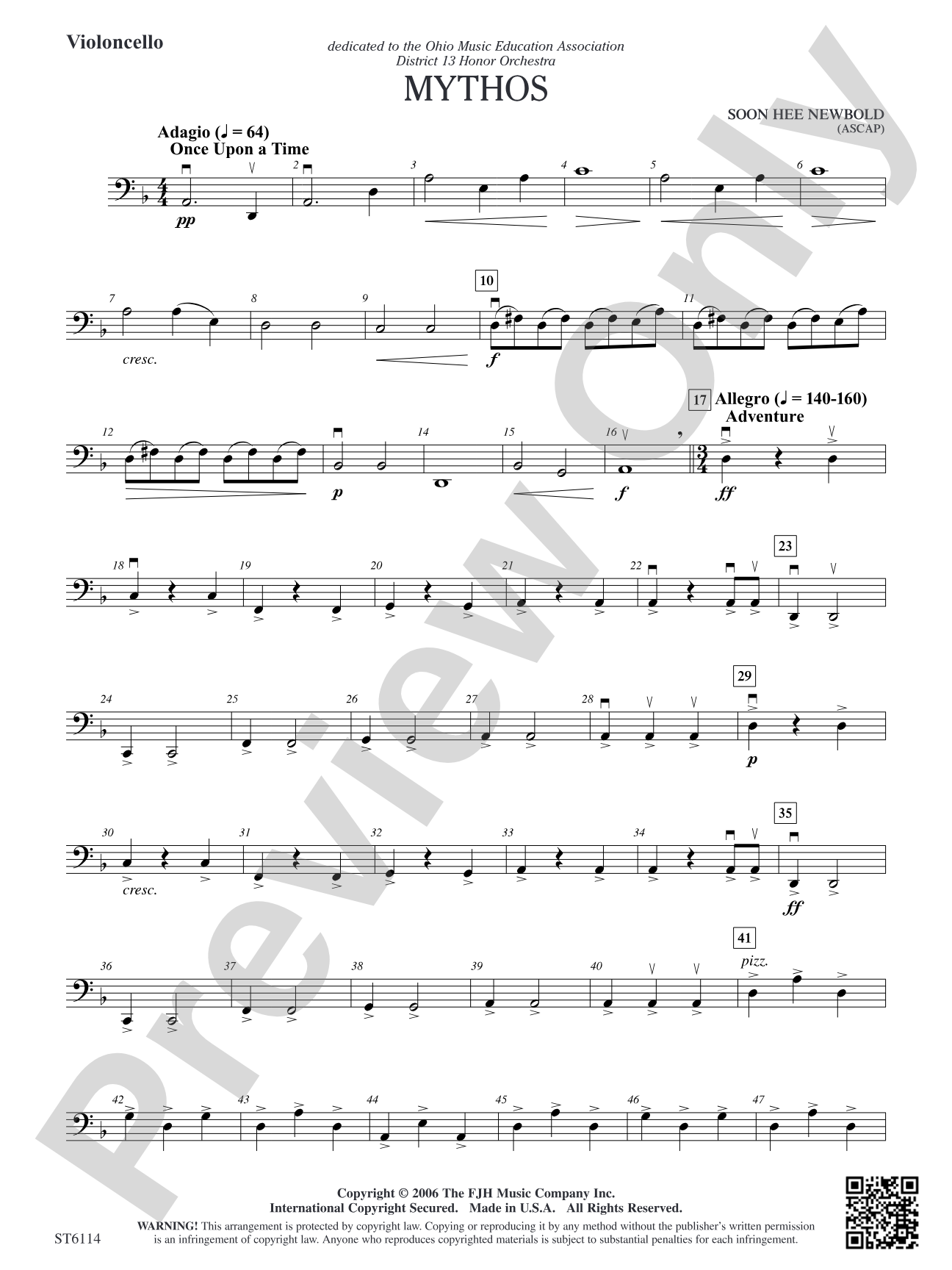

Mythos: Violoncello
By Soon Hee Newbold
Grade: 2.5
Item: 98-PC-DST6114_VC1
$7.00
Pickup currently not available
Description
Inspired by myths, legends, and fairy tales, Soon Hee Newbold has written a masterpiece with unique harmonies and driving melodies. The different sections, performed without pause, include Once Upon a Time, Fantasy, and Final Victory. Sure to spark the imagination of your students as they relive some of the most epic tales ever told!


Don't just read it, hear it, play along with it, and watch your students grow with it. In MakeMusic Cloud, Mythos: Violoncello comes alive with professional accompaniment, adjustable tempo, and built-in practice tools that turn solo practice into real progress.
Open in the Player
Jump straight in and assign it today.
Start Your Free Trial
Open this title and explore the full library in minutes.
Sample Audio
1
Audio File
--:--
0:00
0:00
Sample Video
No sample videos found.
Additional Details
Series:
FJH Developing Strings
Publisher:
The FJH Music Company, Inc.
SKU:
98-PC-DST6114_VC1
More about this title
About the Composer: Soon Hee Newbold

Soon Hee Newbold's compositional voice draws from a lifetime of cross-cultural musical experience. Beginning piano study at five and violin at seven, she performed as a concert artist across professional ensembles worldwide before establishing herself as a composer whose works span every performance level, from beginning elementary groups to major orchestras at venues including Carnegie Hall, the Kennedy Center, and Lincoln Center.
Newbold's compositions reflect her travels and global influences, a perspective she brings to her work as a guest clinician and keynote speaker. Her reach extends beyond concert music into film and recording projects, and she has conducted orchestras and bands throughout the United States, Europe, Asia, and Australia, building a reputation for creating music that engages and inspires musicians at every stage of their development.
Why we love this
Newbold crafts a narrative arc that holds young musicians' attention across three connected movements without pause, making this feel less like a collection of short pieces and more like a complete dramatic journey. The grade 2.5 writing balances accessibility with genuine musical sophistication, offering harmonies that surprise and melodies that stay with players long after rehearsal ends. Programming this at festivals and competitions gives your students a story to tell, not just notes to play.
What to expect
Stepping into a storybook world where the familiar becomes wondrous. The opening section feels hushed and enchanted, then building momentum carries you through a fantastical landscape alive with unexpected harmonic turns and propulsive rhythms that suggest action and adventure, before arriving at a triumphant resolution that feels earned rather than automatic.
Who it's for
String orchestras at the grade 2.5 level who are ready for music with real dramatic scope and harmonic ambition. Directors programming festivals, competitions, or concerts where a single substantial work makes a stronger impression than filler pieces will find Mythos rewarding for both the ensemble and the audience.
How to get the most out of it
- Shape the melodic lines with clear intention in each section. Once Upon a Time establishes the storybook world, so allow the opening phrases to breathe and draw listeners in before the energy shifts.
- Balance the driving momentum of the middle section against rhythmic clarity. These melodies deserve to cut through even as the accompaniment figures propel the piece forward.
- Use the three-movement structure as a rehearsal roadmap. Block work by section first, then practice the transitions between them to ensure the flow feels inevitable rather than segmented.
- Emphasize the harmonic colors Newbold creates, especially where they diverge from expected progressions. These moments reward attentive listening and give your players ownership of the sophistication in her writing.
How to use it
This works beautifully as a centerpiece concert piece or contest selection where you want a single work that showcases your ensemble's musicianship and storytelling ability. Its narrative structure also makes it effective as the bridge between a lighter opening number and a more technically demanding closer, giving audiences a moment of imaginative engagement that anchors the program.
Skills your students will build
- Sustaining musical direction across multiple connected sections
- Responding to harmonic color and unconventional progressions
- Balancing accompaniment figures against primary melodic lines
- Executing seamless transitions between contrasting musical moods
- Projecting character and narrative intent rather than simply playing notes