
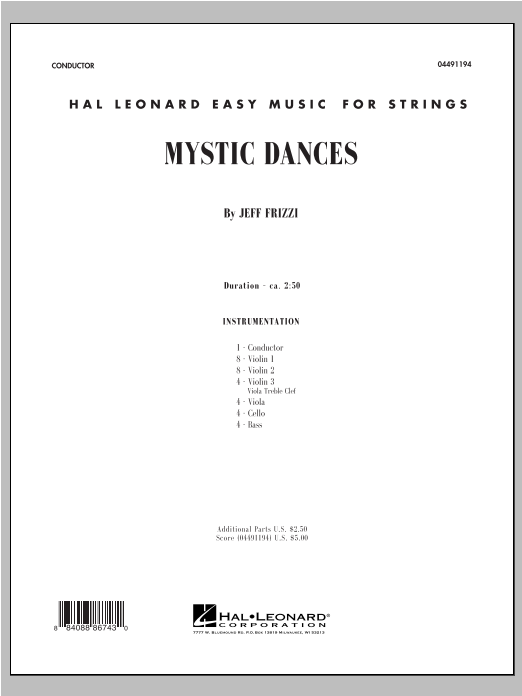

Mystic Dances: String Orchestra Conductor Score & Parts
By Jeff Frizzi
Grade: 2
Item: 35-PK00251112
$40.00
Pickup currently not available
Buy Extra Parts (Digital PDF Download)
| Product | Price | Quantity |
|---|---|---|
| Mystic Dances - Full Score | $7.50 | |
| Mystic Dances - Violin 1 | $7.00 | |
| Mystic Dances - Violin 2 | $7.00 | |
| Mystic Dances - Violin 3 (Viola Treble Clef) | $7.00 | |
| Mystic Dances - Viola | $7.00 | |
| Mystic Dances - Cello | $7.00 | |
| Mystic Dances - String Bass | $7.00 |
Parts Added to Cart!
Description
For developing players, this piece is designed to engage all players on interesting melodic parts in a medium tempo, symphonic dance style. Set in solid E minor, your students will love the strong, modal harmonies and dramatic musical atmosphere. Dur: 2:50


Mystic Dances: String Orchestra Conductor Score & Parts isn't in MakeMusic Cloud just yet...but it could be. Let us know you'd like to see it, and you'll help shape what comes next. In the meantime, start a free trial and dive into thousands of interactive titles your students can play along with today.
Request This Title
Tell us you want it.
Start Your Free Trial
Explore everything that's ready to play right now.
Sample Audio
No sample audio found.
Sample Video
No sample videos found.
Additional Details
Publisher:
Hal Leonard
SKU:
35-PK00251112
More about this title
Why we love this
Frizzi has crafted something rare at this level: a piece where every section genuinely matters. The modal harmonies in E minor create an authentically dramatic sound without requiring technical gymnastics, so your players hear themselves making something substantial. The balanced distribution of melodic material means no one sits in filler territory.
What to expect
Mystic Dances evokes a deliberate, atmospheric mood that sits somewhere between folk tradition and symphonic sophistication. The modal harmony creates an almost ritualistic quality; the tempo allows space for the dramatic weight of each phrase to register fully.
Who it's for
Grade 2 string orchestras with developing ensemble cohesion and intermediate technical facility. Players who have moved past open string basics and are ready to engage with stylistic interpretation will thrive here.
How to get the most out of it
- Shape the phrases around the modal quality rather than rushing through harmonic changes. Let the E minor sonority breathe and settle in the ears of your players and audience.
- Balance the string sections carefully during rhythmic unison passages. The dramatic effect depends on the ensemble locking in together, not one section overpowering another.
- Experiment with vibrato intensity in the melody lines. A restrained, focused vibrato at this tempo will enhance the mystique without sounding overwrought.
How to use it
Pair this with lighter, more straightforward concert openers earlier in your season, then feature it as a centerpiece once your ensemble has built interpretive confidence. The 2:50 duration makes it ideal for filling a programming slot between longer works or leading a thematic concert centered on modal music.
Skills your students will build
- Playing with stylistic intention in a modal harmonic context
- Balancing individual melodic lines within an ensemble texture
- Sustaining tone control and vibrato at medium tempo
- Responding to conducting gestures that shape longer musical phrases
- Reading accidentals and adjusting intonation in E minor tonality