
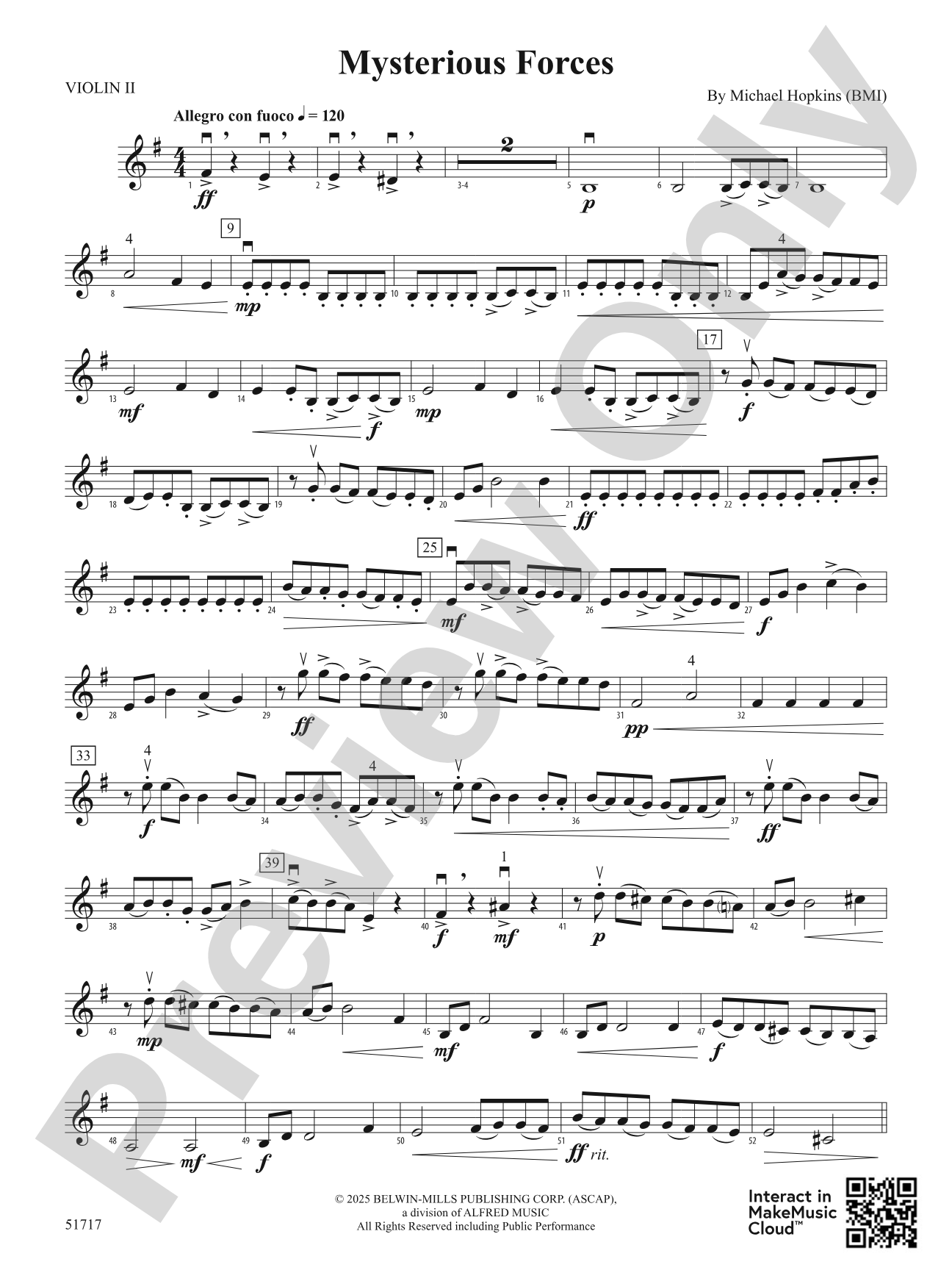

Mysterious Forces: 2nd Violin
By Michael Hopkins
Grade: 3
Item: 00-PC-0019472_VN2
$3.00
Pickup currently not available
Description
Mysterious Forces, by Michael Hopkins, is a fast and rhythmically energetic piece in E minor for intermediate orchestra. All sections of the orchestra are featured on melodic material. Violin, viola, and cello parts are playable in first position. Double basses have a few shifts to half, 2nd, and 3rd positions. Cellos have a few extensions to B-flat on the A string, and violins and violas have a few spots with low 1st finger and high 3rd finger. This is a great piece to work on articulations and bow speed. The melody features the slur 2-separate 2 bowing. The music features both short staccato bow strokes and longer legato bow strokes, and it features lots of dynamic contrasts and opportunities for learning about phrasing and shaping musical lines. (4:10)


Mysterious Forces: 2nd Violin isn't in MakeMusic Cloud just yet...but it could be. Let us know you'd like to see it, and you'll help shape what comes next. In the meantime, start a free trial and dive into thousands of interactive titles your students can play along with today.
Request This Title
Tell us you want it.
Start Your Free Trial
Explore everything that's ready to play right now.
Sample Audio
1
Audio File
--:--
0:00
0:00
Sample Video
No sample videos found.
Additional Details
Series:
Belwin Concert String Orchestra
Publisher:
Alfred Music
SKU:
00-PC-0019472_VN2
More about this title
About the Composer: Michael Hopkins

Michael Hopkins leads the music education program at the University of Michigan, where he teaches string techniques, orchestra methods, and music psychology. His background conducting university and secondary orchestras across Colorado, Michigan, and Vermont, combined with his founding directorship of the Burlington Chamber Orchestra, has shaped his deep understanding of what works in rehearsal and performance.
Hopkins has conducted clinics and festivals at over 100 venues nationwide and brings that wealth of experience directly into his compositions and arrangements. His published research in journals including the Journal of Research in Music Education and American String Teacher, along with his pedagogy book The Art of String Teaching, reflects his commitment to practical, evidence-based string education. He has published more than 70 orchestral works that balance musical substance with pedagogical intent.
Why we love this
Mysterious Forces delivers the rhythmic propulsion and technical engagement that intermediate orchestras need without sacrificing musical substance. Hopkins distributes melodic material across all sections, ensuring every player has something meaningful to execute while developing essential bow control through contrasting articulation patterns and dynamic shaping.
What to expect
Mysterious Forces pulses with dark, driving energy that builds through rhythmic momentum and layered orchestration. The minor key and energetic articulation give the piece a modern edge, while the contrasts between sharp staccato and sustained legato create moments of real drama and shape.
Who it's for
Intermediate string orchestras ready to tackle articulation control and bow speed as expressive tools. The piece works well for ensembles with students in their second or third year of study who can manage first position comfortably and are beginning to explore extended techniques like double bass position shifts.
How to get the most out of it
- Isolate the slur 2-separate 2 bowing pattern in sections before running the full piece; this articulation style drives the rhythmic energy and needs precision to sit properly with the ensemble.
- Use dynamic contrasts as structural markers. The shifts between staccato and legato sections gain impact when each character is fully committed, helping students hear how phrasing shapes the overall arc.
- Balance the lower voice writing carefully. With violas and cellos sharing supportive material alongside violins on melody, check intonation in the middle voices where tuning errors hide most easily.
- Encourage consistent bow speed through the longer legato passages. Many intermediate players rush or press; modeling and sectional work on bow control prevents the piece from losing its mysterious character in these moments.
How to use it
Program this as a festival or contest entry where its technical sophistication and musical character distinguish it from standard Grade 3 fare. The four-minute duration fits concert programs effectively, and the intermediate demands make it an ideal capstone piece for spring concerts or competition showcases.
Skills your students will build
- Slur 2-separate 2 articulation control
- Contrasting bow speeds and stroke lengths
- Dynamic phrasing and musical shaping
- String position work (extension on cello A string, double bass position shifts to 2nd and 3rd positions)
- Ensemble balance with distributed melodic material across all sections
- Rhythmic precision in fast, energetic passages