
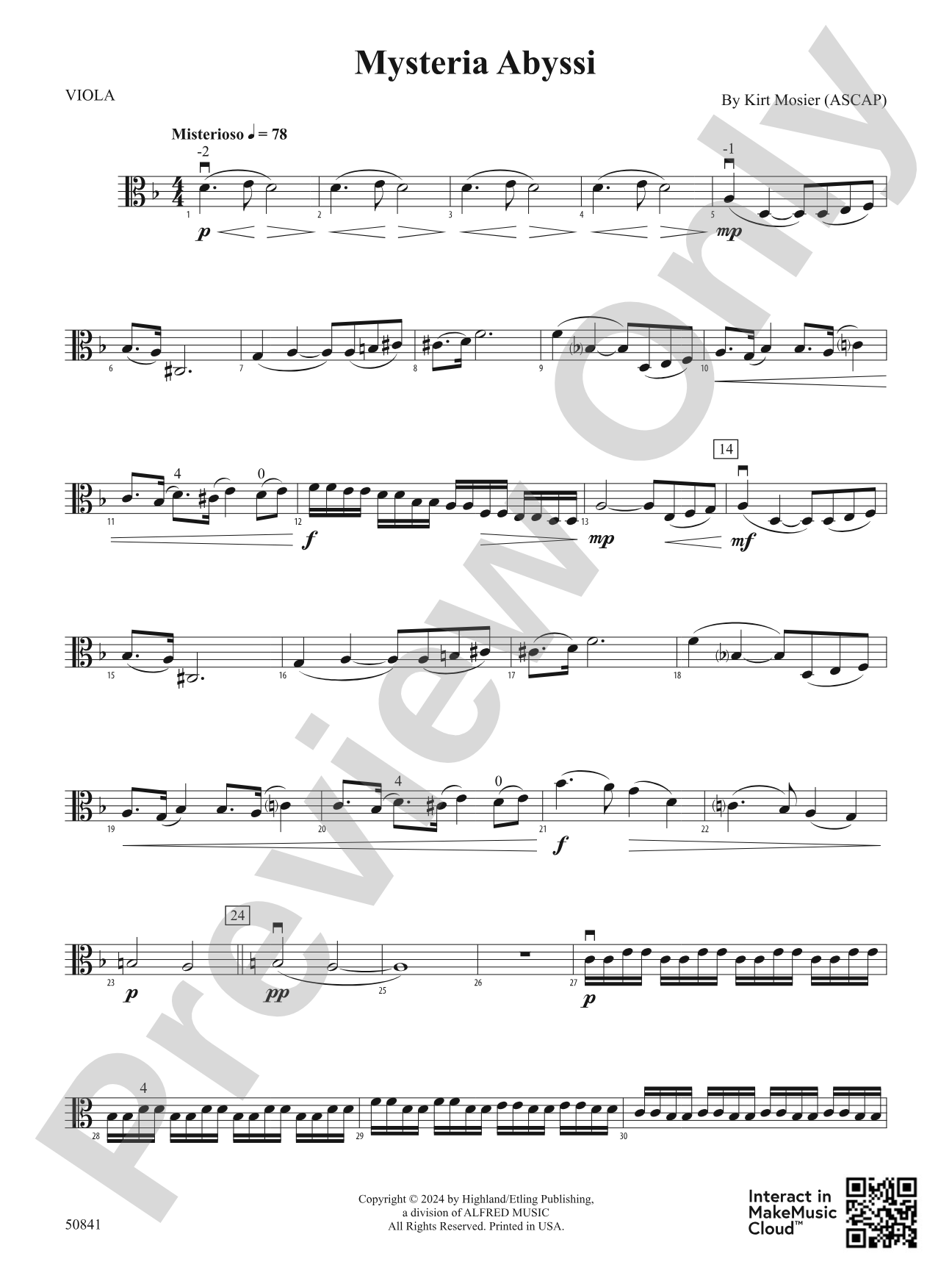

Mysteria Abyssi: Viola
By Kirt Mosier
Grade: 3.5
Item: 00-PC-0019288_VA1
$3.00
Pickup currently not available
Description
Mysteria Abyissi, by Kirt Mosier, was written to evoke the mysteries of the deep as the ethereal scoring takes the listener into the dark areas of the ocean. The optional celesta adds the magical sparkling quality of bioluminescent underwater creatures. (3:30)


Don't just read it, hear it, play along with it, and watch your students grow with it. In MakeMusic Cloud, Mysteria Abyssi: Viola comes alive with professional accompaniment, adjustable tempo, and built-in practice tools that turn solo practice into real progress.
Open in the Player
Jump straight in and assign it today.
Start Your Free Trial
Open this title and explore the full library in minutes.
Sample Audio
1
Audio File
--:--
0:00
0:00
Sample Video
Additional Details
Series:
Highland/Etling String Orchestra
Publisher:
Alfred Music
SKU:
00-PC-0019288_VA1
More about this title
About the Composer: Kirt Mosier

Kirt Mosier is a conductor and composer whose work spans concert halls and educational settings across the globe. From Carnegie Hall to the Sydney Opera House, his compositions have earned national recognition, including two composition awards for "Baltic Dance" (1993) and "American Reel" (2004). He was commissioned by the Portland Ballet Company to compose the score for "The Legend Of Sleepy Hollow," and his orchestral works regularly appear at the Midwest International Clinic in Chicago.
Mosier currently serves as artistic director for the Youth Symphony of Kansas City and associate conductor of the Lee's Summit Symphony. His background includes teaching orchestration at the University of Missouri Kansas City Conservatory and directing orchestral programs in the Raytown and Lee's Summit school districts. He founded the Digital Media Technology program at Summit Technology Academy, where his students have achieved national recognition and pursued careers in professional music and media production.
Why we love this
Mysteria Abyssi delivers vivid programmatic storytelling without demanding advanced technical skills from your ensemble. The optional celesta part creates a sophisticated soundworld that feels larger than Grade 3.5, rewarding students who engage with tone color and dynamic shaping while remaining accessible to developing orchestras. Contest adjudicators consistently respond to pieces that balance musical substance with appropriate difficulty, and this one checks both boxes.
What to expect
You descend into shadow and mystery, guided by sustained harmonies and subtle shifts in texture. Bioluminescent moments flicker like distant light, drawing the listener deeper into the abyss with each phrase, then retreating into darkness again.
Who it's for
String orchestras at the Grade 3.5 level looking for repertoire that develops musicianship and tone color without sacrificing engagement. This work suits both concert and festival contexts, offering students the satisfaction of building a cohesive sound around an evocative central image. Directors seeking programmatic variety will find it a natural fit alongside lighter or more technical selections.
How to get the most out of it
- Establish the dark, mysterious foundation in the lower strings before bringing in the upper voices. The bottom two voices carry the harmonic weight; clarity there stabilizes the ethereal scoring above.
- If using celesta, rehearse it separately with a soloist or advanced student. The sparkling quality only lands if the celesta player hears the orchestral context and shapes their entries as color rather than melody.
- Shape each dynamic swell as a complete gesture rather than mechanically hitting the marked level. The 3:30 length gives you room to breathe and let the programmatic imagery breathe with it.
- Tune carefully at the extremes of register. Deep ocean mysteries live in resonance; if the lower strings lack blend and warmth, the piece flattens into background music.
How to use it
Program this as a contrasting centerpiece in a concert balancing faster or lighter works. Its sustained, introspective character and moderate length make it ideal for late spring festivals where orchestras value repertoire that demonstrates tone control and ensemble cohesion. It also pairs naturally with other programmatic or scene-painting works that let students explore how orchestration and dynamics shape storytelling.
Skills your students will build
- Sustaining tone quality across extended passages and dynamic changes
- Blending within sections to create unified, warm string sound
- Following programmatic imagery to shape phrasing and expression
- Managing divisi and alternate voicings in Grade 3.5 string arrangements
- Responding to subtle variations in texture and orchestral color