

My Way Back Home: SATB Choral Octavo
Music by Jay Althouse
Item: 00-PO-0004207
$2.25
Minimum order quantity: 20 copies
Pickup currently not available
Related Items
My Way Back Home: SATB Choral Octavo |
$2.25
|
View |
Description
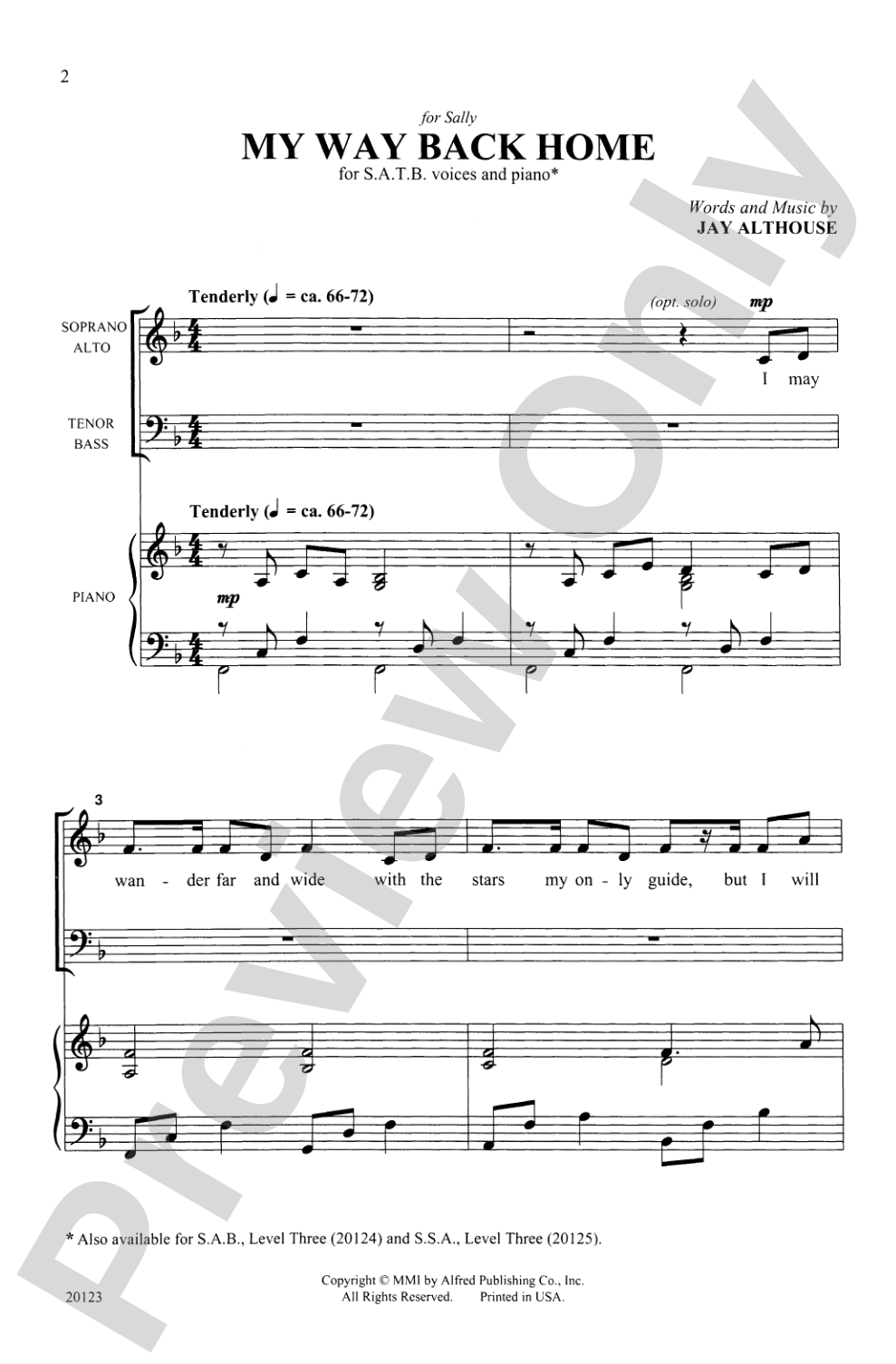
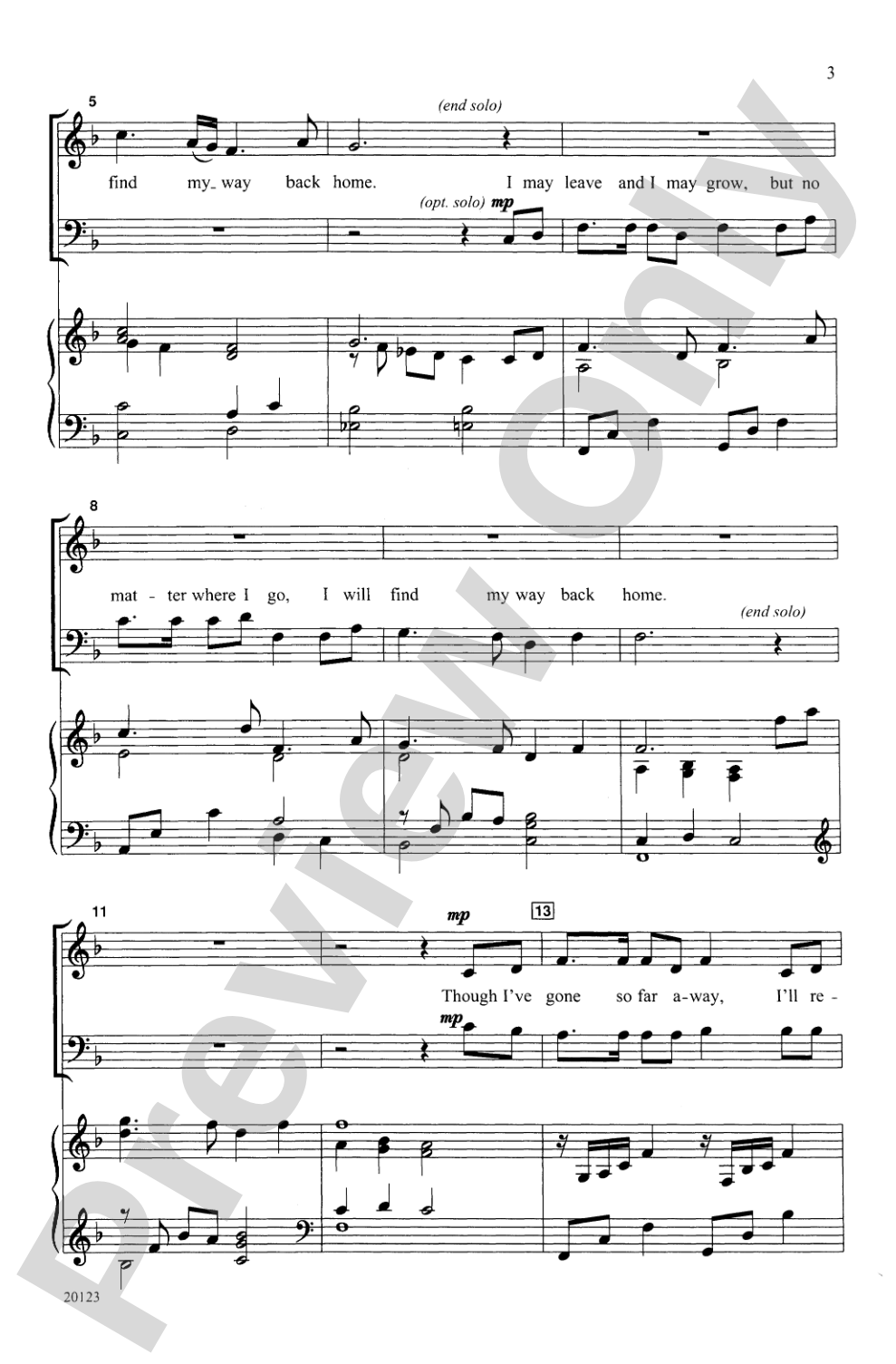
A simple piano introduction opens this melodic masterpiece: "I may wander far and wide with the stars my only guide, but I will find my way back home." The sentiment is as touching as the music, which could be described, stylistically, as an original folk song. It's simplicity is the source of its power and emotion. There are two optional solos to showcase your best singers. Could become a classic for your graduation and end-of-year concerts.


My Way Back Home: SATB Choral Octavo isn't in MakeMusic Cloud just yet...but it could be. Let us know you'd like to see it, and you'll help shape what comes next. In the meantime, start a free trial and dive into thousands of interactive titles your students can play along with today.
Request This Title
Tell us you want it.
Start Your Free Trial
Explore everything that's ready to play right now.
Sample Audio
1
Audio File
--:--
0:00
0:00
Sample Video
No sample videos found.
Additional Details
Series:
Alfred Archive Edition: Alfred Choral Designs
Publisher:
Alfred Music
Page Count:
8
SKU:
00-PO-0004207
More about this title
About the Composer: Jay Althouse

Jay Althouse studied Music Education and Music at Indiana University of Pennsylvania, where he later earned the Distinguished Alumni award. Early in his career, he worked as a rights and licenses administrator for a major educational music publisher and served on the Executive Board of the Music Publishers Association of America.
As a composer, Althouse has created more than 800 choral works performed widely across English-speaking countries. He holds membership in ASCAP and has received the ASCAP Special Award multiple times for his compositions. Beyond original choral music, he has co-written children's musicals with Sally K. Albrecht, compiled respected vocal solo collections, co-authored The Complete Choral Warm-up Book and Accent on Composers, and written classroom resources including Ready to Read Music and One-Page Composer Bios. His choral composition I Hear America Singing, co-written with Albrecht, was performed by the San Francisco Girls and Boys Choirs at President Barack Obama's inauguration in 2009. Althouse resides in North Carolina and serves on the National Advisory Board of the Folk Art Society of America.
Why we love this
Althouse crafts this piece with restraint and clarity, letting a folk-like melody carry the emotional weight rather than relying on harmonic complexity or contrapuntal intricacy. The optional solos give you flexibility to feature standout singers without overshadowing the ensemble sound, and the simplicity makes it accessible for choirs still building confidence in parts-singing. It's the kind of honest, uncluttered writing that stays with audiences long after the concert ends.
What to expect
From the first piano notes, this piece establishes a sense of quiet reflection and hope. The melody unfolds like a traveler's journal, honest and unhurried, with lyrics that resonate at life transitions. The folk idiom gives it a timeless, familiar quality even on first hearing, making it feel like a song the singers might have known all along.
Who it's for
This octavo works beautifully for choirs at high school and community levels seeking graduation or spring concert material that moves audiences without requiring advanced vocal technique. It's equally fitting for church choirs, youth ensembles, and any group that values emotional directness and accessibility. The optional solos make it flexible enough to showcase featured singers while keeping the core piece strong for full-ensemble performance.
How to get the most out of it
- Shape the opening piano introduction to establish the reflective mood; the pianist sets the emotional tone before voices enter.
- Keep the harmonic progressions transparent and warm in the ensemble sections; resist the urge to rush the pacing even though the writing is straightforward.
- Cast the optional solos with singers whose tone color complements the folk aesthetic rather than soloists with a classical vibrato-heavy sound.
- Balance the lyrical melody line (likely in the soprano or alto, depending on the arrangement) so it emerges naturally from the texture without requiring excessive volume from other parts.
How to use it
Program this as your emotional anchor in a graduation or end-of-year concert, where it can stand alone as a touching finale or pair it with lighter, more energetic pieces earlier in the program. Its introspective character makes it ideal for closing a set on a reflective note, and the sentiment of finding one's way home resonates particularly well during transitional moments in a school or community year.
Skills your students will build
- Sustaining lyrical lines while maintaining musical shape across longer phrases
- Blending four-part SATB harmony with consistent vowel and intonation control
- Responding to the expressive intent of text and supporting featured soloists without losing ensemble cohesion
- Singing in a folk idiom with natural, unforced tone quality