
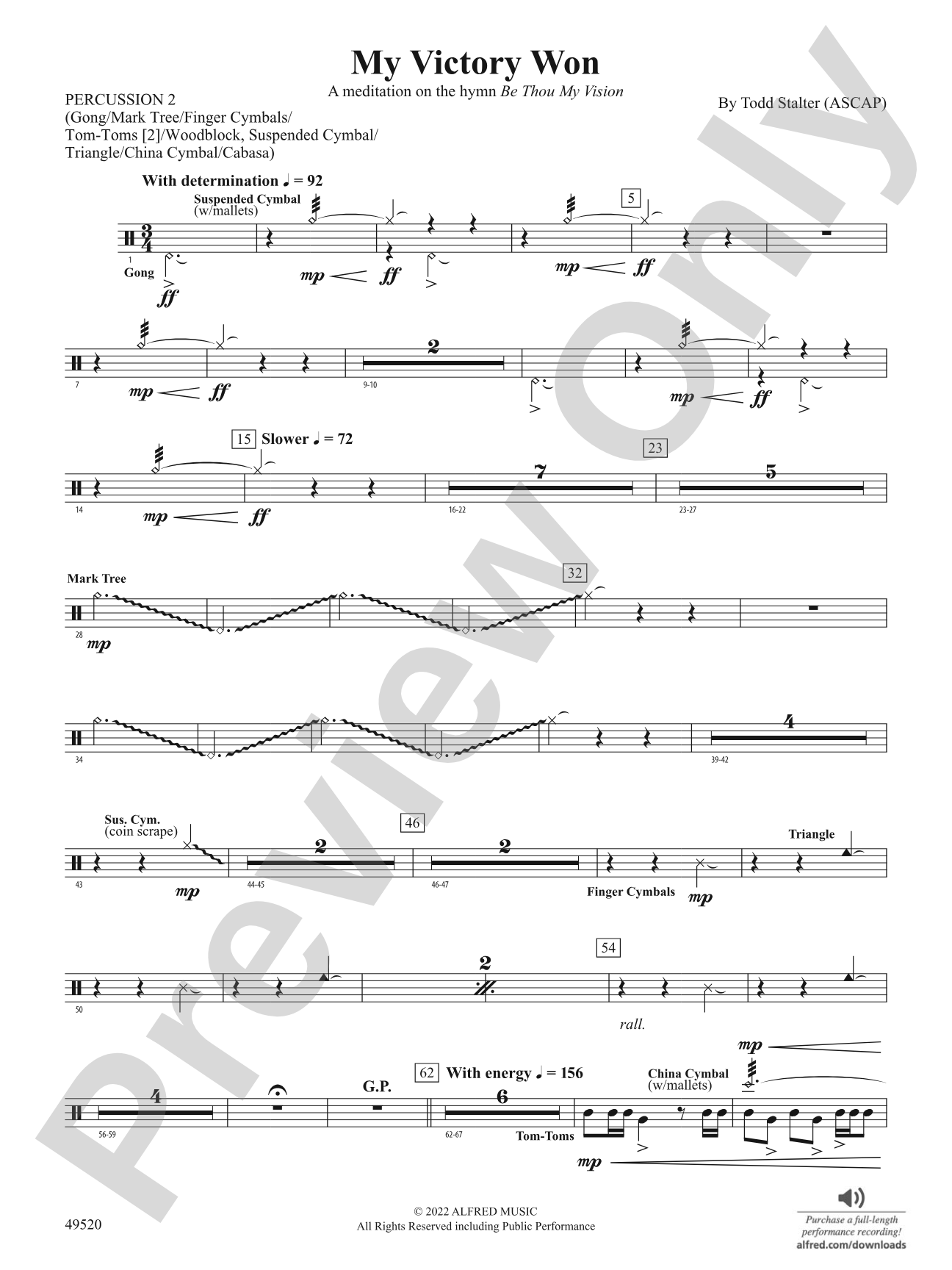

My Victory Won: 2nd Percussion
A Meditation on the Hymn, "Be Thou My Vision"
By Todd Stalter
Grade: 3.5
Item: 00-PC-0018813_PC2
$3.00
Pickup currently not available
Description
My Victory Won, by Todd Stalter, explores melodic and metaphorical aspects of the hymn, "Be Thou My Vision." Taking inspiration from the little-known third verse of the hymn, the bold, percussive introduction soon gives way to a contemplative section featuring unique and interesting timbres, and a passage for solo flute. The work ends in a triumphant, unabashed burst of energy and affirmation. (3:56) This title is available in MakeMusic Cloud.


Don't just read it, hear it, play along with it, and watch your students grow with it. In MakeMusic Cloud, My Victory Won: 2nd Percussion comes alive with professional accompaniment, adjustable tempo, and built-in practice tools that turn solo practice into real progress.
Open in the Player
Jump straight in and assign it today.
Start Your Free Trial
Open this title and explore the full library in minutes.
Sample Audio
1
Audio File
--:--
0:00
0:00
Sample Video
Additional Details
Series:
Alfred Concert Band
Publisher:
Alfred Music
SKU:
00-PC-0018813_PC2
More about this title
About the Composer: Todd Stalter

Todd Stalter spent 34 years building one of Illinois's most celebrated band programs at Eureka High School. His marching band earned 16 Class 1A state championships, his concert band consistently achieved Superior ratings at IHSA contests, and his ensembles performed at venues ranging from Chicago's Orchestra Hall to Walt Disney World and the Cotton and Liberty Bowls. He was inducted into the Illinois State Marching Band Championships Hall of Fame.
Beyond his high school tenure, Stalter has guest-conducted All-State Bands in Georgia and Delaware, led numerous honor bands and ILMEA district ensembles, and maintained an active schedule as an adjudicator and clinician throughout the Midwest. His compositions for band and string orchestra appear on state contest and festival lists nationwide and are featured in the GIA publication "Teaching Music Through Performance in Band." He holds a Bachelor of Music Education and Master of Music in Trumpet Performance from Illinois State University, where he studied with members of the President's Own United States Marine Band and worked as a conducting assistant.
Why we love this
Stalter crafts something rare here: a sacred work that respects the hymn's spiritual core while refusing to play it safe. The bold, percussive opening immediately signals that this is not a straightforward hymn arrangement. The contrast between the driving introduction and the introspective middle section (complete with an exposed flute solo) gives your band genuine musical territory to explore, and the triumphant finale earns its affirmation because the composer has earned it through thoughtful architecture.
What to expect
You begin in bold, driving territory: percussive and grounded. Then the music shifts into something quieter and more mysterious, where thin textures and a solo flute voice invite real listening. The final section unfolds into bright, confident affirmation without ever feeling sentimental. It is music that respects both the hymn's weight and the band's capacity for expression.
Who it's for
This work suits upper-level middle school and high school concert bands seeking sacred repertoire with substance and modern compositional thinking. Grade 3.5 ensembles with solid fundamentals will find the technical demands reasonable, but the interpretive and balance challenges make it rewarding for musicians ready to think beyond note accuracy.
How to get the most out of it
- Balance the percussive elements in the introduction so they punctuate without overwhelming the band's melodic voices. The boldness comes from precision and clarity, not from volume alone.
- The contemplative section demands real stillness from your ensemble. Slight tempo flexibility here will let the flute solo breathe and allow the unique timbres to register with the audience.
- Bring the finale's energy gradually. Build through the final section so the "unabashed burst" feels earned and inevitable, not sudden.
- Use the score's timbral variety as a teaching moment. Point out how Stalter voices different hymn phrases across the band and discuss why certain instruments carry the melody in specific moments.
How to use it
Program this as a centerpiece for a concert exploring sacred or reflective themes, pairing it with works that share similar introspection or modern harmonic language. Its three-minute-fifty-six-second runtime makes it ideal for festival settings or concert programs where pacing matters. It also works well as a spring or end-of-year selection, where your band has the technical polish and musical maturity to handle its dynamic and textural demands.
Skills your students will build
- Balancing independent melodic lines while maintaining ensemble blend
- Sustaining soft, focused dynamic levels with precision
- Interpreting implied harmonic movement within a familiar hymn tune
- Listening for and responding to timbral variety across the ensemble
- Shaping longer musical phrases with intentional direction and buildup