
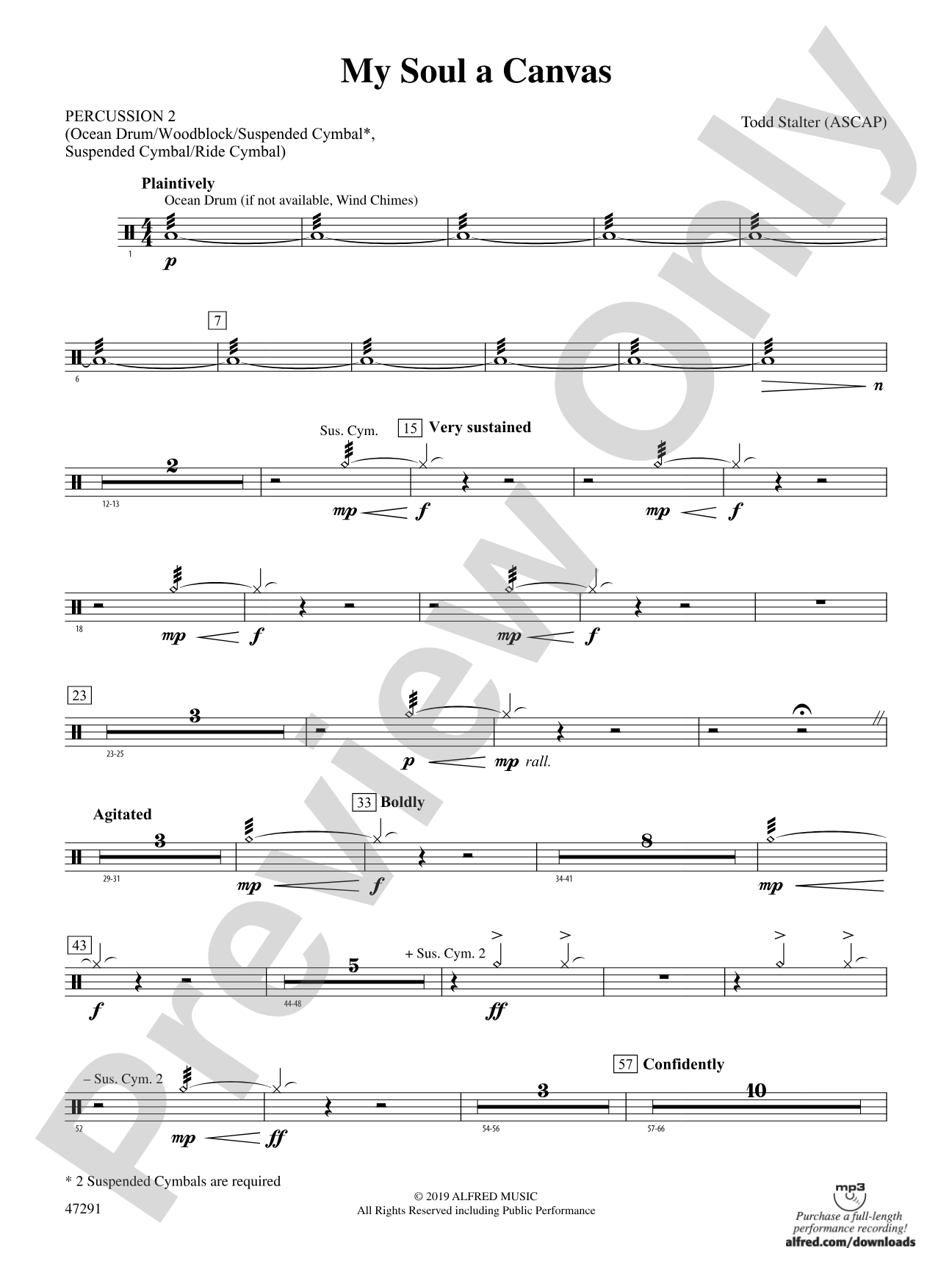

My Soul a Canvas: 2nd Percussion
By Todd Stalter
Grade: 3 (Medium)
Item: 00-PC-0017904_PC2
$3.00
Pickup currently not available
Description
This piece represents feelings of solitude, loneliness, confidence, determination, and conflict. The central theme's rhythm is built on a sad soul's name, solos for the instrument she played, and her love of nature and art.


Don't just read it, hear it, play along with it, and watch your students grow with it. In MakeMusic Cloud, My Soul a Canvas: 2nd Percussion comes alive with professional accompaniment, adjustable tempo, and built-in practice tools that turn solo practice into real progress.
Open in the Player
Jump straight in and assign it today.
Start Your Free Trial
Open this title and explore the full library in minutes.
Sample Audio
1
Audio File
--:--
0:00
0:00
Sample Video
Additional Details
Series:
Alfred Concert Band
Publisher:
Alfred Music
Page Count:
274
SKU:
00-PC-0017904_PC2
More about this title
About the Composer: Todd Stalter

Todd Stalter built a legendary band program at Eureka High School in Illinois, where he directed ensembles for 34 years. His marching band won 16 Class 1A state championships, his concert band earned consistent Superior ratings at IHSA contests, and his groups performed in Orchestra Hall and at Walt Disney World. He was inducted into the Illinois State Marching Band Championships Hall of Fame and has since conducted All-State Bands in Georgia and Delaware while maintaining an active schedule as an adjudicator and clinician across the Midwest.
As a composer, Stalter's works for band and string orchestra have earned national recognition. Many of his pieces appear on state contest lists throughout the United States and are featured in the "Teaching Music Through Performance in Band" series published by GIA. He holds degrees from Illinois State University in Music Education (cum laude) and Trumpet Performance, where he studied with members of the Marine Band and completed graduate work in conducting.
Why we love this
This piece dares to build its musical architecture around something deeply personal: a person's name, their instrumental voice, and their connection to the natural world. The Grade 3 writing balances accessibility with emotional substance, giving students genuine expressive content to work with rather than purely technical exercises. It's ideal for directors seeking concert material that resonates with audiences while remaining fully achievable for mid-level bands.
What to expect
The music moves through introspection and struggle, capturing loneliness and quiet reflection before building toward determination and resolution. Nature imagery permeates the orchestration, with instrumental colors suggesting the outdoors. The central theme carries both vulnerability and quiet strength, never wallowing but never forcing false cheerfulness.
Who it's for
This work suits Grade 3 concert bands preparing contest or festival repertoire. Directors seeking pieces with genuine emotional depth and meaningful programmatic content will find a composition that challenges students musically while connecting them to something beyond technical proficiency.
How to get the most out of it
- Honor the central theme's rhythmic foundation by establishing its character early in sectional rehearsals. This isn't simply a melody to play; it's the emotional anchor of the entire work.
- Shape the solo passages with the care you'd give a featured performer in a chamber setting. Each solo represents the voice of the person honored in the piece, so balance accompaniment dynamics accordingly.
- Allow tempo and dynamics to breathe during transitions between contrasting sections. The piece moves through solitude, conflict, and determination; each shift requires intentional pacing rather than mechanical adherence to the score.
- Balance the full band sound during climactic moments so individual instrumental colors remain audible rather than merging into an undifferentiated mass.
How to use it
Program this at a concert where you want to shift audience perspective from entertainment to reflection. It works effectively as a contest selection or as the centerpiece of a program exploring how music honors individual lives and creative vision. Consider pairing it with contrasting works to highlight the piece's emotional specificity.
Skills your students will build
- Expressing contrasting emotional content (solitude, conflict, determination) through tone and phrasing
- Balancing solo passages within ensemble texture
- Controlling dynamics across extended phrases to shape thematic material
- Responding to programmatic context through interpretive ensemble playing
- Sustaining musical line through harmonic and rhythmic complexity at Grade 3 level